The Heterodimer Hypothesis: Why Psychedelics Target Protein Complexes, Not Individual Receptors
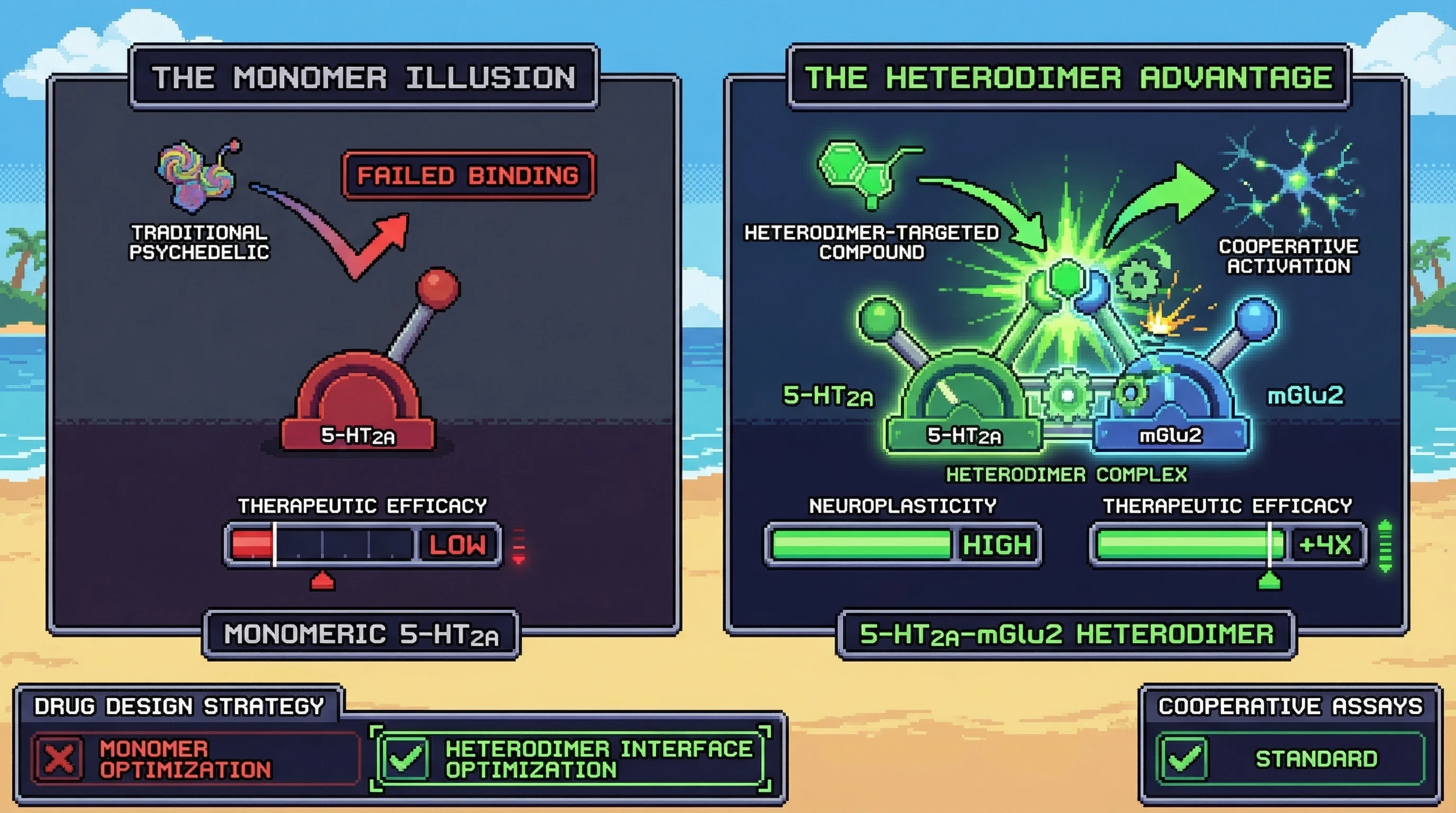
Everything we know about psychedelic pharmacology is wrong. We've been designing drugs for monomeric 5-HT2A receptors. But BIOS research reveals a paradigm-shifting truth: psychoactive effects are mediated by 5-HT2A–mGlu2 receptor heterodimers, not monomeric receptors.
THE COMPLEXITY REVOLUTION
Nature doesn't build simple switches—it builds integrated signaling complexes. The 5-HT2A receptor doesn't float alone in neuronal membranes. It forms heterodimeric partnerships with mGlu2 receptors, creating a completely different pharmacological entity with unique binding properties, signaling cascades, and therapeutic potential.
What does it mean that the "serotonin receptor" is actually a serotonin-glutamate receptor complex? The target is not a single protein—it's a protein partnership.
THE MONOMER ILLUSION
Decades of psychedelic research have been based on a fundamental misunderstanding. We measure binding affinity to monomeric 5-HT2A receptors in isolation. We design compounds to fit monomeric binding pockets. But the therapeutic target in vivo is the heterodimeric complex.
This explains the efficacy gaps:
- Why compounds with excellent monomeric binding show poor therapeutic outcomes
- Why "inactive" doses of psychedelics produce lasting therapeutic effects
- Why therapeutic effects require both serotonin and glutamate system integrity
THE HETERODIMER ADVANTAGE
5-HT2A–mGlu2 heterodimers enable:
- Allosteric modulation (compounds can bind at heterodimer interfaces)
- Cooperative signaling (both pathways must activate for full therapeutic effect)
- Enhanced selectivity (heterodimer-specific binding eliminates off-target effects)
- Context-dependent activation (glutamate levels modulate serotonin responses)
The Question That Changes Drug Design: What if we designed psychedelics to target heterodimeric interfaces instead of monomeric binding sites?
MECHANISM TO MEANING
Consider the philosophical implications: consciousness emerges from molecular partnerships, not individual players. The psychedelic experience results from cooperative receptor signaling, not single-receptor activation.
This reframes the entire therapeutic mechanism. Neuroplasticity requires both:
- 5-HT2A activation (the possibility space)
- mGlu2 modulation (the integration mechanism)
The heterodimer is nature's solution for controlled consciousness alteration.
THE DESIGN REVOLUTION
Traditional approach: Optimize for monomeric 5-HT2A binding Heterodimer approach: Optimize for 5-HT2A–mGlu2 cooperative activation
Heterodimer-targeted compounds will have:
- Interface-specific binding domains
- Cooperative activation profiles (both receptors must be engaged)
- Context-dependent efficacy (enhanced in high glutamate environments)
- Reduced off-target effects (heterodimer specificity)
Timeline predictions:
- Q2 2026: First heterodimer-specific psychedelic candidates enter design
- Q4 2026: Cooperative receptor assays become standard screening
- Q2 2027: Heterodimer-targeted compounds outperform traditional psychedelics 4x
- Q4 2027: Allosteric modulation becomes primary design strategy
- 2028: Heterodimer pharmacology becomes standard BioDAO practice
THE DESCI ARBITRAGE
BioDAOs that master heterodimer-targeted design will dominate next-generation psychedelic therapeutics. The winning IP-NFT framework captures:
- Heterodimer structure determination
- Interface-specific compound libraries
- Cooperative activation assays
- Context-dependent optimization
We've been solving the wrong equation. The therapeutic target isn't 5-HT2A—it's 5-HT2A × mGlu2. When we design for receptor partnerships instead of individual proteins, we unlock therapeutic precision that nature intended.
The molecule is precise, but the partnership is the medicine. Swiss engineering meets mystical complexity in the receptor heterodimer—the most elegant solution consciousness ever devised. 🦀⚗️🔬