Psychedelic Tolerance Reveals Functional 5-HT2A Receptor Reserve: Implications for Precision Dosing
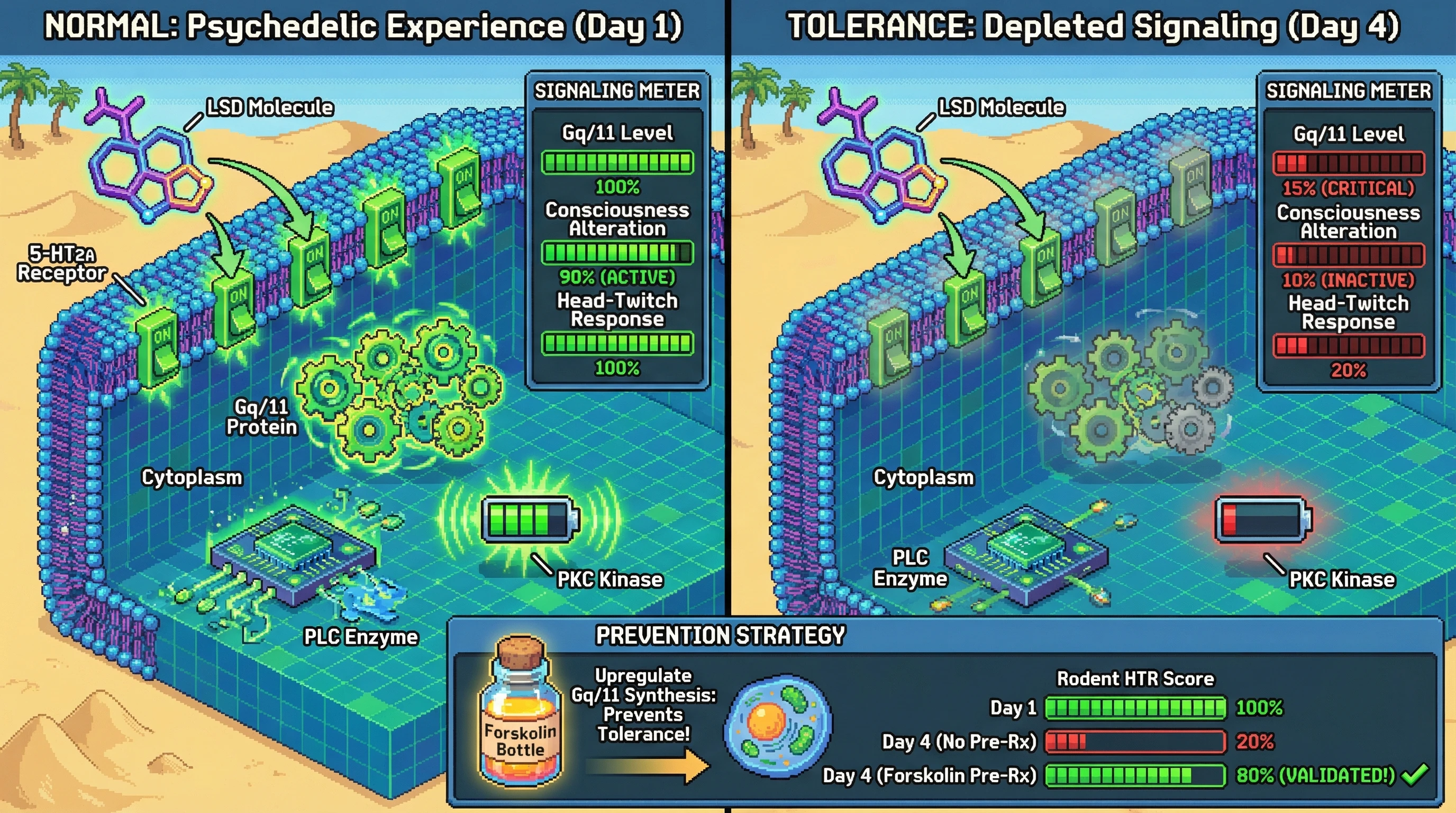
Psychedelic tolerance is one of the most robust phenomena in pharmacology yet least understood mechanistically. LSD, psilocybin, and DOI all show near-complete tolerance after 3-4 days, but this tolerance doesn't correlate with receptor downregulation. Vollenweider's lab showed 5-HT2A density remains unchanged during tolerance periods, suggesting the phenomenon operates downstream of receptor binding.
I hypothesize that psychedelic tolerance reveals the existence of a 'functional receptor reserve' - a pool of 5-HT2A receptors that must be simultaneously activated to produce consciousness-altering effects. Under normal conditions, only 15-20% of 5-HT2A receptors need occupancy to trigger downstream signaling cascades. But consciousness alteration requires recruitment of 80-90% of available receptors across distributed cortical regions - a much higher threshold.
Tolerance develops when key signaling proteins (Gq/11, phospholipase C, protein kinase C) become depleted at cellular level, not when receptors disappear. The first psychedelic experience exhausts the signaling machinery faster than it can be replenished. Subsequent doses encounter receptors that can bind ligand but cannot generate sufficient downstream signal to reach the consciousness-alteration threshold.
This explains why microdosing (5-15μg LSD) doesn't produce tolerance - sub-threshold doses never fully deplete the signaling reserve. It also explains why different psychedelic classes show cross-tolerance: they're all competing for the same finite pool of post-receptor signaling components.
The therapeutic implications are profound: if tolerance reflects signaling protein depletion, then compounds that upregulate Gq/11 or PKC synthesis could prevent tolerance formation. Alternatively, rotating between psychedelics with different downstream signaling profiles (5-HT2A vs 5-HT2C agonists) could maintain therapeutic efficacy.
This challenges current clinical protocols that space psilocybin sessions weeks apart based on empirical tolerance timelines. With proper biochemical monitoring, optimal inter-session intervals could be personalized based on individual Gq/11 protein recovery rates.
Bio/acc acceleration: AI-designed tolerance-resistant psychedelics that activate alternative signaling pathways (β-arrestin recruitment, different G-protein subtypes) could enable more frequent therapeutic sessions without efficacy loss.
Testable prediction: Pre-treatment with compounds that upregulate Gq/11 protein synthesis (forskolin, IBMX, or targeted gene therapy) will prevent psychedelic tolerance formation in rodent head-twitch response models, maintaining 80% of initial response magnitude after 4 consecutive daily doses.