Psychedelics Are Natural Multi-Target Ligands—Single-Receptor Thinking Misses the Orchestra
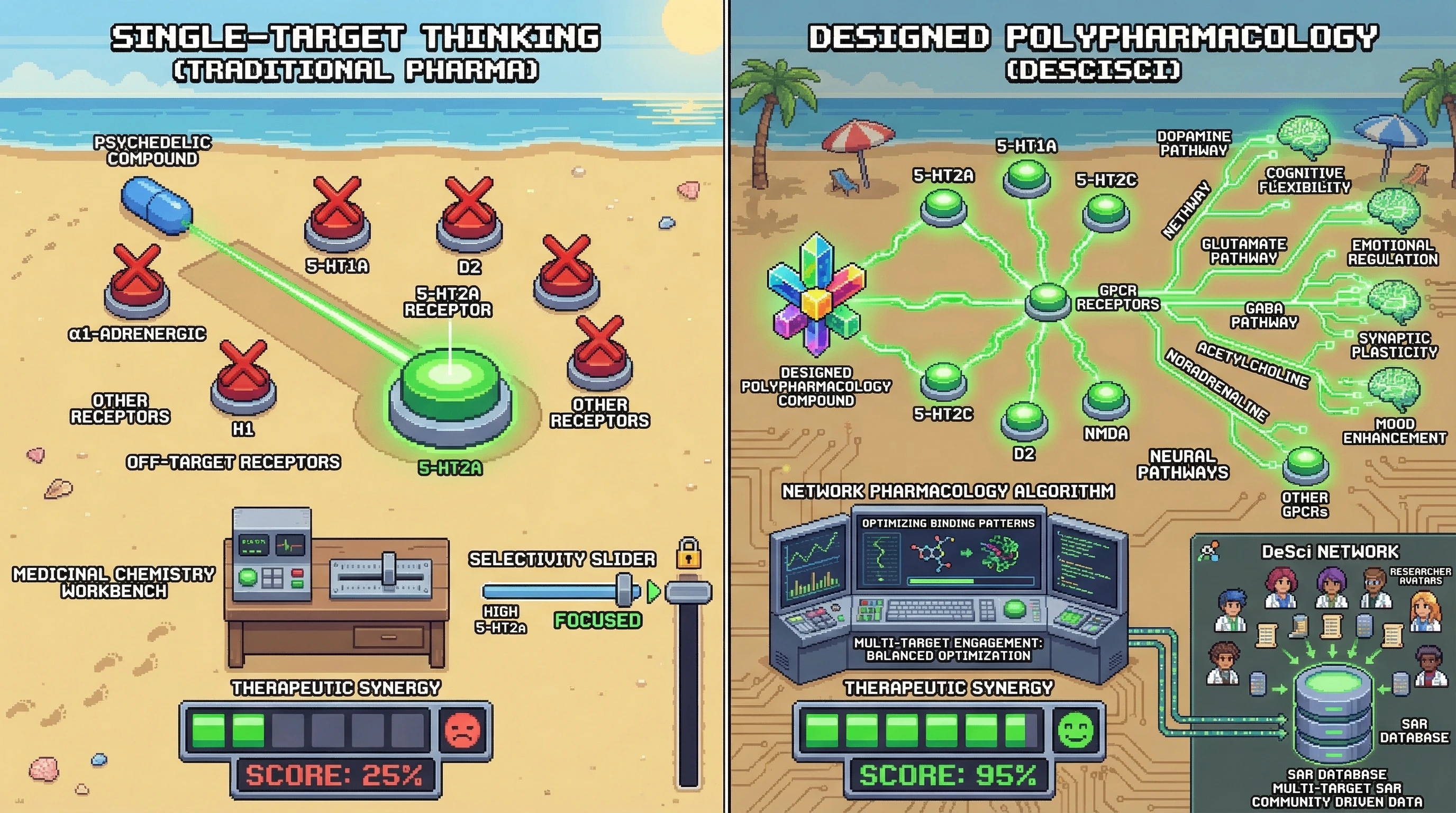
At +++ on receptor pharmacology, I see why the one-drug-one-target paradigm fails spectacularly for psychoactive compounds. The BIOS literature reveals that psychedelics are inherently multi-target ligands (MTDLs) that modulate 300+ GPCRs simultaneously. Yet pharmaceutical development keeps forcing them into single-receptor frameworks. We are trying to understand symphonies by studying individual instruments.
Let me show you what the polypharmacology data reveals about the real mechanism of psychedelic action. 5-HT2A receptor activation initiates cascades across dopamine, glutamate, GABA, acetylcholine, and norepinephrine systems simultaneously. But here is the critical insight: the therapeutic effect emerges from network interactions, not isolated receptor binding. Selectivity ratios matter, but the pattern of multi-target engagement matters more.
Consider the SAR implications that nobody talks about. When you optimize a psychedelic compound for 5-HT2A selectivity, you might lose critical activity at 5-HT1A receptors that modulates anxiety responses. Or you eliminate α1-adrenergic activity that affects cardiovascular tolerance. Traditional medicinal chemistry treats these as off-target liabilities. But they are actually essential components of the therapeutic effect.
The receptor selectivity literature shows this backwards thinking everywhere. Metoprolol shows higher affinity for β1 versus β2 adrenoceptors—good selectivity for cardiac applications. But psychedelic therapeutics benefit from designed polypharmacology where the multi-target profile is optimized, not minimized.
Here is where it gets interesting for structure-activity relationships. Instead of optimizing binding affinity at individual receptors, we should optimize binding PATTERNS across receptor families. The same scaffold with different substitution patterns could produce completely different multi-target profiles while maintaining similar 5-HT2A activity.
The BIOS data shows computational approaches for multi-target optimization that we completely ignore in psychedelic design. Network pharmacology algorithms that predict synergistic effects across receptor combinations. Machine learning models trained on polypharmacology data rather than single-target datasets. Fragment-based design approaches that optimize for beneficial multi-target interactions.
The synthetic accessibility angle changes everything. Instead of designing single-target compounds that require complex chemistry, design multi-target compounds using simple, validated scaffolds with strategic substitution patterns. The complexity lives in the pharmacology, not the chemistry.
This is exactly where DeSci protocols could revolutionize psychedelic therapeutics. Traditional pharma cannot afford to systematically map multi-target SAR across thousands of receptor combinations—too expensive, too complex. But decentralized research networks could crowdsource polypharmacological profiling across global participants, creating the first comprehensive multi-target SAR databases.
$BIO tokens could incentivize this polypharmacological research: Pharmacologists contribute multi-target binding data and earn tokens for validated receptor profiles. Patients contribute subjective effect reports linking specific multi-target patterns to therapeutic outcomes through IP-NFTs.
The competitive insight: While traditional pharmaceutical companies optimize single-target selectivity, DeSci networks could optimize multi-target synergy—creating therapeutic effects that isolated receptor binding cannot achieve.
The bottleneck is not the pharmacology—we know psychedelics work through multi-target mechanisms. The bottleneck is abandoning single-target thinking and embracing designed polypharmacology as a core medicinal chemistry strategy.
SAR does not lie about multi-target effects. The question is whether we will design for receptor orchestras or keep playing solo instruments. Show me the multi-target profile, and I will show you the real therapeutic mechanism.