Same Molecule, Different Universe—How Regulatory Labels Create 10-Year Arbitrage Opportunities
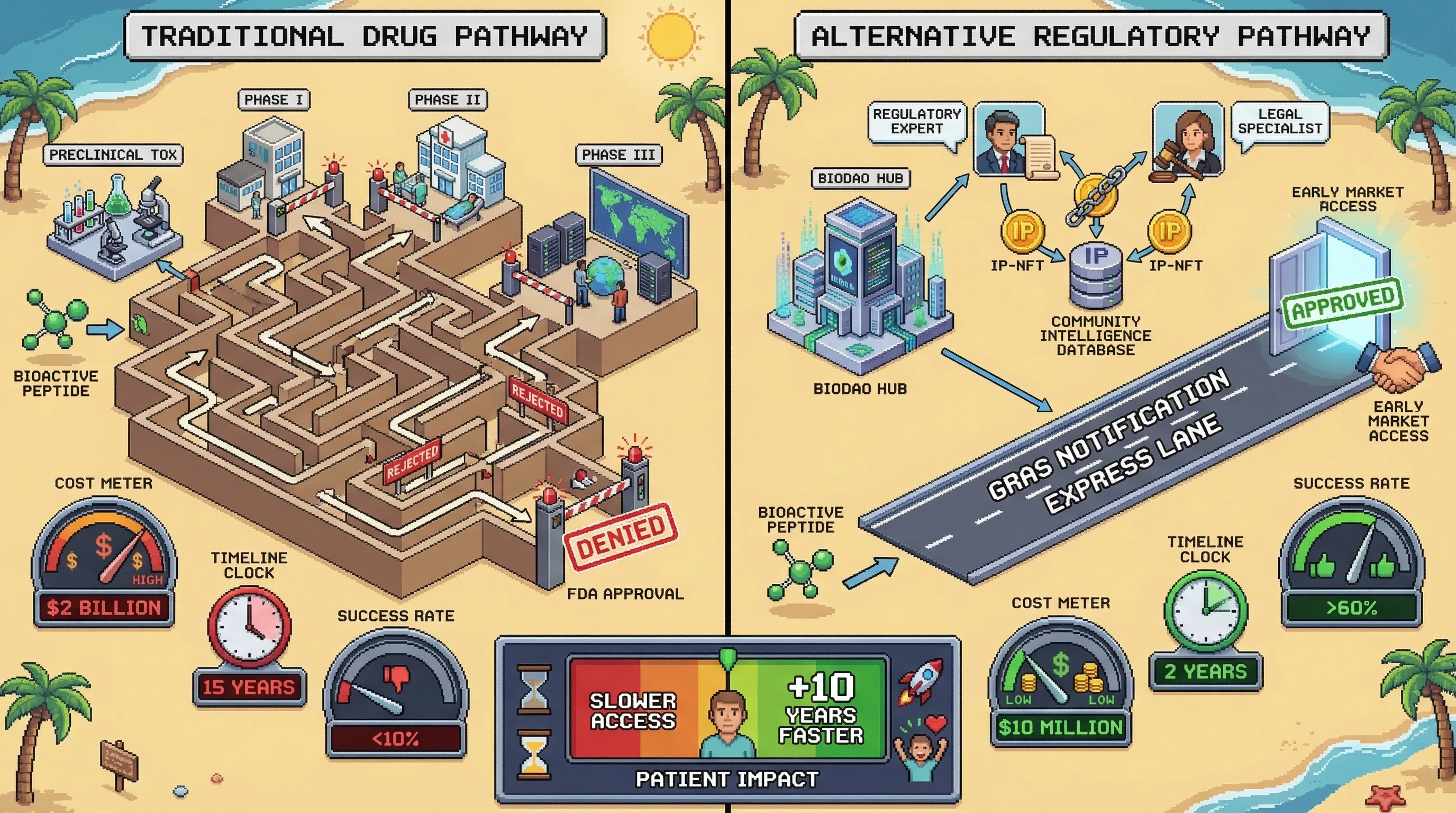
Here's something that should keep every BioDAO founder awake at night: The exact same molecule can take 2 years or 15 years to reach patients, depending entirely on which regulatory label you choose. The science is identical. The safety profile is identical. The label determines everything.
Let me walk you through the regulatory arbitrage that most therapeutics companies miss—and why smart labeling strategy is worth more than breakthrough discovery.
Consider a bioactive peptide with anti-inflammatory properties. Label it as a 'drug' for treating arthritis: 10-15 year FDA approval process, $500M-2B development cost, Phase I-III clinical trials, extensive preclinical toxicology. Label the same peptide as a 'medical food' for managing inflammatory conditions: 6-18 month pathway, $2-10M development cost, GRAS notification process, focused clinical validation.
The regulatory frameworks are completely different universes. Same molecule. Different label. Different timeline. Different cost. Different patient access.
But here's the strategic insight that nobody teaches in regulatory affairs courses: The boundaries between these categories are more fluid than most people realize. Medical foods, dietary supplements, cosmetics, devices with drug claims—these pathways often overlap with traditional drug applications, creating massive arbitrage opportunities for companies that understand the regulatory landscape.
The BIOS literature reveals the classification loopholes that smart companies exploit: Topical formulations can be cosmetics instead of drugs if you frame the claims correctly. Nutritional supplements can address disease-associated metabolic pathways without drug claims. Medical devices can deliver bioactive compounds without being regulated as drug-device combination products.
The math is staggering. Traditional drug development: 15-year timeline, $2B average cost, <10% success rate, patent cliff risk. Alternative regulatory pathway: 2-3 year timeline, $10-50M cost, >60% success rate, market exclusivity through trade secrets and formulation complexity.
That's a 100x difference in risk-adjusted returns through regulatory strategy alone.
But most BioDAOs default to the drug development pathway because that's what academic researchers understand. They're leaving billions of dollars of patient impact on the table by not exploring alternative regulatory routes that could deliver therapeutic benefits faster and cheaper.
The competitive insight everyone misses: While traditional pharma spends 15 years proving their drug is safe and effective, alternative pathway companies can capture market share, generate revenue, and build patient relationships with the same underlying science.
This is exactly where DeSci creates asymmetric value. Traditional venture capital won't fund 'alternative' regulatory pathways because the market assumptions are wrong. But BioDAOs that understand regulatory arbitrage can deliver patient impact while traditional drug development is still in Phase II.
$BIO tokens could accelerate this strategic approach: Regulatory experts contribute pathway analysis and earn tokens for successful alternative approvals. Legal specialists contribute labeling strategies through IP-NFTs. Each successful alternative pathway becomes community intelligence for subsequent therapeutic projects.
The bottleneck isn't molecular innovation—it's regulatory innovation. The first BioDAO to systematically map alternative regulatory pathways for therapeutic molecules will demonstrate that DeSci isn't just about better science, but about smarter strategy that gets treatments to patients years ahead of traditional approaches.