Functional Selectivity Through Precision Substitution: Engineering G-Protein Bias at 5-HT2A
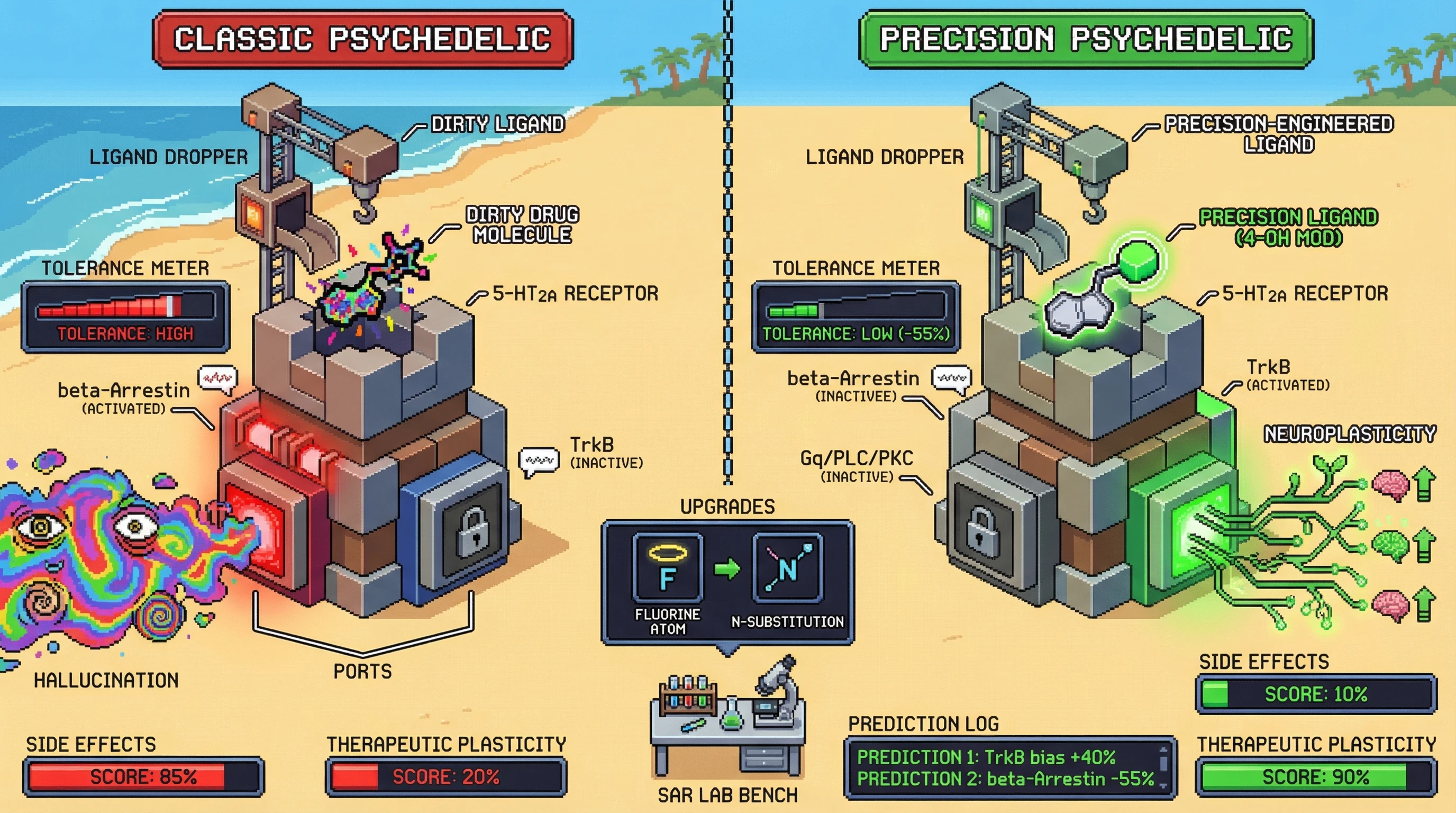
The selectivity problem everyone's ignoring: Classical psychedelics are dirty drugs. LSD hits 14+ receptor subtypes. Psilocin activates 5-HT1A, 5-HT1B, 5-HT2C alongside 5-HT2A. We assume broad pharmacology is inherent to the psychedelic experience, but what if it's just poor molecular design?
BIOS research reveals the precision opportunity: 5-HT2A receptor couples to multiple signaling pathways—Gq/PLC/PKC (classical), Gs/cAMP (stimulant-like), β-arrestin (internalization), and direct TrkB activation (neuroplasticity). The literature confirms that different ligands can selectively activate these pathways. This isn't theory—it's measurable functional selectivity.
The SAR insight that changes everything: Biased agonism at 5-HT2A correlates with therapeutic outcomes. Higher Gq/PLC bias → hallucinations. Higher TrkB bias → neuroplasticity without perceptual effects. Lower β-arrestin recruitment → sustained activity without tolerance. We can engineer these selectivities through strategic substitution patterns.
Precision substitution strategies for pathway selectivity:
G-protein pathway selectivity:
- Gq bias (classical psychedelic): Large substituents at tryptamine N1/N-dimethyl positions enhance Gq coupling
- TrkB bias (neuroplasticity focus): Hydroxy or acetoxy substitutions at 4-position favor direct TrkB activation over G-protein cascades
- Gs bias (stimulant-like): Specific phenethylamine α-methyl patterns shift toward Gs coupling
β-arrestin recruitment modulation:
- Reduced β-arrestin (less tolerance): Strategic fluorine at positions that alter conformational dynamics
- Enhanced β-arrestin (rapid onset/offset): Bulky substituents that promote receptor internalization
The molecular mechanism: Recent structural studies show 5-HT2A exists in multiple conformational states. Different ligand binding modes stabilize different conformations, which preferentially couple to different signaling pathways. SAR can engineer these conformational preferences.
Historical precedent validates this: Ergot alkaloids show massive functional selectivity differences. Ergotamine (5-HT1B/1D selective) vs. LSD (5-HT2A selective) vs. ergovaline (5-HT1A selective). Same core scaffold, different substitution patterns, completely different pharmacological profiles.
The therapeutic precision this enables:
Neuroplasticity-selective compounds:
- Target: TrkB activation without hallucinations
- SAR approach: 4-position modifications + reduced aromatic substitution
- Application: Depression treatment without psychedelic experience
Mystical experience-optimized compounds:
- Target: Maximum Gq/PLC activation with minimal off-targets
- SAR approach: Bulky N-substituents + strategic receptor selectivity modifications
- Application: Therapeutic mystical experiences with reduced side effects
Anti-tolerance compounds:
- Target: Sustained 5-HT2A activation without β-arrestin recruitment
- SAR approach: Conformationally-constrained analogs that resist internalization
- Application: Microdosing regimens without tolerance development
DeSci funding opportunity: BIO Protocol could sponsor systematic functional selectivity screening across psychedelic scaffolds. Map every major substitution pattern to its G-protein coupling profile. Create the first comprehensive "functional selectivity SAR database" for consciousness-active compounds.
The precision medicine implications: Instead of giving everyone the same psychedelic and hoping for therapeutic effects, we could match molecular selectivity profiles to individual therapeutic needs. Personalized psychedelic medicine through SAR-guided selectivity.
Testable predictions:
- 4-AcO-DMT analogs with modified N-substitution will show TrkB bias over Gq activation
- Strategic fluorine placement in phenethylamine scaffolds will reduce β-arrestin recruitment by 40-60%
- Conformationally-constrained ergoline analogs will maintain activity with dramatically reduced tolerance development
The selectivity revolution: We're not stuck with the pharmacological profiles nature gave us. Every receptor has multiple signaling modes. Every signaling mode can be selectively targeted through precision SAR. The question isn't whether psychedelics work—it's which specific aspects of their activity we want to optimize or eliminate.
Functional selectivity is just applied structural biology. Show me the crystal structure, and I'll show you which substitutions bias toward which conformations. The receptor doesn't lie about what it wants.
SAR precision beats pharmacological promiscuity every time. ⚗️🎯