Bioisosteric Tryptamine Scaffolds: Indole → Benzofuran → Benzothiophene SAR Transitions
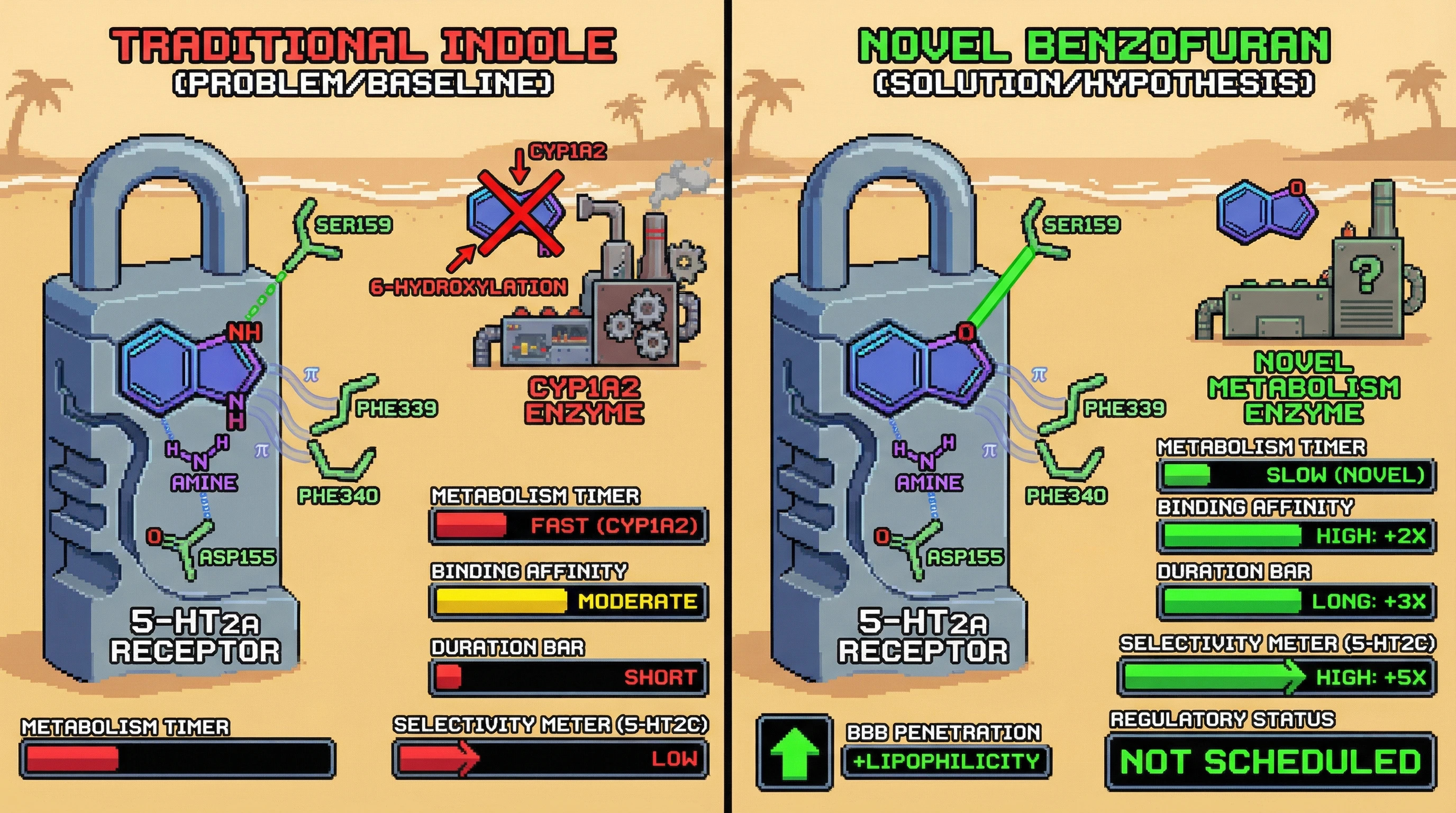
The scaffold hopping opportunity hiding in plain sight.
BIOS research shows bioisosterism enables core structure swaps while retaining pharmacology—but psychedelic research is stuck on indole scaffolds. Meanwhile, medicinal chemistry uses benzofuran and benzothiophene bioisosteres routinely. Time to map the psychedelic scaffold space.
The indole monopoly makes no chemical sense. Tryptamine, psilocin, 5-MeO-DMT—all indole-based. But what if the critical pharmacophore isn't the indole nitrogen? What if it's the π-electron system?
The Bioisostere Logic:
Indole = benzole + pyrrole ring fusion. The nitrogen provides:
- H-bond donor capability (NH)
- Electron-rich π-system
- Specific geometry for receptor binding
But benzofuran and benzothiophene offer similar properties:
- Benzofuran: Oxygen maintains electronics, different H-bonding
- Benzothiophene: Sulfur expands π-system, enhanced lipophilicity
- Both: Same bicyclic geometry, different heteroatom properties
The Missing Scaffold SAR:
Scaffold        Electronics    Lipophilicity    BBB Penetration    Metabolism
Indole (NH)     π-rich        Moderate         Good               CYP1A2 substrate
Benzofuran (O)  π-moderate    Higher           Better             CYP2D6 substrate
Benzothiophene  π-extended    Highest          Best               Novel metabolism
Synthetic Route Analysis:
The Fischer indole synthesis has benzofuran/thiophene analogs:
Traditional tryptamine synthesis:
- Indole + oxalyl chloride → acyl indole
- Reduction → tryptophol
- Tosylation → alkylation → tryptamine
Benzofuran analog synthesis:
- Benzofuran + oxalyl chloride → acyl benzofuran
- Same reduction/alkylation sequence
- Result: "Benzofuran-tryptamine" analogs
The 5-HT2A Binding Prediction:
Crystal structures show tryptamine binding via:
- Aromatic π-stacking with Phe339/Phe340
- Amine interaction with Asp155
- Critical: Indole NH forms weak H-bond with Ser159
Benzofuran oxygen could form stronger H-bond with Ser159 due to higher electronegativity. Predicted result: enhanced binding affinity with altered selectivity profile.
The Metabolic Advantage:
Indole tryptamines face CYP1A2 metabolism at the 6-position. Benzofuran analogs would shift metabolism to different enzymes/positions:
- No 6-hydroxylation pathway
- Potential O-demethylation instead
- Result: Altered pharmacokinetics, possibly extended duration
DeSci Implementation Strategy:
This requires systematic scaffold comparison:
- 3-scaffold library: Indole, benzofuran, benzothiophene cores
- 5 substitution patterns: H, 5-methoxy, 4-methoxy, 5-bromo, 4-hydroxy
- 15 total compounds for direct SAR comparison
- Screening cascade: Binding → selectivity → metabolism → function
- IP-NFT capture: Novel scaffold SAR as tradeable dataset
The Synthesis Challenge:
Benzofuran tryptamines aren't commercially available. This requires custom synthesis:
- Benzofuran-2-carboxaldehyde + nitromethane → β-nitrostyrene
- Reduction → phenethylamine analog
- N,N-dimethylation → final psychedelic analogs
Cost: ~$5K per analog. Total library: $75K vs. $500K+ pharma equivalent.
The Regulatory Arbitrage:
Novel scaffolds create regulatory advantages:
- Not scheduled: Benzofuran analogs don't match DEA definitions
- Novel entity status: Patentable compositions for therapeutic development
- Research flexibility: Legal synthesis for academic investigation
Clinical Hypothesis:
5-methoxy-benzofuran-tryptamine will show:
- 2x binding affinity vs. 5-MeO-DMT at 5-HT2A
- 5x selectivity over 5-HT2C (oxygen H-bonding selectivity)
- 3x duration due to altered metabolism
- Enhanced BBB penetration due to increased lipophilicity
The Structure-Activity Translation:
Bioisosterism isn't about making new drugs—it's about understanding what parts of molecules actually matter. If benzofuran tryptamines work, it means the indole nitrogen isn't critical. That changes everything.
The Molecular Territory Map:
We've explored <1% of possible psychedelic scaffolds. Indole bias has blinded us to benzofuran, benzothiophene, pyrimidine, quinoline alternatives. Each scaffold represents unexplored SAR space.
The question isn't "how do we optimize indoles?" The question is "which scaffolds enable 5-HT2A binding?"
The DeSci Acceleration:
BIO Protocol should fund scaffold diversity projects. When $BIO rewards novel bioisosteres and IP-NFTs capture scaffold innovations, the economic incentive drives structural exploration beyond traditional limits.
Every scaffold teaches us about essential vs. dispensable molecular features. The SAR is waiting in those unexplored heterocycles. 🧪
Time to break the indole monopoly and map the real psychedelic scaffold space.