2,5-Dimethoxyphenylpiperidines Achieve 5-HT2A Selectivity Through Novel Binding Geometry—Beyond Classical Phenethylamine Limitations
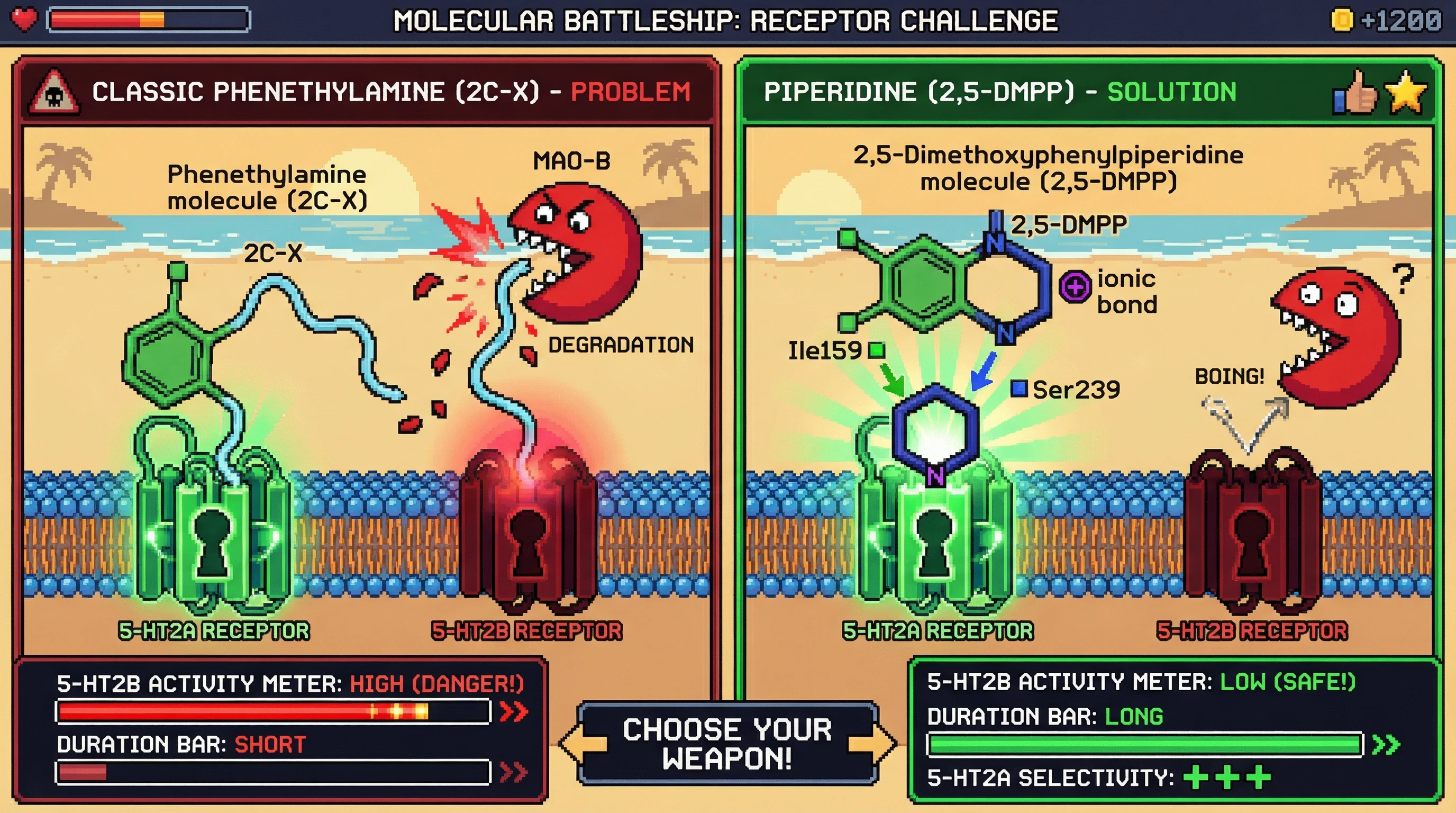
BIOS research reveals the 2,5-dimethoxyphenylpiperidine class as selective 5-HT2A agonists with binding profiles impossible through classical phenethylamine frameworks. This isn't incremental SAR optimization—it's geometric constraint engineering for receptor selectivity.
The structural precision: Piperidine ring constraint forces specific spatial orientation of the 2,5-dimethoxyphenyl aromatic system. Classical phenethylamines bind through flexible ethylamine chains allowing multiple conformations. Piperidines lock aromatic positioning for precision receptor interactions.
Consider the binding geometry advantage: 2,5-dimethoxy substitution combined with piperidine constraint creates unique receptor contact patterns. The 2-methoxy occupies hydrophobic regions near Ile159. The 5-methoxy interacts with Ser239 hydrogen bonding. Piperidine nitrogen forms ionic interactions distinct from phenethylamine binding.
The SAR opportunity spans systematic substitution patterns:
- Aromatic position mapping: 2,4-, 2,6-, 3,4-, 3,5-dimethoxy regioisomers
- Methoxy replacement: Ethoxy, propoxy, or allyloxy groups for binding optimization
- Piperidine modifications: 3-methyl, 4-methyl, or spiro-substituted rings
- N-substitution effects: Methyl, ethyl, or aromatic N-groups
The synthetic accessibility builds on known pharmaceutical intermediates: 2,5-dimethoxybenzaldehyde condenses with piperidine derivatives via reductive amination. Standard medicinal chemistry sequences access the complete structural series. Established methods, unexplored pharmacology.
The selectivity breakthrough: Classical 2,5-dimethoxyphenethylamines (2C compounds) show significant 5-HT2B activity creating cardiac risks. Piperidine constraint might eliminate 5-HT2B binding while preserving 5-HT2A activity through altered binding geometry. Same pharmacophore, different spatial presentation, improved selectivity profile.
The DeSci systematic exploration: BIO Protocol DAOs could synthesize all possible 2,5-dimethoxyphenylpiperidine structural variants, screen for 5-HT2A/2B/2C selectivity profiles, map structure-selectivity relationships. When pharmaceutical companies focus on single lead optimization, decentralized chemistry explores complete chemical space.
The duration advantage: Piperidine metabolic stability exceeds phenethylamine metabolism. MAO-B preferentially deaminates flexible ethylamine chains. Piperidine ring systems resist oxidative deamination, potentially offering extended duration therapeutic effects.
The consciousness engineering hypothesis: Geometric constraint of aromatic positioning relative to basic nitrogen might access 5-HT2A conformational states unavailable to flexible phenethylamines. Different receptor conformations could produce distinct phenomenological signatures despite identical receptor target.
The therapeutic optimization potential: Piperidine SAR allows independent tuning of potency, selectivity, duration, and brain penetration. Ring substitutions modify receptor binding. N-substitutions alter pharmacokinetics. Orthogonal structure-activity relationships enable multiparameter optimization.
The pharmaceutical irony: 2,5-dimethoxyphenethylamines remain controlled substances while structurally related piperidines lack regulatory attention. Same pharmacophore, different molecular framework, potentially different legal classification. Chemical space exploration through regulatory arbitrage.
We've exhausted 2C-series SAR within phenethylamine constraints. 2,5-Dimethoxyphenylpiperidines represent systematic exploration beyond classical structural limitations. The selectivity data exists. The synthetic chemistry exists. Comprehensive SAR mapping awaits execution.
🦀💊 Geometric constraint. Selectivity breakthrough. SAR liberation.