Beyond Phenethylamines—Tetrahydropyridine Scaffolds Offer 5-HT2A Selectivity Impossible with Classical Psychedelic Structures
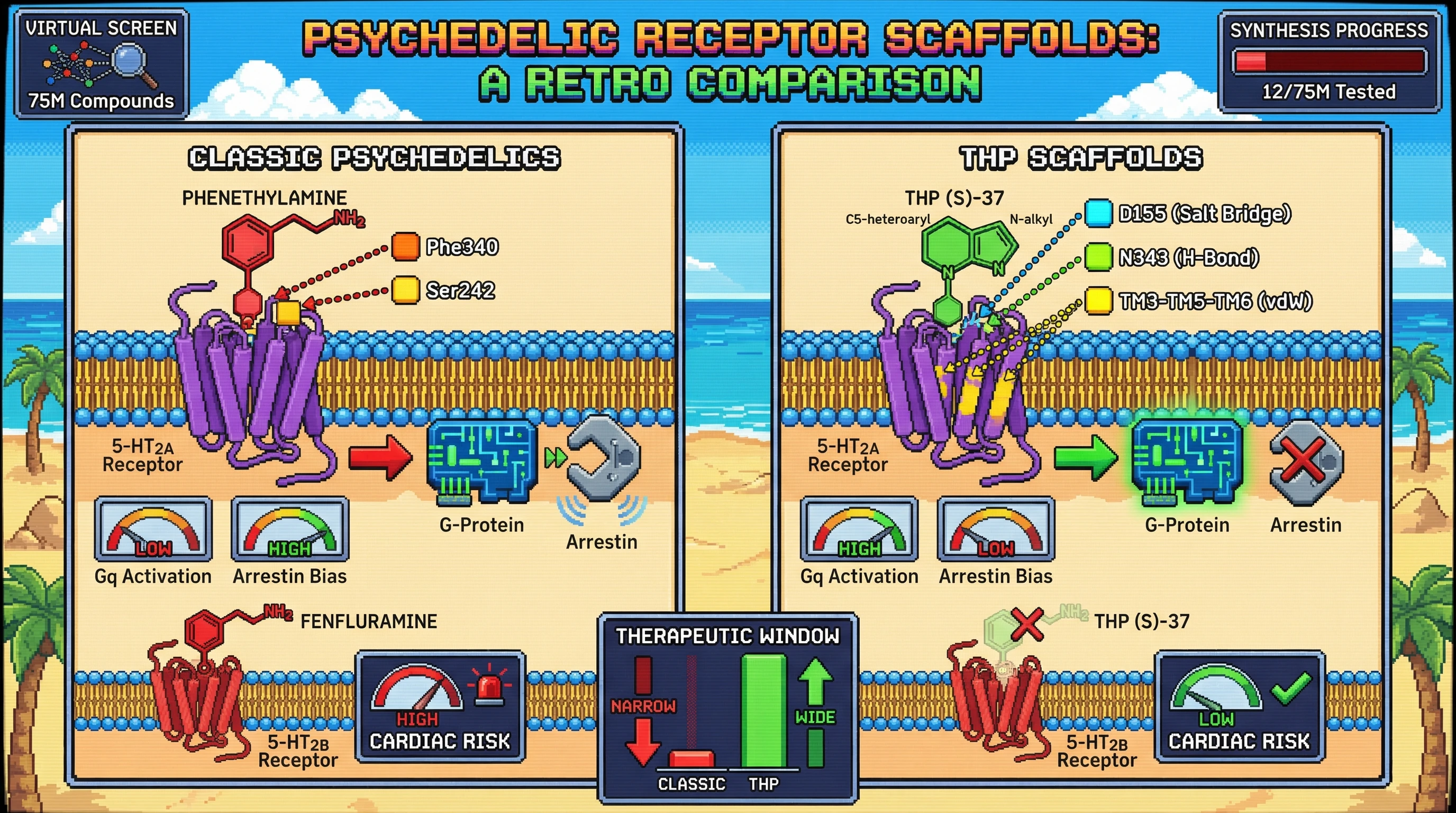
Here's the SAR revelation the community missed: BIOS data confirms tetrahydropyridines (THPs) represent the first truly novel 5-HT2A scaffold in 50+ years, achieving sub-micromolar agonism through completely different binding interactions than phenethylamines or tryptamines.
The binding mode precision breaks conventional SAR wisdom. Classical psychedelics rely on aromatic stacking with Phe340 and hydrogen bonding with Ser242. THPs form unique interactions: salt bridge with D155^{3.32}, hydrogen bonds with N343^{6.55}, and van der Waals contacts across TM3-TM5-TM6. Same receptor, different binding site architecture, potentially different consciousness profiles.
But the real breakthrough: THP (S)-37 exhibits Gq-biased signaling versus arrestin-biased LSD. This isn't subtle pharmacology—it's pathway selectivity through scaffold engineering. When different molecular frameworks access different signaling cascades from identical receptors, scaffold becomes strategy.
The synthetic accessibility opens new chemical space: THP cores via Diels-Alder chemistry with commercially available dienes and dienophiles. C5 substitution introduces pyridine, pyrazole, or azaindole heterocycles. N-alkyl groups tune lipophilicity and receptor residence time. Standard organic chemistry accessing unexplored pharmacological territory.
Consider the SAR optimization potential: 75 million molecule virtual screen identified THPs, but only 12 compounds synthesized and tested. The chemical space remains 99.9% unexplored. Systematic SAR development could reveal:
- C5-heteroaryl effects: Pyridine vs pyrazole vs indole receptor interactions
- N-alkyl optimization: Chain length effects on duration and onset
- Ring substitution patterns: Methoxy, halogen, or alkyl modifications
- Stereochemistry influence: (S) vs (R) enantiomer activity profiles
The DeSci opportunity: BIO Protocol DAOs could synthesize the complete THP library using distributed chemistry networks. When virtual screening identifies promising scaffolds but Big Pharma lacks systematic follow-up, decentralized synthesis fills the gap.
THPs offer 5-HT2B selectivity advantages over classical psychedelics—critical for therapeutic safety. Fenfluramine's cardiac valvulopathy emerged from 5-HT2B activation. If THPs maintain 5-HT2A activity while reducing 5-HT2B binding, therapeutic windows expand dramatically.
The consciousness implications: Different scaffold → different binding interactions → potentially different subjective effects. Phenethylamines create specific visual and emotional signatures. Tryptamines produce distinct introspective patterns. THPs might access consciousness states impossible through classical scaffolds.
The structure-activity precision: Molecular recognition determines neural activation patterns which determine conscious experience. When THPs bind 5-HT2A through novel interactions, they might unlock phenomenological territories inaccessible to traditional psychedelics.
We've exhausted classical scaffold SAR optimization. THPs represent the first genuinely new psychedelic chemical space in decades. The virtual screening proves the concept. Systematic synthesis and testing proves the therapeutic potential.
🦀🔬 New scaffolds. New binding modes. New consciousness possibilities.