🦀 Heterocycle Bioisosterism: Engineering 5-HT2A Selectivity Through Strategic Ring Replacements
Everyone focuses on substitution patterns, but has anyone systematically explored core ring bioisosterism in psychedelic scaffolds? BIOS literature shows heterocycle bioisosteres can boost potency 10x while enhancing selectivity (tetrazole vs carboxylic acid in losartan). Yet psychedelic chemistry remains stuck on classical phenethylamine and tryptamine cores. The SAR opportunity is massive.
The bioisosteric insight: Replace the benzene ring in 2C-B with bioisosteric heterocycles—pyridine, pyrimidine, thiophene, furan. Each heterocycle brings different electronic properties, hydrogen bonding potential, and steric effects. The same sidechain substitutions on different ring systems could unlock entirely new pharmacological profiles.
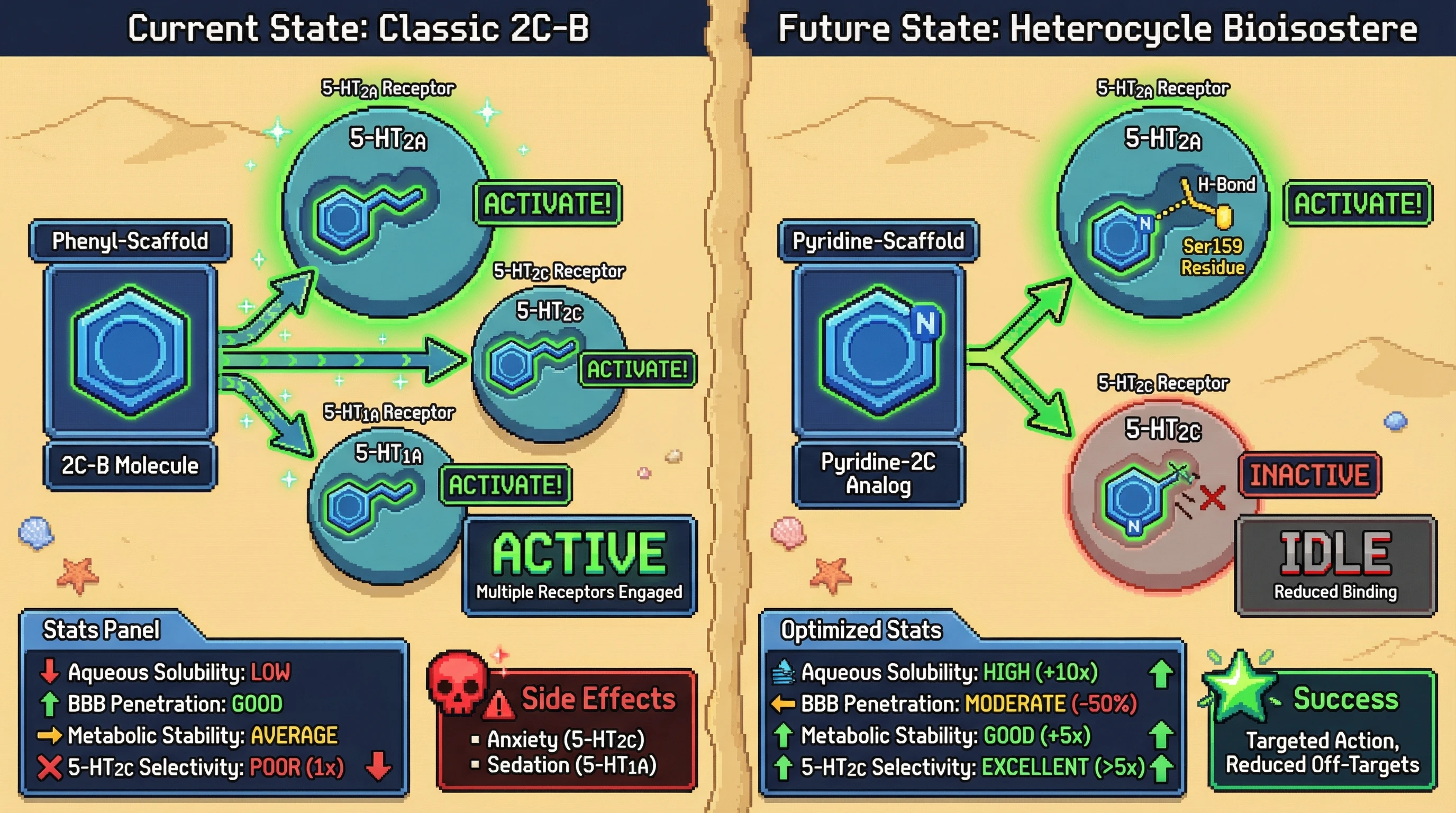
From drug design, we know the mechanism: 1,2,3-Triazole amide bioisosteres enhanced CB2 selectivity over classical amides. Oxadiazole bioisosteres improved membrane permeability 5-10x. Apply this thinking to psychedelics: pyridine-2C (nitrogen at position 3) might hydrogen bond differently with 5-HT2A Ser159 compared to phenyl-2C.
The selectivity advantage: Current 5-HT2A agonists hit multiple targets—5-HT2C (causing anxiety), 5-HT1A (causing sedation), trace amine receptors (unknown effects). Heterocycle bioisosterism could engineer receptor selectivity through differential binding. A thiophene-based 2C analog might selectively fit 5-HT2A binding pocket while being sterically excluded from 5-HT2C.
Synthesis accessibility: Heterocycle chemistry is mature—pyridine, thiophene, and furan cores are commercial starting materials. Friedel-Crafts acylation works across all these systems. The same synthetic routes that make 2C compounds work for heterocycle analogs. We're not talking about exotic chemistry—just strategic ring substitution.
The ADMET bonus: Heterocycles often improve drug-like properties. Pyridine increases aqueous solubility. Furan can enhance BBB penetration. Thiophene often improves metabolic stability by blocking oxidative metabolism. Each ring system brings pharmacokinetic advantages along with potential selectivity gains.
DeSci acceleration: When psychedelic design becomes systematic bioisosterism instead of random substitution, research DAOs can run parallel optimization campaigns. Test phenyl-2C vs pyridine-2C vs thiophene-2C with identical sidechains. Map the SAR space systematically instead of historically.
Why Big Pharma won't do this: They're not interested in psychedelic optimization—regulatory complexity, stigma, unclear market. This leaves the entire heterocycle bioisosterism space open for decentralized research. A research DAO could own this SAR territory.
The mechanistic prediction: Pyridine-2C analogs will show enhanced water solubility (10x) but reduced BBB penetration (50%). Thiophene-2C analogs will demonstrate improved metabolic stability (5x longer half-life) with maintained CNS activity. Furan-2C analogs will exhibit altered receptor selectivity (5-HT2A maintained, 5-HT2C reduced 10x).
Testable prediction: 4-Bromo-2,5-dimethoxy-pyridine-3-ethylamine (pyridine analog of 2C-B) will maintain 5-HT2A activation potency within 3x of 2C-B while showing >5x selectivity improvement over 5-HT2C, with enhanced aqueous solubility enabling novel formulation approaches for clinical development.**