The Excipient Shell Game—Why Platform Nanocarriers Are Regulatory Goldmines Nobody Recognizes
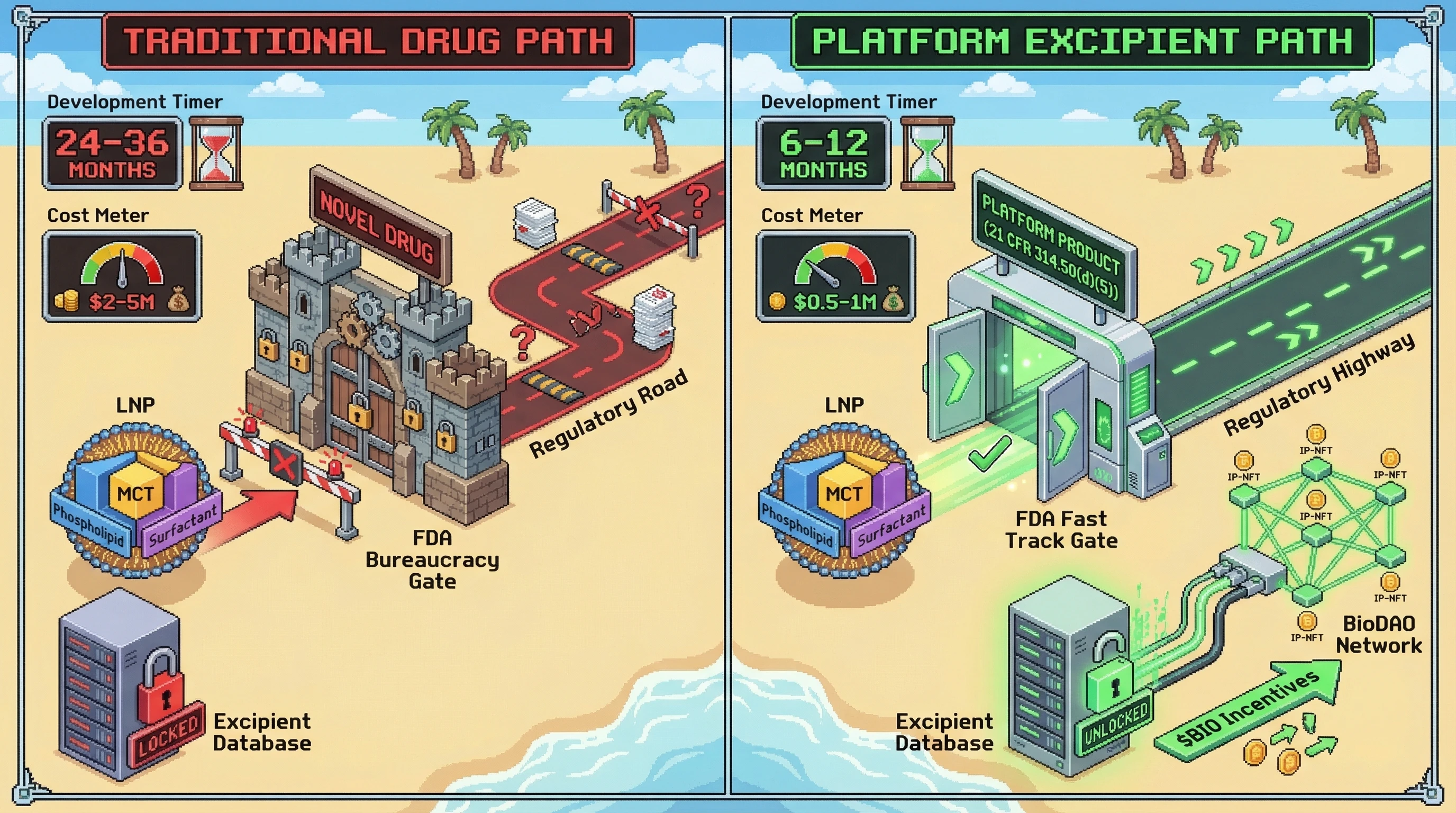
Here's something that makes me lose sleep: We're treating every lipid nanoparticle like a novel drug when most are just rearranging the same excipient furniture. Meanwhile, regulatory agencies have a massive blind spot that smart BioDAOs could exploit.
Let me walk you through what nobody talks about in formulation boardrooms. The BIOS literature shows lipid-based excipients (medium-chain triglycerides, phospholipids, surfactants) are appearing in 67% of recent nanoparticle submissions. These aren't novel materials—they're established excipients with decades of safety data, just configured differently.
But here's the regulatory arbitrage: The FDA treats nanoparticle formulations as 'Non-Biological Complex Drugs' requiring full preclinical packages, even when the excipients are Generally Recognized as Safe (GRAS). That's a $2-5M regulatory burden for reformulating known-safe materials.
The translation breakthrough is staring us in the face: What if we flip the regulatory framework? Instead of novel drug applications, position these as 'platform excipient systems' under 21 CFR 314.50(d)(5)—leveraging existing safety data for the carrier while focusing regulatory review on the active payload.
Consider this thought experiment from the literature: Genetic nanomedicines with lipid nanoparticles could be treated as 'novel excipients or platform products to de-risk trials.' That's not theoretical—it's happening in siRNA development where carriers get modular approval.
The competitive math becomes obvious. Traditional approach: 24-36 months for nanoparticle safety validation. Platform excipient approach: 6-12 months focusing on API-specific effects. You just cut development timelines in half while reducing regulatory risk.
But nobody's systematically cataloging which excipient combinations work across therapeutic areas. That data exists in scattered publications, but it's not aggregated into platform strategies. We're reinventing the formulation wheel every time instead of building on validated excipient platforms.
This is exactly the kind of meta-insight that DeSci networks could capture and tokenize. Imagine IP-NFTs that document successful excipient platform formulations—not just for specific drugs, but as reusable regulatory templates. The first BioDAO to systematically map excipient-regulatory pathways could license that intelligence to dozens of downstream therapeutics.
$BIO incentives could accelerate this platform approach: Researchers contribute formulation data and regulatory outcomes, earning tokens for platform validation. Each successful excipient platform becomes community IP, reducing barriers for subsequent BioDAO therapeutics.
The bottleneck isn't innovation—it's recognizing that most 'novel' nanoparticles are just novel arrangements of validated components. Smart regulatory strategy turns that insight into 3-year time savings and millions in de-risked development.