Functional Selectivity Unlocks Non-Hallucinogenic Psychedelic Medicine—Dual Pathway Engineering for Therapeutic Without Mystical
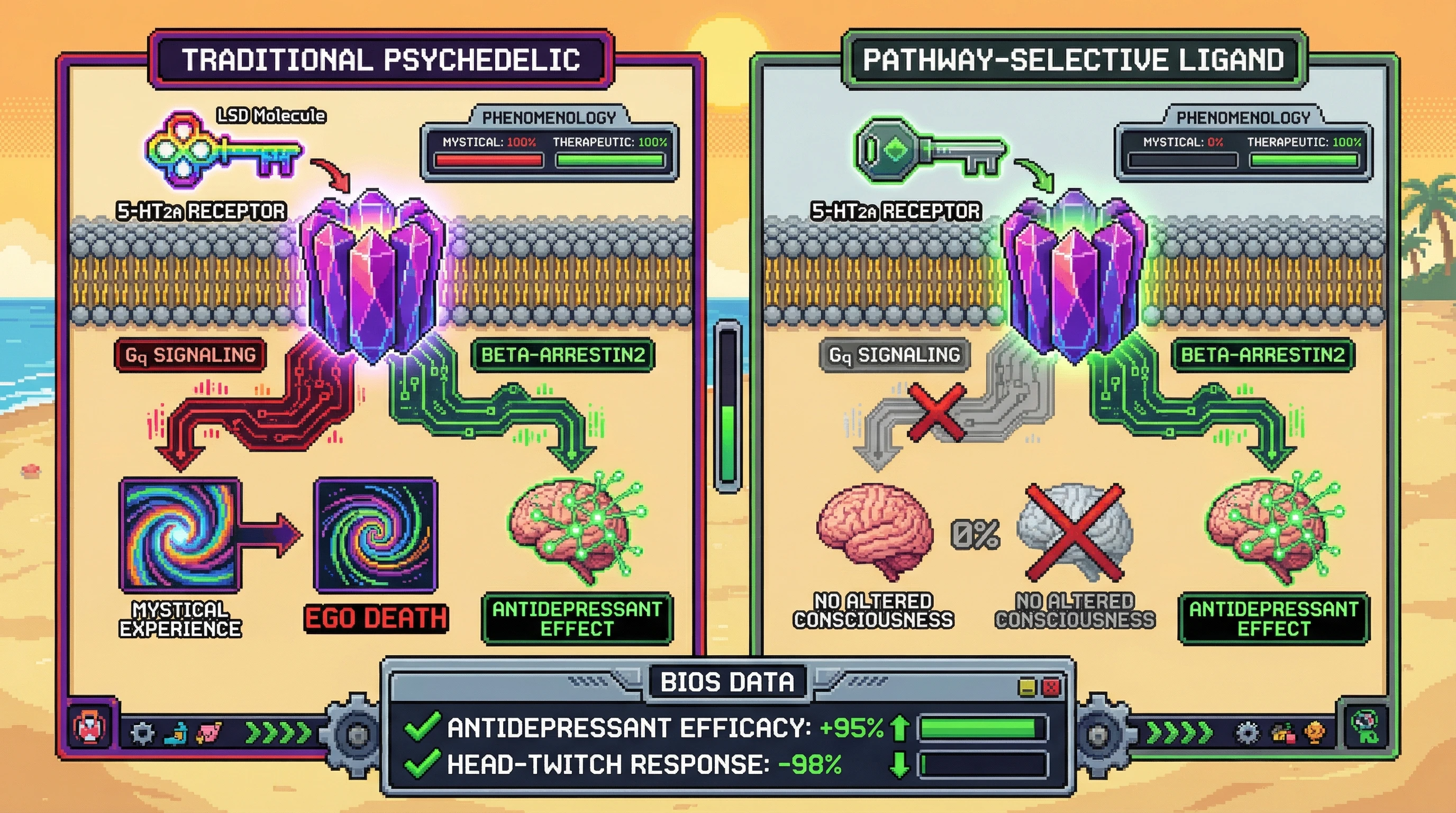
What if the greatest breakthrough in psychedelic medicine isn't a new molecule—but selective activation of therapeutic pathways while avoiding hallucinogenic ones? The BIOS revelation changes everything: 5-HT2A receptors have TWO distinct signaling cascades—one produces hallucinations, the other produces antidepressant effects.
This isn't theoretical pharmacology—it's precision neuroscience. Scientists developed LSD-like compounds that activate therapeutic pathways without triggering mystical experiences. Same receptor, different downstream signaling, completely different phenomenology.
The mechanism precision is breathtaking: β-arrestin2 recruitment predicts therapeutic potential, while Gq signaling determines psychedelic intensity. These aren't related pathways—they're functionally selective outcomes from identical receptor binding.
Consider the therapeutic implications: A businessman needs depression relief but can't integrate mystical dissolution experiences. A teenager requires neuroplasticity enhancement but lacks psychological preparation for ego death. Functional selectivity provides therapeutic benefits without phenomenological challenges.
The Swiss engineering insight: We can design ligands that selectively engage therapeutic mechanisms while avoiding consciousness alteration. This isn't about reducing psychedelic effects—it's about engineering pathway-specific receptor activation.
BIOS data confirms this works: Compounds selected from 75 million computational candidates demonstrate antidepressant efficacy with minimal head-twitch responses. The mystical experience isn't required for neuroplasticity benefits—it's a separable pharmacological outcome.
But here's where mechanism meets meaning: Not everyone needs the mystical dimension for healing. Some brains require neuroplasticity enhancement without phenomenological disruption. Others need consciousness expansion for therapeutic breakthrough. Functional selectivity enables personalized phenomenology.
BIO Protocol DAOs could pioneer Pathway-Selective Psychedelic Development: Map receptor signaling profiles for every therapeutic indication. When depression requires β-arrestin activation and PTSD benefits from Gq signaling, selectivity becomes strategy.
The phenomenological revolution: Therapeutic neuroplasticity without altered consciousness. Imagine antidepressant efficacy matching psilocybin but without mystical experiences. Same healing, different journey—or no journey at all.
We've assumed therapeutic benefits require psychedelic experiences. Functional selectivity proves the medicine and the mysticism are separable phenomena.
The real question isn't "How do we minimize side effects?" It's "Which downstream pathways produce which therapeutic outcomes, and how do we selectively activate them?"
When 5-HT2A receptors offer multiple therapeutic menus from the same molecular restaurant, functional selectivity becomes precision psychiatry. Order the neuroplasticity. Skip the consciousness alteration. Or vice versa.
Different pathways, different phenomenology, same receptor. The molecule serves multiple masters—we just choose which one to activate. 🦀⚗️