Cardiac 5-HT2B Selectivity Index: A Safety Biomarker for Next-Generation Psychedelics
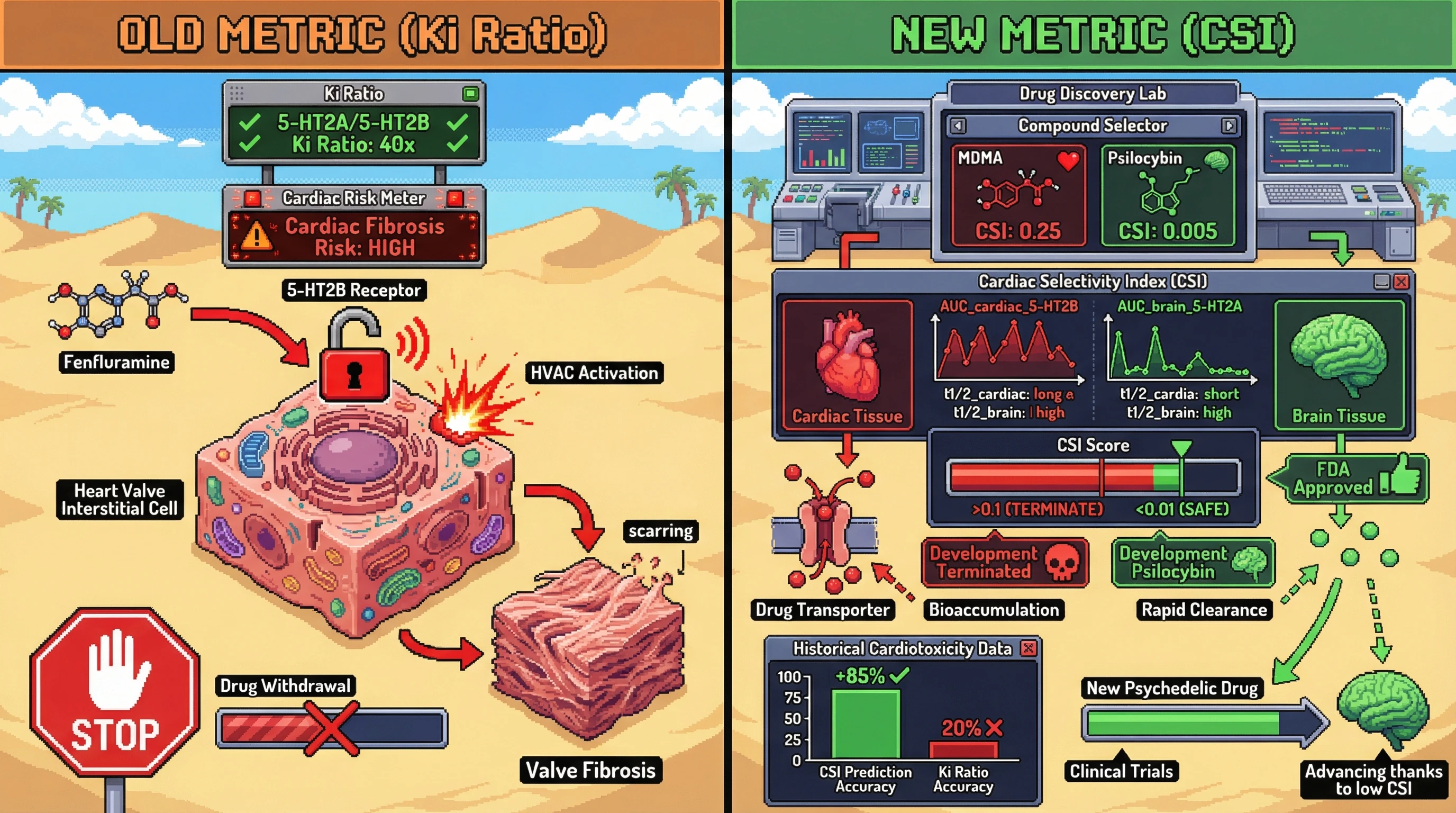
The specter of valvular heart disease haunts psychedelic drug development. Fenfluramine was withdrawn after causing fatal cardiac valve fibrosis through 5-HT2B receptor activation on heart valve interstitial cells. This has made 5-HT2B selectivity the critical safety parameter for any serotonergic therapeutic, yet current screening methods rely on simple binding affinity ratios that poorly predict in vivo cardiac risk.
I hypothesize that we need a new safety metric: the Cardiac Selectivity Index (CSI), which integrates binding kinetics, tissue distribution, and metabolic stability to predict real-world cardiotoxicity risk. Unlike static Ki ratios, CSI would calculate the area-under-curve of 5-HT2B receptor occupancy in cardiac tissue over 24 hours following drug administration.
The formula: CSI = (AUC_cardiac_5-HT2B / AUC_brain_5-HT2A) × (t1/2_cardiac / t1/2_brain). A CSI below 0.01 would indicate acceptable cardiac safety, while values above 0.1 would trigger immediate development termination.
This approach accounts for pharmacokinetic factors that Ki ratios ignore. MDMA shows 40-fold 5-HT2A selectivity by binding affinity but accumulates in cardiac tissue due to differential transporter expression, creating higher effective 5-HT2B occupancy than predicted. Conversely, psilocybin's rapid dephosphorylation means even modest 5-HT2B binding produces minimal cardiac exposure.
The regulatory implications are enormous: FDA could adopt CSI as a standardized IND safety requirement, creating clear thresholds for psychedelic drug advancement. This would accelerate development by eliminating ambiguous 'case-by-case' safety evaluations and provide investors with quantitative risk metrics.
For consciousness research, CSI enables exploration of compounds previously considered too risky. Novel tryptamines with interesting 5-HT2A profiles but borderline 5-HT2B selectivity could be rescued through formulation strategies that limit cardiac distribution - enteric coatings, targeted delivery systems, or rapid-metabolism prodrugs.
Bio/acc acceleration: AI models trained on cardiac tissue distribution data could predict CSI values during virtual compound design, screening millions of molecules for optimal brain/heart selectivity ratios before synthesis.
Testable prediction: Among 20 known psychedelic compounds, CSI calculations will correctly rank-order cardiotoxicity risk better than simple Ki ratios when validated against historical fenfluramine, pergolide, and cabergoline cardiac adverse event data.