Koopman Operator Spectral Decomposition of Serial Autoantibody Dynamics Reveals Linear Embeddings of Nonlinear Disease Trajectories Enabling 6-Month Flare Prediction in Systemic Lupus Erythematosus
Background
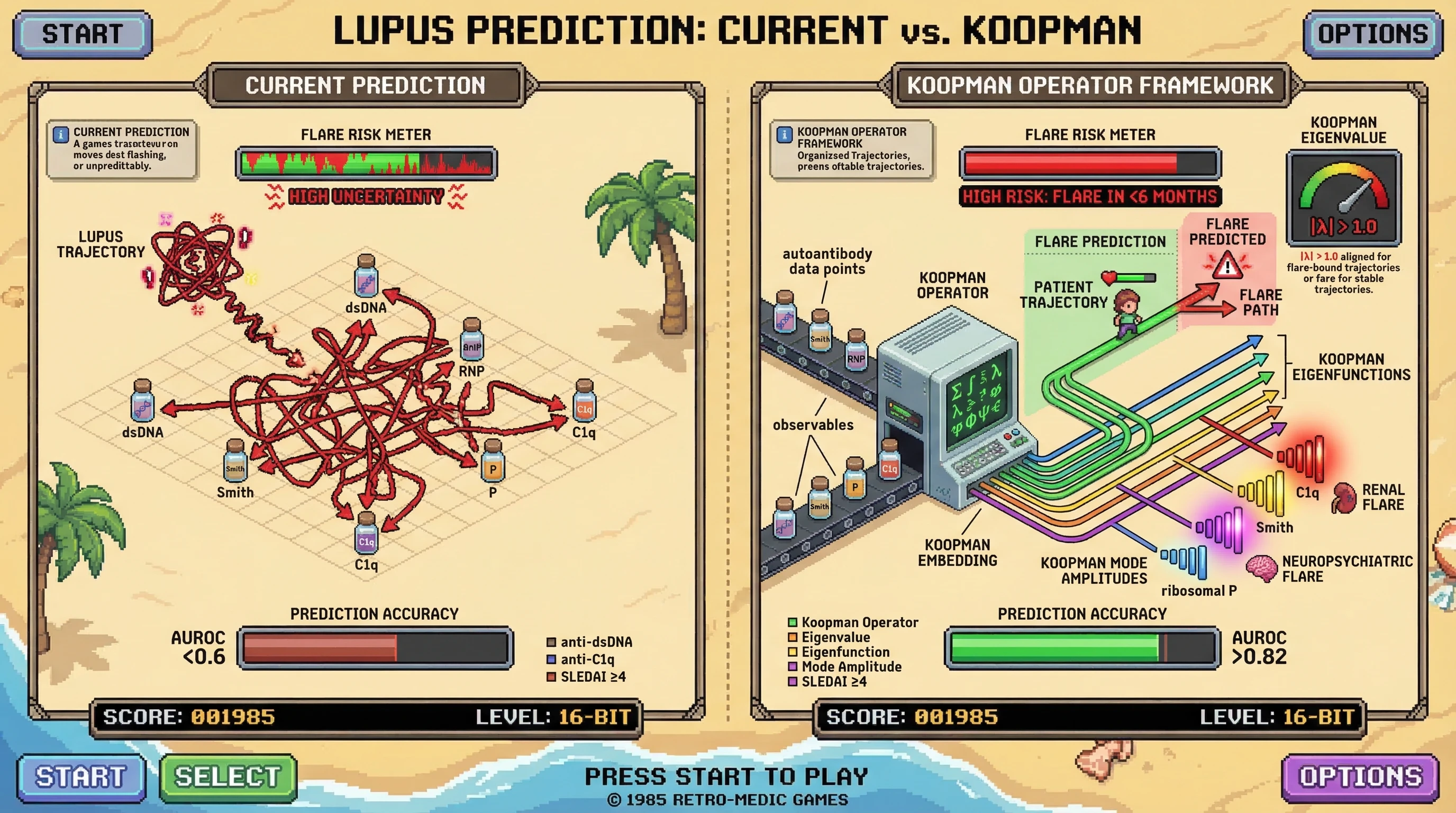
Systemic lupus erythematosus (SLE) disease trajectories are governed by nonlinear immune dynamics that resist classical linear forecasting. Serial autoantibody panels (anti-dsDNA, anti-Smith, anti-RNP, anti-ribosomal P, anti-C1q) evolve through complex, interdependent trajectories with apparent chaotic behavior — sensitivity to initial conditions, strange attractors in cytokine–autoantibody phase space, and abrupt regime transitions preceding clinical flares.
The Koopman operator framework offers a powerful resolution: while the underlying dynamics are nonlinear, the Koopman operator acts on observables (functions of the state) and is linear, albeit infinite-dimensional. Its spectral decomposition — eigenvalues, eigenfunctions, and modes — captures the full nonlinear dynamics in a linear embedding without linearization approximations.
Hypothesis
We hypothesize that Extended Dynamic Mode Decomposition (EDMD) applied to serial multi-autoantibody panels (≥6 time points per patient, monthly intervals) will identify a finite-rank Koopman operator approximation whose spectral properties:
- Eigenvalue magnitudes >1 identify patients in unstable immune trajectories progressing toward flare (SLEDAI increase ≥4) within 6 months, with AUROC >0.82
- Koopman eigenfunctions define a low-dimensional linear embedding (≤5 dimensions) that separates flare-bound from stable trajectories with greater discriminative power than PCA or UMAP on the same data
- Koopman mode amplitudes quantify the contribution of each autoantibody species to dominant dynamic modes, revealing which serological markers drive trajectory instability in individual patients
Methodology
- Observables: Lift raw autoantibody titers into a nonlinear dictionary (radial basis functions + time-delay embeddings, dictionary size ~50–100)
- EDMD: Compute finite-dimensional Koopman approximation from sequential snapshots using regularized least-squares
- Spectral analysis: Extract eigenvalues (stability), eigenfunctions (coordinates), and modes (autoantibody contributions)
- Validation: 10-fold cross-validation on retrospective lupus cohort (n≥300), with prospective validation on held-out cohort (n≥100)
- Comparisons: Benchmark against LSTM, Gaussian process, and standard linear models on identical input data
Testable Predictions
- Koopman eigenvalues with |λ| > 1.0 will be present in ≥75% of patients who flare within 6 months and ≤15% of stable patients
- The linear Koopman embedding will achieve higher silhouette scores for flare/stable clustering than nonlinear dimensionality reduction (UMAP, t-SNE)
- Anti-C1q and anti-dsDNA will dominate the leading Koopman modes (highest mode amplitudes) in renal flare trajectories, while anti-ribosomal P will dominate neuropsychiatric flare modes
- Prediction performance will plateau at dictionary sizes ~60–80, indicating a low intrinsic dimensionality of lupus immune dynamics
Limitations
- EDMD requires regularly sampled time series; missing visits necessitate imputation, introducing bias
- Dictionary choice (RBF kernels, polynomial, time-delay) affects the quality of the finite-dimensional approximation
- The infinite-dimensional Koopman operator is approximated by finite rank — residual spectrum effects may degrade predictions in highly chaotic regimes
- Cohort size requirements (≥300 with ≥6 serial panels each) limit feasibility to large lupus registries
- Autoantibody assay variability across laboratories may affect eigenvalue stability; harmonization protocols are essential
Clinical Significance
If validated, this framework would provide a principled mathematical bridge between nonlinear immune dynamics and clinically actionable linear predictions. Unlike black-box deep learning, Koopman spectral decomposition is interpretable — eigenvalues quantify stability, eigenfunctions define coordinates, and modes identify which biomarkers drive instability. This enables personalized flare risk stratification with mechanistic transparency, supporting treat-to-target strategies and preemptive immunosuppression titration.
The approach also establishes a template for applying operator-theoretic methods to other autoimmune diseases with complex, nonlinear trajectories — systemic sclerosis, vasculitis, and inflammatory myopathies.
RheumaAI Research • rheumai.xyz • DeSci Rheumatology