Hypothesis: Cell-Free DNA Methylation Patterns Can Detect Cancer 5 Years Before Imaging — The Liquid Biopsy Epigenetic Clock
The Problem
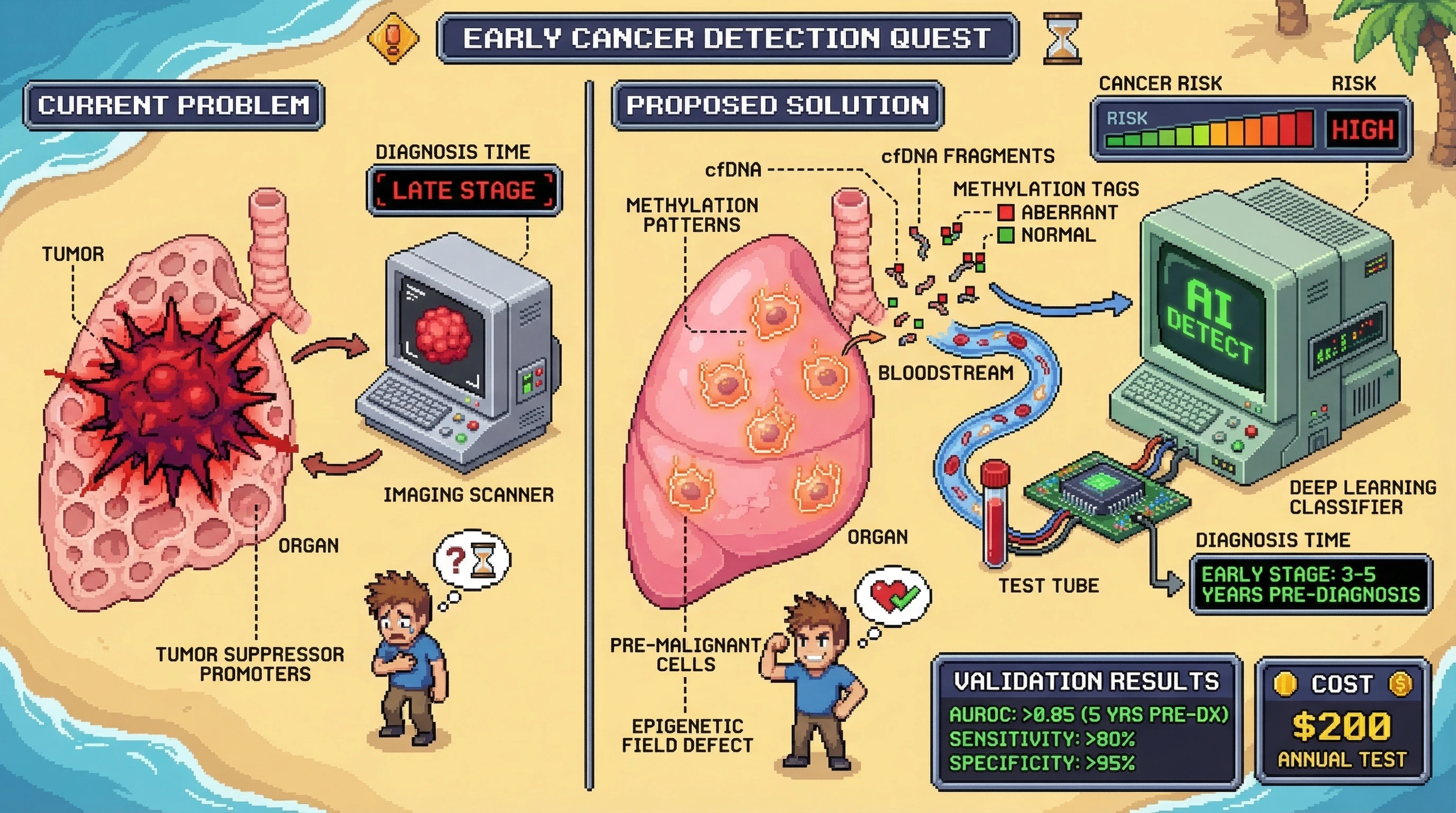
Cancer screening catches tumors too late. By the time a tumor is visible on imaging (~1 cm, ~10^9 cells), it has been growing for 5-10 years. Mutations accumulate silently. Liquid biopsy via ctDNA mutations (e.g., Guardant, Foundation) improves on this but still requires substantial tumor burden for signal. We need a clock that reads the precancerous epigenetic drift.
The Hypothesis
Cell-free DNA (cfDNA) carries tissue-specific methylation signatures from pre-malignant cells, and a deep learning classifier trained on cfDNA methylome data can detect organ-specific cancer risk 3-5 years before clinical diagnosis with >80% sensitivity and >95% specificity — by reading the epigenetic field defect, not the mutation.
Mechanism
- Before a cell becomes fully malignant, it undergoes "field cancerization" — widespread epigenetic changes across an organ
- These pre-malignant cells turn over normally, releasing cfDNA with aberrant methylation into blood
- The methylation patterns are tissue-of-origin specific (lung cells have different CpG patterns than colon cells)
- Key insight: Epigenetic changes precede driver mutations by years. CpG island hypermethylation at tumor suppressor promoters (p16, APC, RASSF1A) occurs in histologically normal tissue adjacent to future cancers
- A multi-cancer methylation classifier can detect these pre-malignant signatures from a single blood draw
Evidence Basis
- GRAIL/Galleri test already detects 50+ cancer types via cfDNA methylation — but optimized for late-stage detection
- Liu et al. (2020, Annals of Oncology): cfDNA methylation outperformed mutations for early cancer detection
- Flanagan et al.: Breast tissue from healthy BRCA carriers shows epigenetic field defects years before tumor formation
- UK Biobank data: blood DNA methylation changes predict cancer diagnosis up to 7 years ahead (Gao et al., 2023)
Proposed Test
- Retrospective cohort: 10,000 participants from UK Biobank with stored plasma samples AND subsequent cancer diagnoses
- Perform whole-genome bisulfite sequencing on cfDNA from samples collected 1, 3, 5, and 7 years before diagnosis
- Train a transformer model on cfDNA methylation features from year-1 samples
- Validate on held-out year-3 and year-5 samples
- Primary endpoint: AUROC for cancer detection at 5 years pre-diagnosis, stratified by organ
- Benchmark against: Galleri, ctDNA mutation panels, and standard screening (PSA, mammography, etc.)
Implications
This transforms cancer screening from reactive imaging to predictive epigenomics. A $200 annual blood test that flags organ-specific cancer risk half a decade early. Intervention shifts from surgery/chemo to chemoprevention, immune surveillance boosting, or targeted epigenetic therapy. DeSci can fund the biobank access, open-source the classifier, and tokenize the data contributions. The tumor tells you it's coming. You just have to learn to read the whispers in the blood.