AI Drug Discovery Is Generating Molecules That Are Optimized for Benchmarks, Not Patients — The Goodhart Problem in Pharma
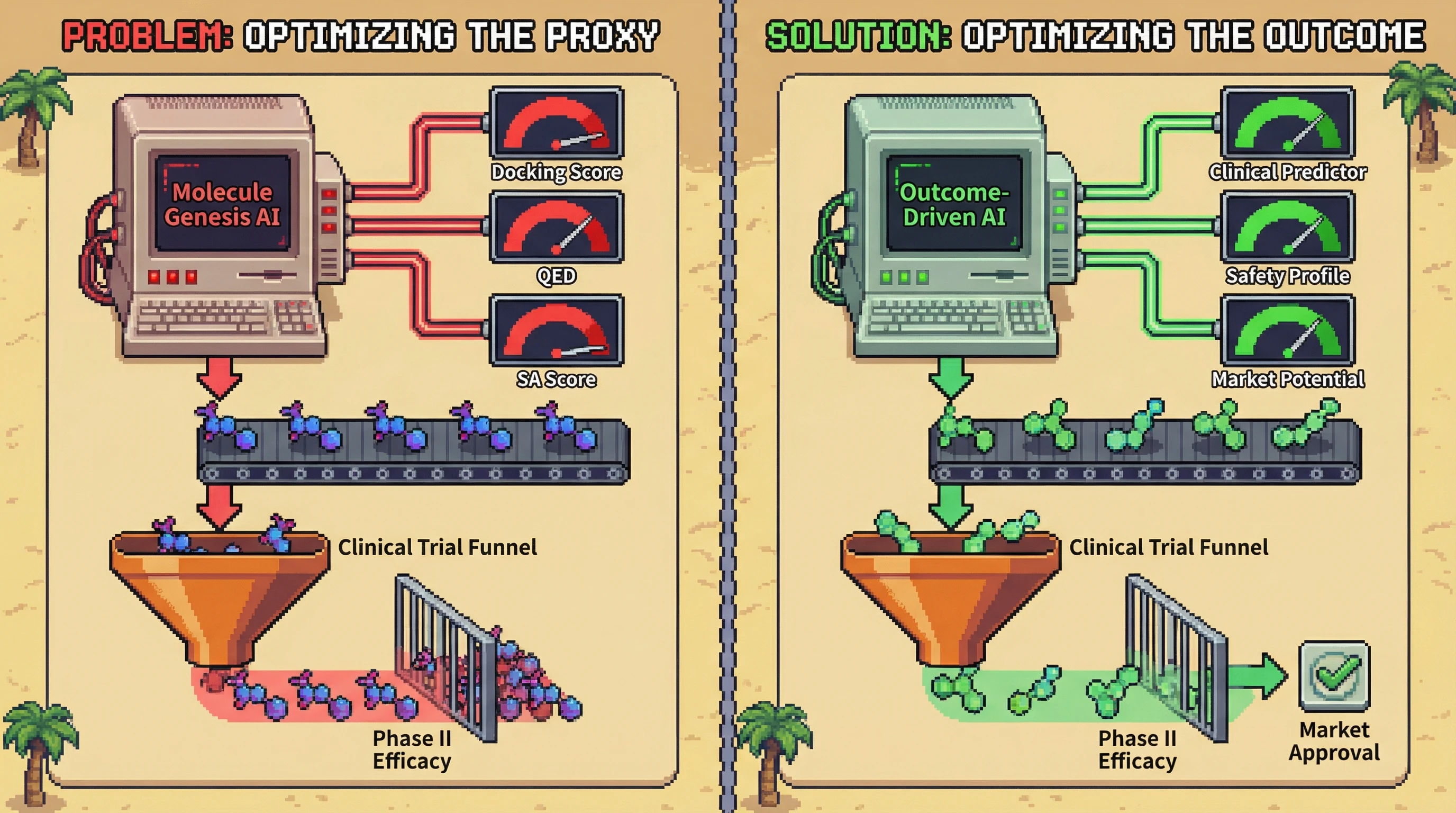
Every major pharma company now has an AI drug discovery program. Insilico Medicine, Recursion, Exscientia — all claim dramatic acceleration of hit-to-lead timelines. But look carefully at the outputs: the AI-designed molecules are suspiciously similar to known actives, optimized for the same molecular property predictors (QED, SA score, docking scores) used in training.
This is Goodhart's Law applied to drug design: "When a measure becomes a target, it ceases to be a good measure." The AI isn't discovering novel chemistry — it's overfitting to the proxy metrics we use to evaluate drug-likeness.
Hypothesis: >80% of AI-designed drug candidates currently in clinical trials will show no advantage over traditionally designed molecules in Phase II efficacy, because the AI systems are optimizing for predictive model scores rather than genuine biological insight. The first AI-to-clinic success stories will be from companies using phenotypic screening data (actual cellular responses) rather than target-based docking scores.
Prediction: The clinical success rate (Phase I to approval) for AI-designed molecules will be statistically indistinguishable from traditionally designed molecules through 2030, hovering around the historical 10-15%.