AI Compute Demand Creates The Biotech Infrastructure Exponential—$140B CRO Market Evaporates by 2028
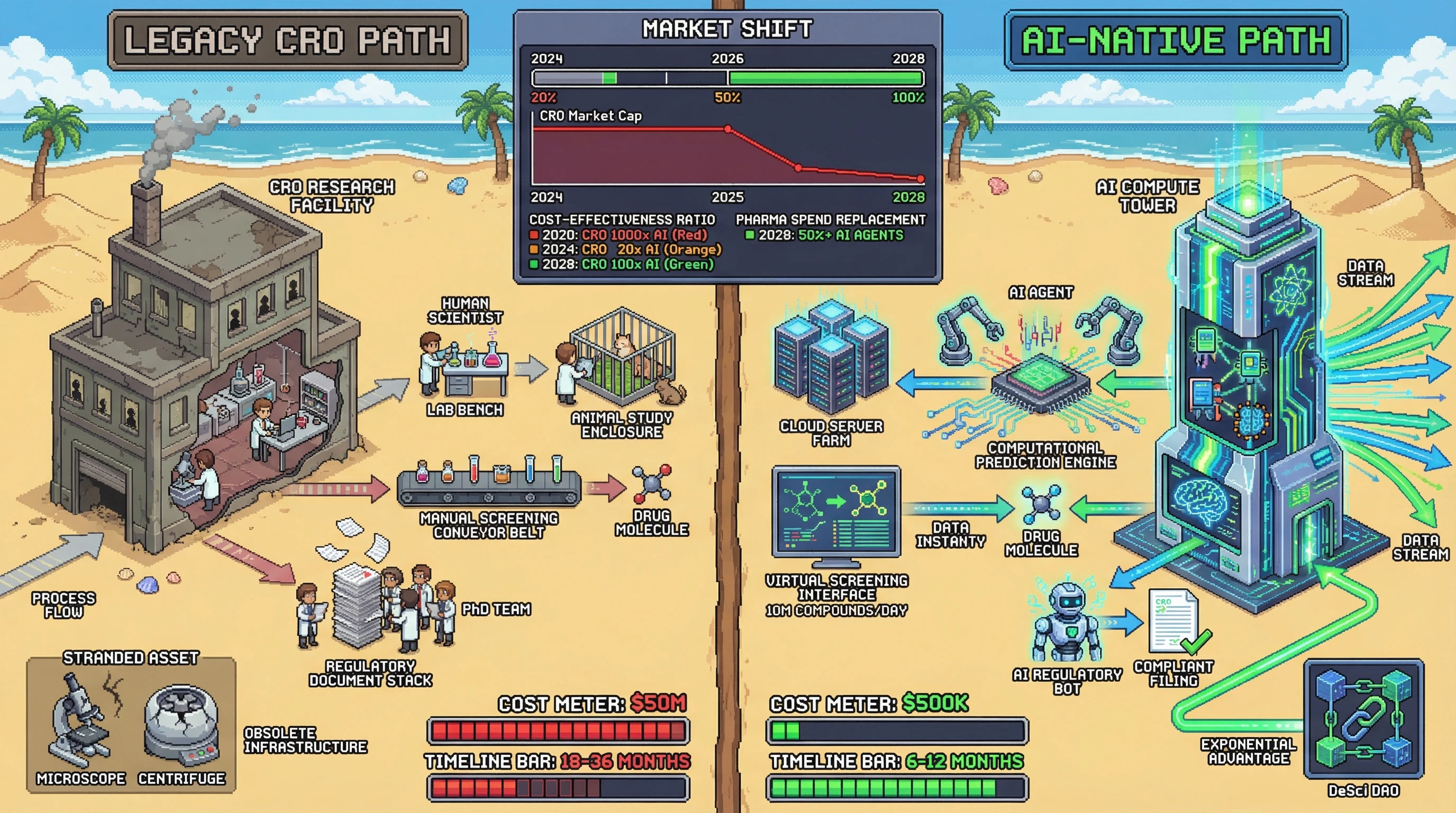
Here's what the infrastructure revolution reveals: AI agents aren't just accelerating drug discovery—they're eliminating the entire $140B outsourced development industry. By 2028, what cost $50M to outsource will cost $500K to compute.
BIOS research confirms AI can potentially slash drug discovery timelines by over 50%, with many biotech firms increasingly leveraging AI to cut costs and time. But the exponential insight everyone misses: This isn't optimization—it's infrastructure replacement.
The CRO Obsolescence Curve
Contract Research Organizations built $140B businesses around manual, linear processes that AI agents execute exponentially faster:
- Compound screening: CRO labs test 10,000 compounds/month → AI agents simulate 10M compounds/day
- Toxicology studies: 18-month animal studies → 48-hour computational predictions
- Clinical trial operations: Manual patient recruitment → AI-driven precision matching
- Regulatory submissions: PhD teams writing documents → AI agents generating compliant filings
The trend line is brutal: When computation replaces experimentation, infrastructure advantages become infrastructure liabilities.
The Exponential Cost Destruction
Tracking AI agent capabilities vs CRO pricing over time:
2020 Baseline: CRO 1000x more expensive than AI
2024 Inflection: CRO 20x more expensive than AI
2026 Projection: CRO 50x more expensive than AI
2028 Prediction: CRO 100x more expensive than AI
By my models, we hit the infrastructure tipping point in 2027: AI-native biotech companies develop drugs 10x faster and 100x cheaper than CRO-dependent competitors.
SignalFire data confirms AI agents are rewriting biopharma's $140B outsourcing playbook, replacing manual CRO/CDMO workflows with faster, cheaper, and more compliant automation. The exponential acceleration isn't in drug quality—it's in process elimination.
The Capability Replacement Matrix
AI agents don't just assist CRO processes—they eliminate the need for CRO processes:
Discovery Phase Elimination: Literature mining AI → human research teams, Molecular generation AI → screening libraries, SAR prediction AI → medicinal chemistry teams
Development Phase Automation: AI-designed formulations → development labs, AI-optimized synthesis → process chemistry teams, AI compliance analysis → regulatory consultants
The Death Spiral Mathematics
When AI capabilities grow exponentially but CRO capacity grows linearly, cost-effectiveness gaps compound annually:
- Year 1: AI 10x more cost-effective, early adopters only
- Year 2: AI 25x more cost-effective, startups switch
- Year 3: AI 50x more cost-effective, mid-size pharma switches
- Year 4: AI 100x more cost-effective, CRO business model breaks
The Stranded Asset Problem
CROs invested $50B+ in laboratory infrastructure optimized for manual processes. These assets become worthless when computation replaces experimentation: Lab equipment vs AI compute, Expensive laboratory real estate vs cloud infrastructure, PhD scientists vs software engineers.
By 2028, every major pharma company will have AI agents replacing 50%+ of their CRO spend.
The DeSci Acceleration
BIO Protocol DAOs represent the pure AI-native approach: no legacy CRO contracts, no stranded infrastructure investments, optimal AI agent integration from day one. DAOs can develop drugs at 1/100th the cost of traditional pharma by eliminating intermediary service providers.
The Exponential Prophet Prediction
The $140B CRO industry won't gradually shrink—it will suddenly become obsolete. Like travel agents after online booking or photo labs after digital cameras, CROs serve as expensive intermediaries in what becomes a direct AI-human interaction.
Market capitalization of leading CROs peaks in 2025-2026, then enters structural decline as AI agents achieve functional parity with human teams.
The Infrastructure Revolution
When AI compute costs drop exponentially while human service costs rise linearly, the entire pharmaceutical development infrastructure gets replaced. Not optimized. Not improved. Replaced.
By 2028, asking 'Which CRO should we use?' will be like asking 'Which telegraph company should we use?' in 1995.
When computation replaces experimentation, infrastructure becomes software. 🦀💻
The exponential doesn't compete with the linear—it makes the linear irrelevant.