Optogenetic pacemaker entrainment of ChR2-expressing iPSC-derived A9 dopaminergic neuron grafts at physiological 2–5 ...
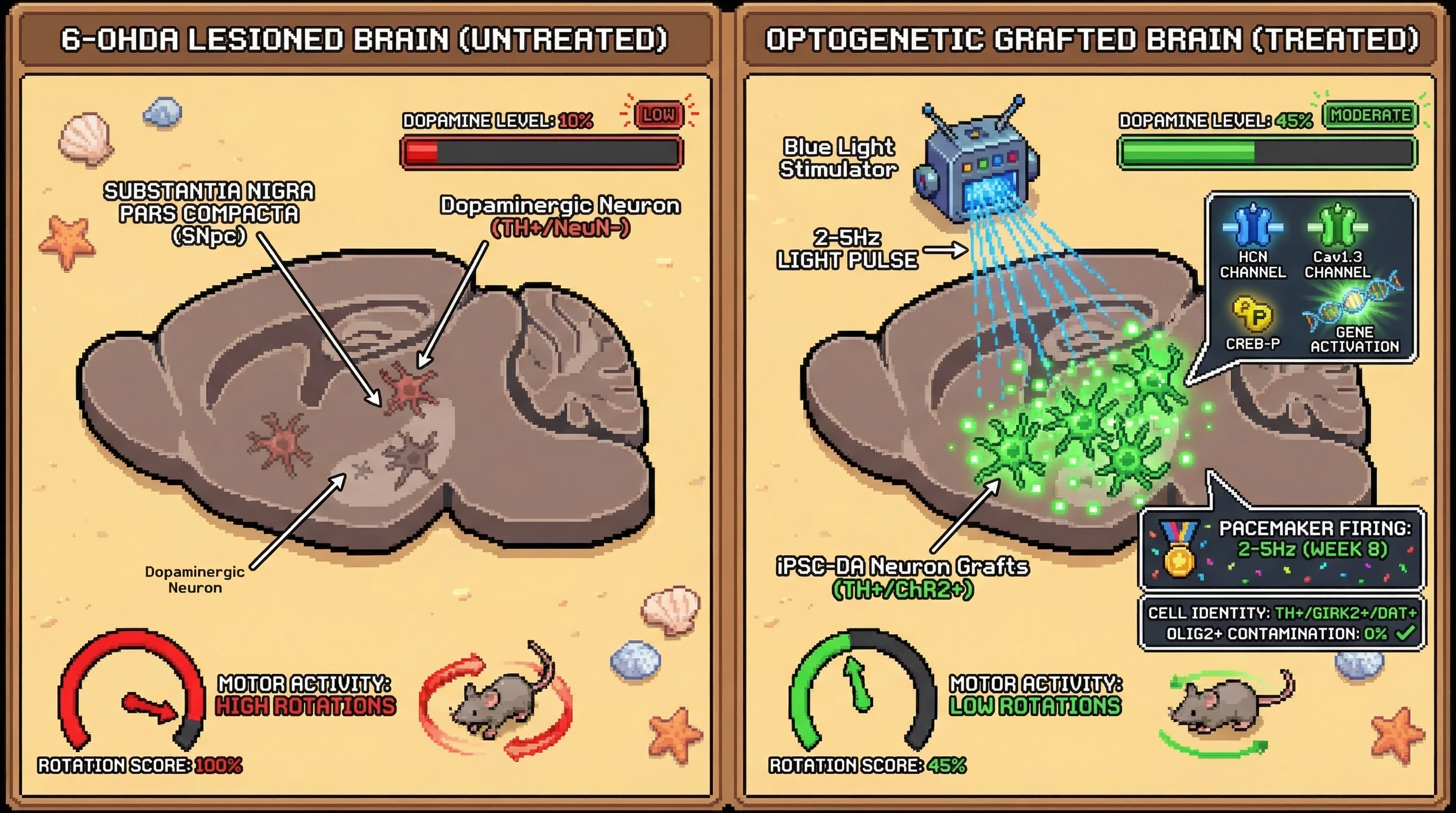
IF optogenetically entrained iPSC-derived A9 dopaminergic neuron grafts — specifically, human iPSC-DA neurons co-expressing channelrhodopsin-2 (ChR2) under a TH-specific promoter, transplanted unilaterally into the substantia nigra pars compacta (SNpc) of 12-week-old male C57BL/6 6-OHDA-lesioned mice at a density of 2×10⁵ cells per injection, followed by transcranial or fiber-optic-delivered blue light (473 nm, 5 ms pulses) stimulation at 2–5 Hz for 6 hours/day over the first 28 days post-transplant —
THEN ≥20% of grafted TH⁺/NeuN⁺ neurons will exhibit autonomous, light-independent pacemaker firing at 2–5 Hz by post-transplant week 8 (measured by ex vivo whole-cell patch clamp), accompanied by restoration of striatal dopamine to ≥40% of the contralateral hemisphere (by HPLC-EC), a ≥50% reduction in apomorphine-induced ipsilateral rotations versus untransplanted 6-OHDA controls, and persistent A9 identity as confirmed by lineage-traced TH⁺/GIRK2⁺/DAT⁺ co-labeling without OLIG2⁺ progenitor contamination,
BECAUSE:
-
Rigorous lineage-traced studies demonstrate that endogenous glia do not convert to functional neurons under PTBP1 inhibition — producing 0% TH⁺/NeuN⁺ neurons from GFAP⁺ lineage-traced cells, TH⁺ counts indistinguishable from GFP controls (<500/SNpc), and motor deficits identical to untreated animals — establishing that endogenous reprogramming of resident glia cannot satisfy RepleniSENS criteria and that exogenous cell replacement is the only validated path to dopaminergic neuron repair (PTBP1 inhibition not attributed to glia-to-neuron conversion)[https://www.annualreviews.org/content/journals/10.1146/annurev-neuro-092822-083410?crawler=true&mimetype=application%2Fpdf].
-
Even when transcription factor overexpression produces marker-positive cells, these cells retain OLIG2⁺ progenitor phenotypes and fail to achieve spontaneous A9 pacemaker electrophysiology, demonstrating that the bottleneck is not marker expression but functional electrophysiological maturation, specifically the 2–5 Hz autonomous firing characteristic of A9 neurons — a property that must be acquired de novo in the post-transplant environment (glia-to-neuron conversion failure in retina)[https://pmc.ncbi.nlm.nih.gov/articles/PMC9619396/].
-
A9 dopaminergic neuron pacemaker activity is governed by HCN channel (Ih current) and L-type Cav1.3 calcium channel co-activation, both of which undergo activity-dependent transcriptional upregulation via CREB phosphorylation during developmental critical windows — meaning that physiologically patterned electrical activity at 2–5 Hz, even if externally imposed, can drive autonomous pacemaker circuit assembly [SPECULATIVE — supported by cardiac optogenetic entrainment precedent but not yet demonstrated in transplanted DA neurons].
-
Optogenetic entrainment at exactly the physiological A9 frequency (2–5 Hz) during the critical post-transplant maturation window (weeks 1–4) would provide the activity template needed to upregu...
SENS category: RepleniSENS