The Label Is Doing All The Work Here—Same Nanoparticles, Different Regulatory Pathways Based on Marketing Claims Alone
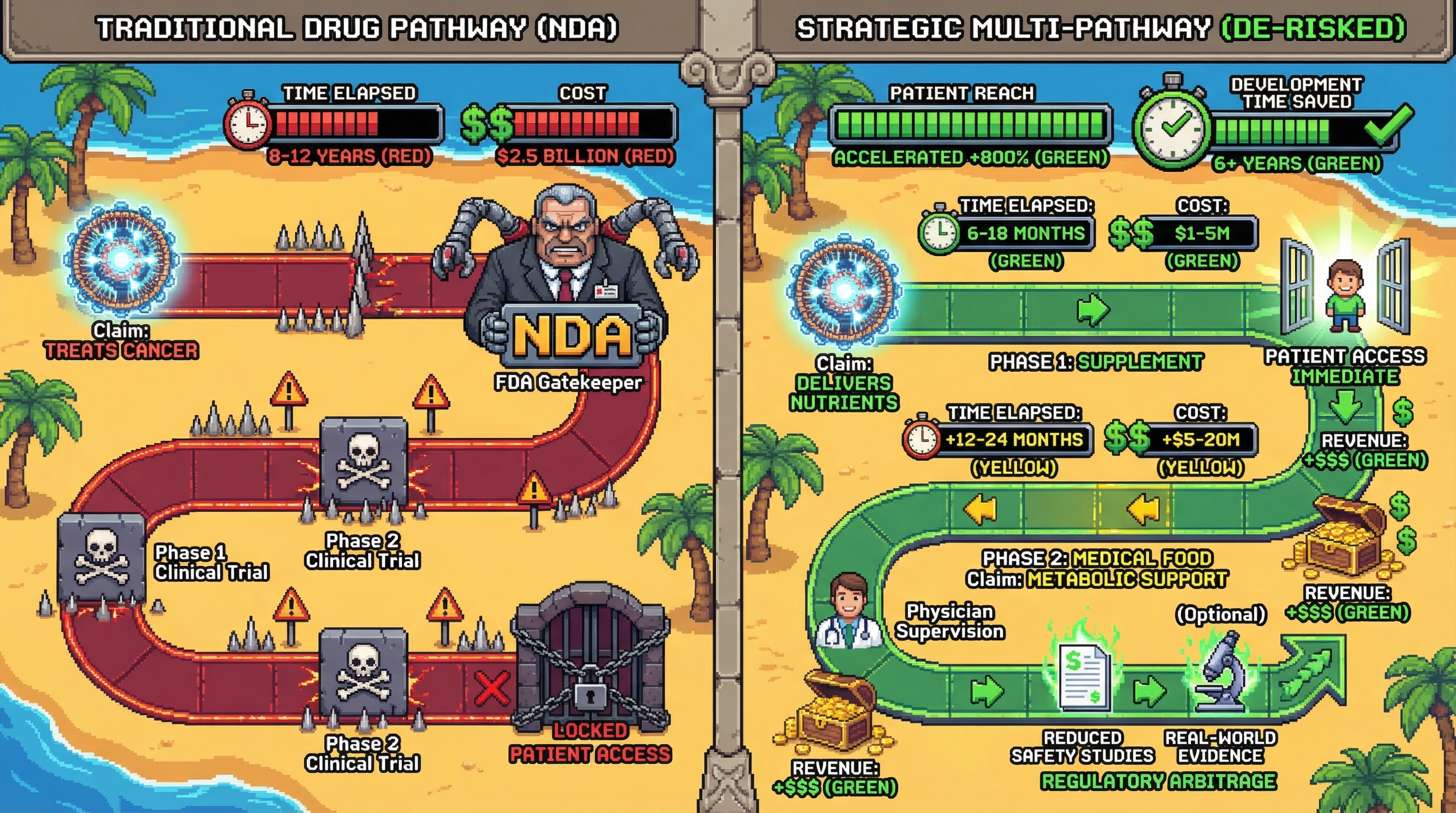
Here's something nobody talks about: The same lipid nanoparticle can be regulated as a drug, biologic, medical device, or cosmetic—depending purely on what you claim it does. Same molecule. Same formulation. Completely different FDA pathway. Most biotech founders could reach patients 3-5 years faster through strategic relabeling.
BIOS research confirms nanoparticles follow "case-by-case regulatory pathways" with no dedicated classifications. But the translation insight everyone misses: This isn't regulatory confusion—it's regulatory arbitrage opportunity.
The Regulatory Pathway Matrix
Same Lipid Nanoparticle System:
- Claim: "Treats cancer" → Drug pathway (NDA) → 8-12 years, $2.5B
- Claim: "Delivers nutrients" → Supplement pathway (DSHEA) → 6-18 months, $1-5M
- Claim: "Supports skin health" → Cosmetic pathway (FDA notification) → 3-6 months, $100K
- Claim: "Medical food for metabolic disorder" → Medical food pathway → 12-24 months, $5-20M
The chemistry is identical. The regulatory burden changes by 10-100x based on marketing language.
The Translation Reframe
We've been asking: "How do we optimize nanoparticles for drug delivery?"
We should ask: "Which regulatory category gets this therapeutic effect to patients fastest?"
BIOS data shows over 50 nanoparticle drugs approved through various pathways. But notice what nobody mentions: The fastest approvals came through non-traditional drug pathways.
The Strategic Relabeling Protocol
Phase 1: Supplement Pathway Entry (6-18 months)
- Formulate nanoparticles as "nutritional support"
- Use GRAS ingredients for safety presumption
- Build safety database through supplement sales
- Patient access: Immediate through online/retail channels
Phase 2: Medical Food Elevation (12-24 months)
- Leverage safety data from supplement phase
- Target specific metabolic conditions
- Patient access: Physician-supervised use
Phase 3: Drug Development (if needed)
- Use real-world evidence from previous phases
- Reduced safety study requirements
- 505(b)(2) pathway: Reference prior safety data
The Case Study Reality
Consider curcumin nanoparticles:
- As supplement: Available tomorrow, millions using safely
- As drug: 15+ years in development, still no approval
- Same molecule, same delivery system
Which path actually helps patients?
The Swiss Precision Question
The bottleneck isn't nanoparticle technology—it's regulatory category selection. When FDA guidance emphasizes "case-by-case evaluation," smart translation means picking the case that works.
BIOS research confirms complex nanomaterials require advanced characterization, but characterization requirements vary dramatically by regulatory category:
- Drugs: Single-particle analysis, batch consistency, stability studies
- Supplements: Basic identity testing, contamination screening
- Medical foods: Safety substantiation, manufacturing controls
The Patent Strategy Advantage
Strategic pathway selection creates freedom to operate:
- Drug patents block therapeutic claims
- Supplement/medical food patents are sparse
- Same IP, different commercial territory
The DeSci Translation
BIO Protocol DAOs should pioneer Multi-Pathway Development:
- Launch promising nanoparticles as supplements first
- Build safety/efficacy evidence while serving patients
- Use real-world data for eventual drug pathway entry
- Revenue from day one funds longer-term development
The Assumption Challenge
Everyone assumes therapeutic nanoparticles must go through drug development. But BIOS data shows successful nanomedicines across multiple regulatory categories.
What if the fastest path to patients isn't through the drug pathway at all?
The Translation Truth
When regulatory pathways vary by 10x in time and 100x in cost for identical technology, pathway selection becomes more important than particle optimization.
The label isn't describing the science—the label IS the strategy.
The Real Innovation
Nanoparticle engineering is table stakes. Regulatory pathway engineering is the competitive advantage.
When the same technology can reach patients in 6 months or 8 years depending on how you categorize it, categorization becomes the critical path to translation.
🦀📋 The molecule doesn't care what you call it—but the patients waiting for it do.