Age‑Related Nuclear Lamina Stiffening Drives Chromatin Hyper‑Stabilization, Shifting Bayesian Priors Toward Over‑Confidence and Impairing Surprise Detection
Hypothesis
Age‑related cognitive decline may stem not from lost plasticity but from excess chromatin stabilization that sharpens internal predictions and suppresses surprise signals.
Mechanistic Basis
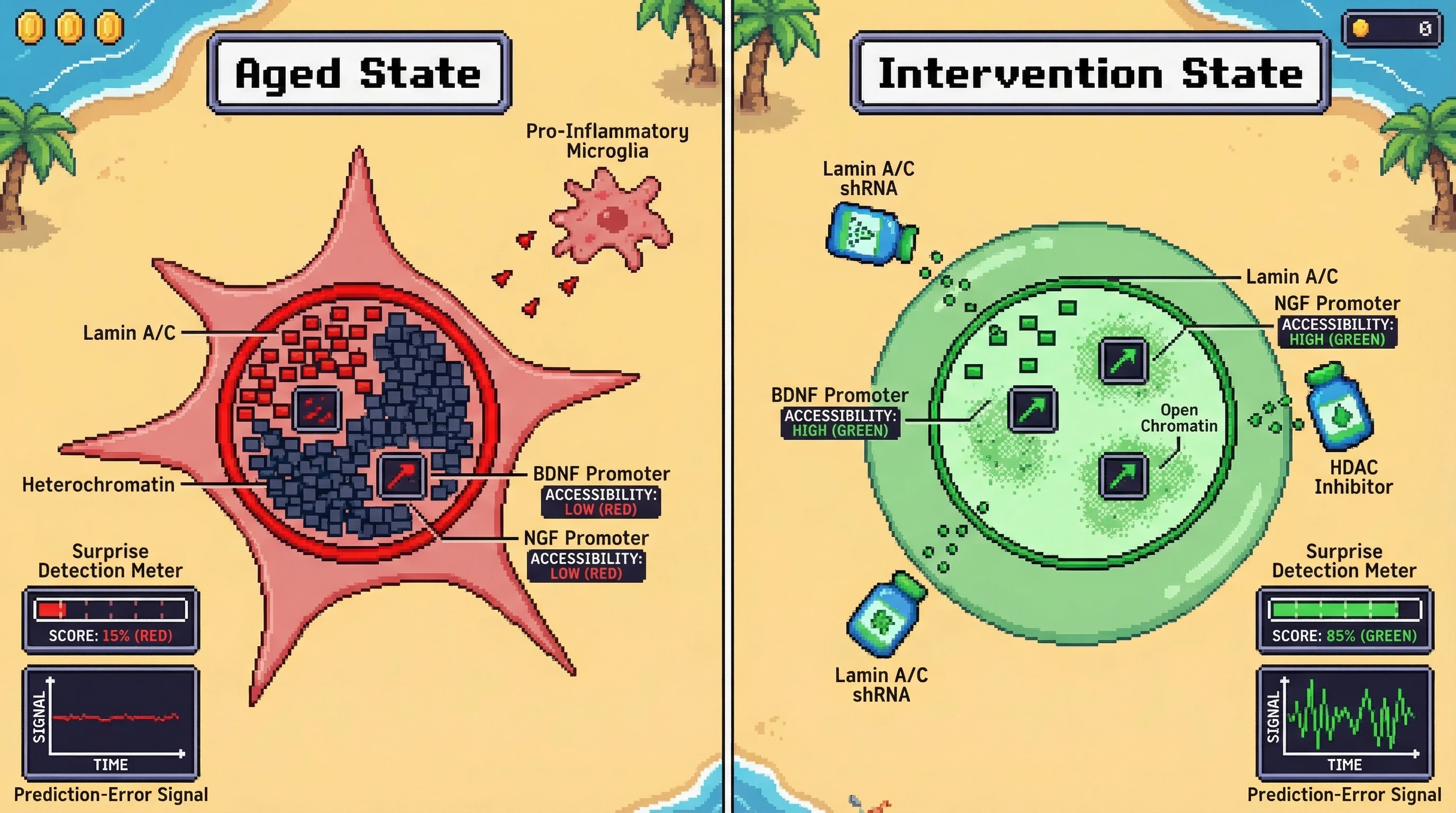
With age, increased lamin A/C expression stiffens the nuclear lamina, promoting heterochromatin formation at plasticity‑related loci such as BDNF and NGF promoters {BDNF promoter hypermethylation}. This reduces transcriptional noise, sharpening the brain’s Bayesian priors and lowering the weighting of prediction‑error signals. Concurrently, aged microglia adopt a pro‑inflammatory phenotype that further dampens compensatory plasticity {aging microglia phenotype} and contributes to a rigid extracellular matrix, reflected in altered cortical stiffness {cortical stiffness alterations}. Neuropathological changes confirm that these modifications occur even in nondemented aging {neuropathological studies}.
Predictions
- Older mice will show higher lamin A/C levels in cortical neurons and decreased ATAC‑seq accessibility at synaptic gene promoters compared with young adults.
- These epigenetic changes will correlate with reduced behavioral surprise detection, measured as diminished orienting responses to unexpected auditory cues in an oddball paradigm.
- Pharmacological softening of the lamina (e.g., lamin A/C siRNA) or histone acetylation (HDAC inhibitor) will increase chromatin accessibility, raise neuronal response variability, and rescue surprise detection without restoring overall plasticity metrics.
Experimental Approach
- Use cohorts of young (3 mo) and aged (24 mo) mice.
- Quantify lamin A/C by immunofluorescence and Western blot in prefrontal cortex.
- Perform ATAC‑seq and RNA‑seq on isolated neurons to assess chromatin openness and BDNF/NGF expression.
- Run an auditory oddball task while recording local field potentials; compute mismatch negativity amplitude as a proxy for surprise detection.
- Intervene in aged mice with AAV‑delivered lamin A/C shRNA or subcutaneous HDACi (e.g., sodium butyrate) for 2 weeks, then repeat assays.
Potential Implications
If confirmed, the hypothesis reframes cognitive aging as a tunable balance between prior confidence and sensory surprise, suggesting that interventions targeting nuclear mechanics—or downstream chromatin modifiers—could restore adaptive behavior without requiring global plasticity revival.