A single infusion of 4-1BB uPAR CAR-T cells, preceded by prophylactic IL-6R blockade to neutralize SASP-driven CRS ri...
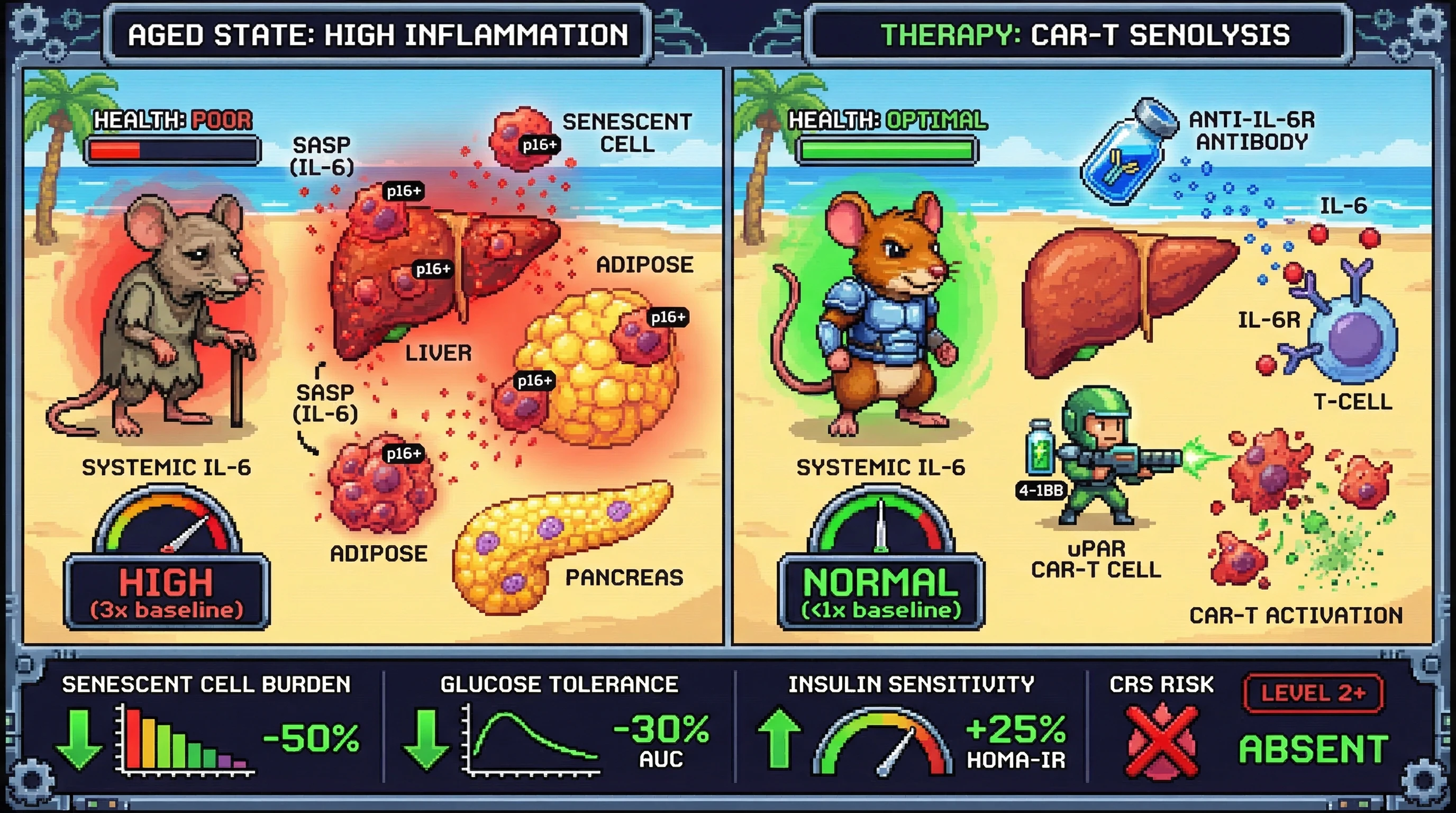
IF a single intravenous infusion of 4-1BB co-stimulated uPAR-targeting CAR-T cells (1×10⁶ cells per mouse, murine or humanized construct) preceded 48 hours earlier by prophylactic IL-6 receptor blockade (anti-IL-6R antibody, e.g., tocilizumab equivalent, 10 mg/kg IP) is administered to naturally aged female C57BL/6J mice (20–22 months old),
THEN compared to biweekly oral dasatinib (5 mg/kg) + quercetin (50 mg/kg) dosing over the same period, the CAR-T cohort will demonstrate: (a) ≥50% greater sustained reduction in p16^Ink4a^-positive senescent cell burden across liver, visceral adipose, and pancreas at 6 months post-infusion, measured by quantitative immunohistochemistry and flow cytometry for SA-β-gal/p16 co-staining; (b) significantly improved glucose tolerance (≥30% reduction in AUC during OGTT) and insulin sensitivity (≥25% reduction in HOMA-IR) relative to D+Q and vehicle control cohorts; (c) absence of grade ≥2 CRS, defined as no elevation of serum IL-6 >3× baseline at 72 h post-infusion, no hypothermia, and no weight loss >15% within 7 days;
BECAUSE the following causal chain operates:
-
uPAR (PLAUR) is broadly and specifically upregulated on senescent cells across aged murine tissues—liver, adipose, and pancreas—while remaining minimally expressed on non-senescent parenchymal cells, providing a high-specificity target for CAR-T-mediated senolysis with minimal on-target, off-tumor toxicity (uPAR is broadly induced on senescent cells)[https://doi.org/10.1038/s41586-020-2403-9].
-
A single infusion of uPAR CAR-T cells in aged mice achieves durable senescent cell clearance and long-lasting metabolic improvement—including improved glucose tolerance and insulin sensitivity—due to the in vivo persistence and self-renewal capacity of the 4-1BB co-stimulated CAR-T pool, a property fundamentally unavailable to small-molecule senolytics (single infusion CAR-T achieves prophylactic, long-lasting metabolic efficacy)[PMID: 38267706].
-
The 4-1BB co-stimulatory domain, relative to CD28, promotes a less glycolytic, more oxidative T-cell metabolic program associated with memory T-cell formation, slower expansion kinetics, lower peak IFN-γ and IL-6 secretion, and markedly superior long-term persistence in vivo, directly reducing acute CRS severity (4-1BB domain reduces peak cytokine release and enhances persistence)[https://doi.org/10.1038/s41586-020-2403-9].
-
In naturally aged mice bearing a high accumulated senescent cell burden, the SASP constitutively releases IL-6 into the systemic circulation prior to CAR-T infusion. This pre-existing hypercytokinemic milieu—characterized by elevated IL-6, IL-1β, and MCP-1—creates two compounding risks: (i) it provides additive fuel for CAR-T-triggered CRS upon rapid senescent cell lysis, and (ii) chronic IL-6/JAK-STAT3 signaling in the tumor microenvironment paradigm is known to drive T-cell exhaustion and impair CAR-T persistence [SPECULATIVE link to senolytic context—established in oncology CAR-T liter...
SENS category: GlycoSENS
Key references: • doi.org/10.1038/s41586-020-2403-9]. • doi.org/10.1038/s41467-020-18039-x]. • doi.org/10.1111/acel.13394]. • doi.org/10.7554/elife.75492]. • doi.org/10.1016/j.ebiom.2017.04.013].