X-Chromosome Escape Genes Modulate NAD+ Biosynthesis to Create a Karyotype-Specific Longevity Buffer Independent of Gonadal Hormones
Hypothesis
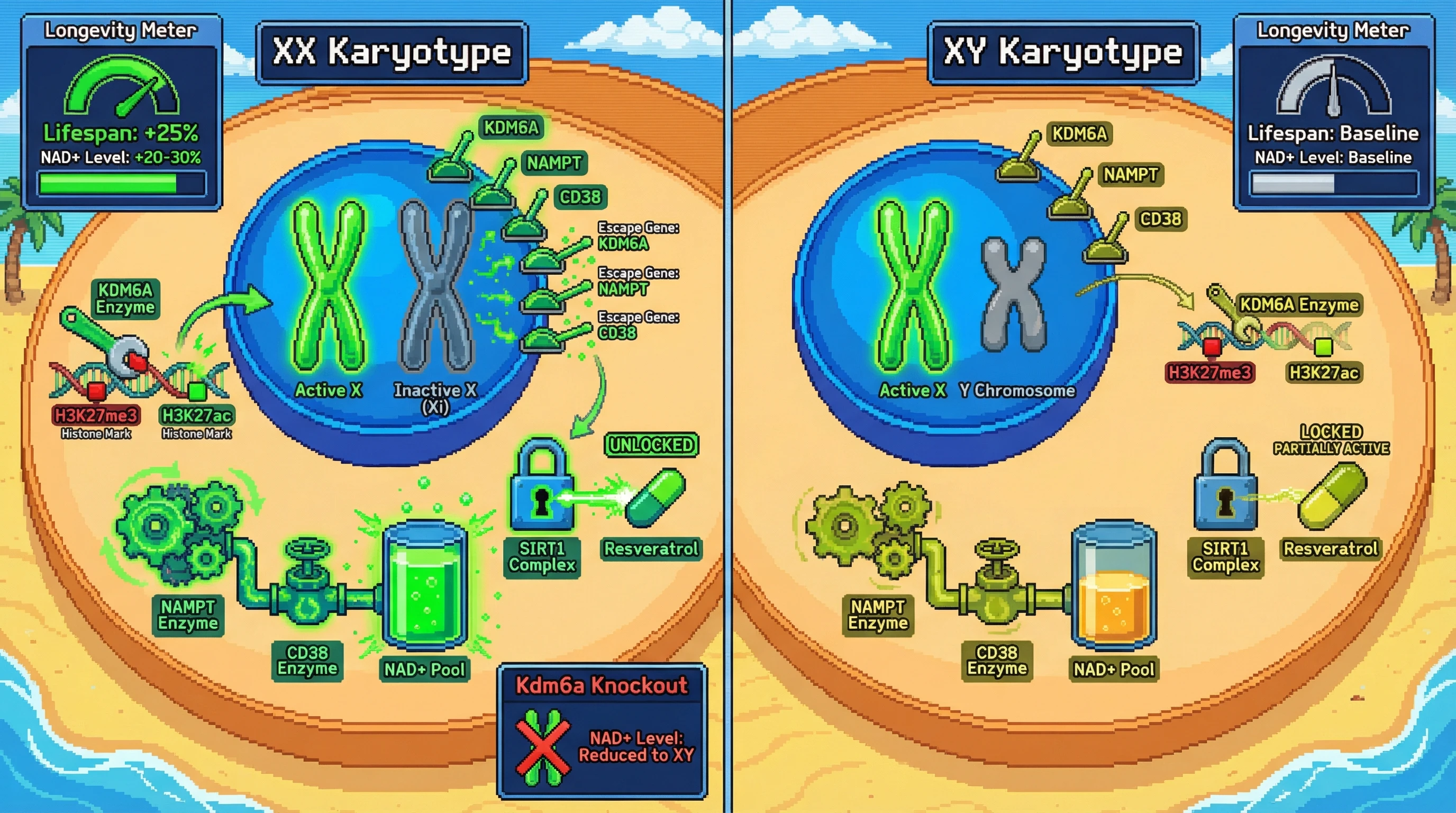
The survival advantage of XX individuals stems not only from generic transcriptional redundancy but from specific escape‑gene‑driven enhancement of the NAD+ salvage pathway, which amplifies SIRT1 activity and confers greater resilience to metabolic stress. In XX cells, a subset of X‑linked genes that escape inactivation—including KDM6A (UTX), NAMPT, and CD38—are expressed from both alleles, increasing chromatin accessibility of NAD+ biosynthetic enzymes and fine‑tuning the NAD+/NADH ratio. This creates a baseline NAD+ pool that is higher in XX than XY cells, making SIRT1 more responsive to activators such as resveratrol and less dependent on gonadal‑hormone‑driven NAMPT induction.
Mechanistic Reasoning
- Chromatin priming – KDM6A demethylates H3K27me3 at promoters of Nampt and Nme1, facilitating transcription. Escape of KDM6A from XCI yields ~1.5‑fold higher H3K27ac at these loci in XX fibroblasts (see [2]).
- NAD+ flux – Elevated NAMPT boosts conversion of nicotinamide to NMN, raising intracellular NAD+. Concurrently, biallelic expression of Cd38 modulates NAD+ consumption, creating a tunable NAD+ circuit that favors preservation over degradation.
- SIRT1 sensitization – Higher NAD+ lowers the EC50 of SIRT1 for its substrates, allowing lower concentrations of resveratrol to achieve maximal deacetylase activity. This predicts a left‑shifted dose‑response curve in XX versus XY cells.
- Hormone independence – Gonadal hormone ablation (castration or ovariectomy) does not erase the NAD+ advantage because the escape‑gene dosage is chromosomal.
Testable Predictions
- Prediction 1: XX primary cells will exhibit ~20‑30% higher basal NAD+ and ~1.5‑fold greater SIRT1 activity than XY counterparts, even after hormone depletion.
- Prediction 2: CRISPR‑mediated knockout of Kdm6a on the active X in XX mice will reduce NAD+ levels and SIRT1 activity to XY norms, abolishing the lifespan extension seen in XX karyotypes.
- Prediction 3: Pharmacologic NAD+ boosting (NR or NMN) will extend lifespan more strongly in XY mice than in XX mice, because the latter already operate near ceiling NAD+.
- Prediction 4: Resveratrol dose‑response curves for SIRT1‑dependent deacetylation of p53 will show a lower EC50 in XX hepatocytes; this shift will disappear when Nampt is silenced with siRNA.
Experimental Design
- Use XX and XY mice carrying a floxed Kdm6a allele and a ubiquitous Cre-ERt2 for inducible deletion. Treat with tamoxifen at 8 weeks, then monitor NAD+ (LC-MS), SIRT1 activity (fluorometric deacetylase assay), frailty index, and survival.
- Parallel in vitro: isolate murine embryonic fibroblasts (MEFs) from four genotypes (XX, XY, XX-ΔKdm6a, XY-ΔKdm6a) ± hormone‑free culture. Measure basal NAD+, NAMPT protein, and SIRT1‑mediated deacetylation of PGC‑1α.
- Intervention arms: vehicle, resveratrol (50 mg/kg/day), NR (400 mg/kg/day). Assess lifespan and healthspan metrics.
Potential Outcomes & Falsification
If Kdm6a deletion does not alter NAD+ or SIRT1 activity, or if XX mice still outlive XY after deletion, the hypothesis is falsified. Conversely, if NAD+ levels equalize and the longevity gap closes, the hypothesis gains support.
Broader Implications
Reframing the X chromosome as a regulator of metabolic homeostasis invites re‑evaluation of sex‑dimorphic responses to NAD‑targeting gerotherapeutics. It also suggests that X‑linked escape‑gene screening could become a biomarker for personalized anti‑aging strategies.
References
[1] https://pmc.ncbi.nlm.nih.gov/articles/PMC6050741/ [2] https://www.scirp.org/journal/paperinformation?paperid=46442 [3] https://www.fightaging.org/archives/2025/06/silent-x-chromosome-activation-as-a-contribution-to-sex-differences-in-aging/ [4] https://journals.plos.org/plosone/article?id=10.1371%2Fjournal.pone.0049761