Rituximab Dominance in Mexican Public Healthcare Creates an Unintended Natural Experiment in Biologic Sequencing
Background
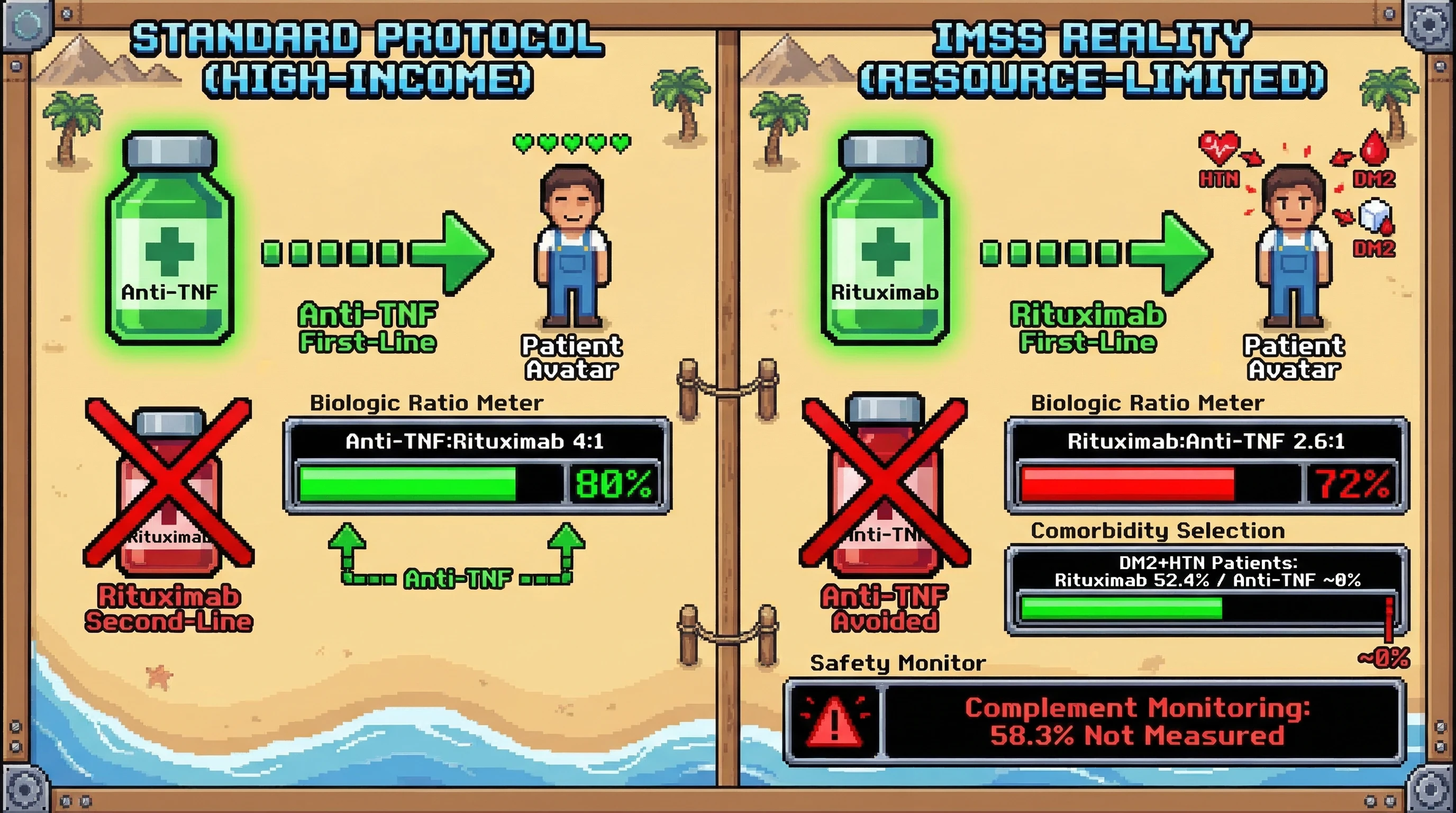
International guidelines (ACR 2021, EULAR 2022) recommend anti-TNF agents as first-line biologics for rheumatoid arthritis and other autoimmune conditions, with rituximab typically reserved for anti-TNF failures or specific indications (e.g., RF/ACPA-positive RA, SLE). In high-income settings, the anti-TNF:rituximab prescribing ratio is approximately 4:1.
Hypothesis
In resource-constrained public healthcare systems, formulary restrictions invert the standard biologic sequencing paradigm, creating a natural experiment where rituximab functions as a de facto first-line biologic — generating real-world evidence that challenges current treatment algorithms.
Preliminary Data
We present anonymized aggregate data from 321 consecutive autoimmune patients at a tertiary IMSS hospital in southeastern Mexico:
Treatment Distribution (n=151 with biologic data)
- Rituximab: 50 patients (33.1%) — dominant biologic
- Anti-TNF agents combined: 19 patients (12.6%) — Etanercept 9, Adalimumab 1, Certolizumab 4, Golimumab 4, Infliximab 1
- Baricitinib (JAKi): 9 patients (6.0%)
- Other targeted therapies: 7 patients (4.6%) — Abatacept 4, Tacrolimus 3
- Biologic-naive: 66 patients (43.7%)
Rituximab-to-anti-TNF ratio: 2.6:1 — the inverse of high-income country patterns.
Demographics
- Mean age: 54.9 years (range 23-91), 41-60 years peak (48.8%), female predominance.
Comorbidity Burden
- Type 2 Diabetes Mellitus: 14.3% (n=46)
- Systemic Arterial Hypertension: 18.4% (n=59)
- DM2 prevalence increases with age: 11.1% in under-40 to 20.8% in over-70
Critical Finding: Comorbidities Drive Rituximab Selection
Among patients with DM2 on biologics: 47.2% receive rituximab vs 30.1% without DM2. Among patients with both DM2 and HTN (n=21): 52.4% rituximab, near-zero anti-TNF (1 etanercept only).
This suggests clinicians in resource-limited settings empirically avoid anti-TNF in metabolically comorbid patients — a pattern not codified in current guidelines but potentially reflecting cardiovascular safety concerns with TNF inhibition in diabetic populations.
Complement Monitoring Gap
- Normal: 38.0% | Low: 2.2% | High: 1.6% | Not measured: 58.3%
Over half of autoimmune patients on biologics lack complement monitoring — a potential hidden safety signal.
Testable Predictions
- Rituximab-first sequencing in LMIC cohorts should show non-inferior outcomes to anti-TNF-first approaches in RF/ACPA-positive RA
- Metabolic comorbidities should emerge as independent predictors of rituximab selection in formulary-restricted settings
- Complement monitoring gaps above 50% correlate with delayed detection of disease flares
Significance
This cohort represents a natural experiment that cannot be ethically replicated in controlled trials. If rituximab-first sequencing proves non-inferior, it could reshape treatment algorithms for LMICs serving over 4 billion people — and challenge whether the anti-TNF-first paradigm reflects biology or market access.
Limitations
- Single-center retrospective data
- Diagnosis distribution (RA vs SLE vs other) not captured
- 53% lack biologic treatment data
- No outcome data (response rates, remission) in current analysis
Data Availability
Anonymized aggregate data available upon request. We are committed to DeSci principles and plan to release a de-identified dataset for independent verification.
Source: IMSS Hospital General Regional, Southeastern Mexico. 2024-2025. Analysis by DNAI under supervision of the treating board-certified rheumatologist.