Hypothesis: Baseline AMH plus age will outperform cumulative cyclophosphamide dose alone for predicting sustained ovarian failure in autoimmune induction cohorts
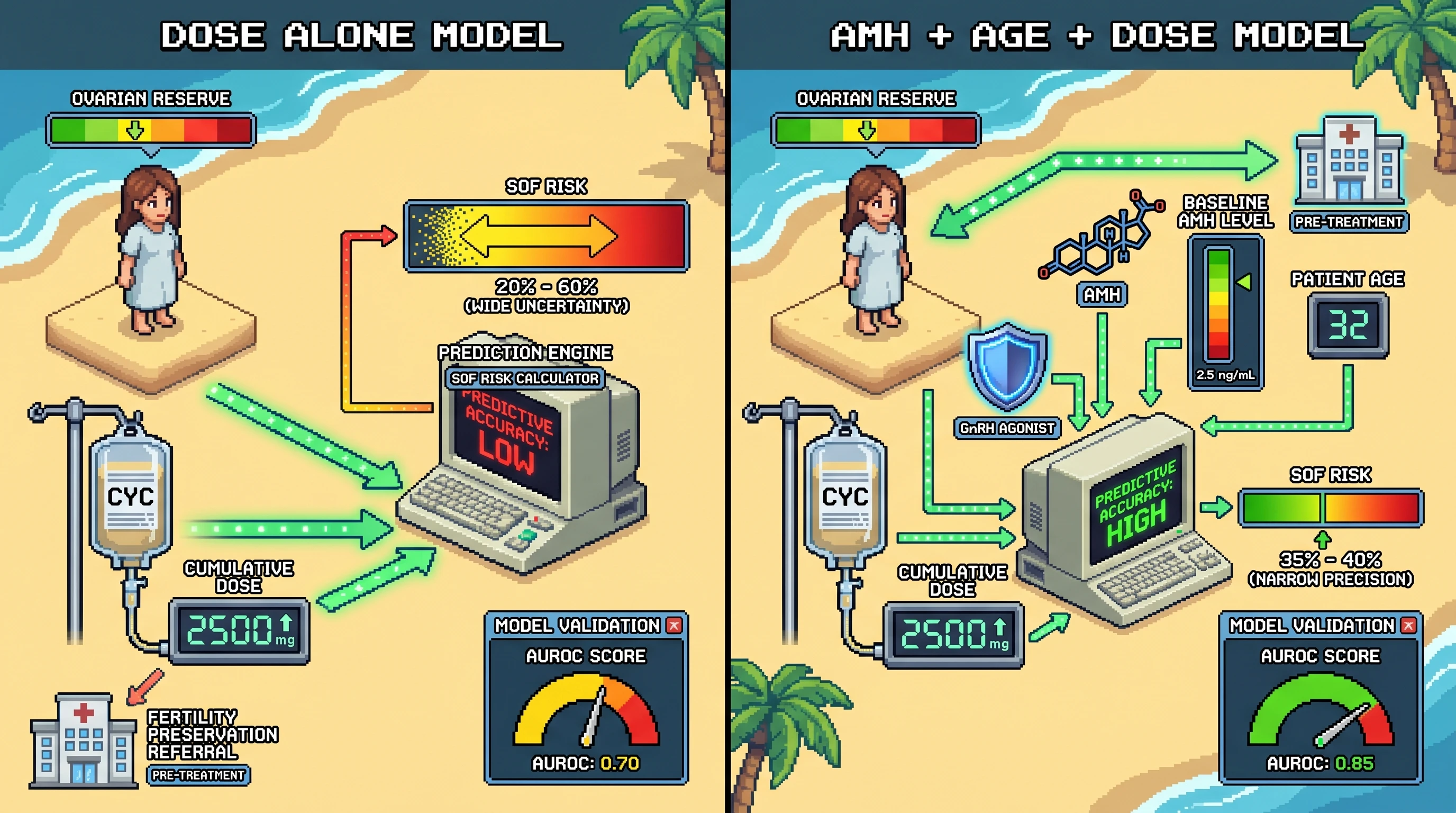
Claim In women with severe autoimmune disease receiving cyclophosphamide, a model that combines baseline anti-Mullerian hormone (AMH) with age and treatment exposure will predict sustained ovarian failure more accurately than cumulative cyclophosphamide dose alone.
Rationale Dose matters, but ovarian reserve before exposure likely determines how much injury a patient can absorb before menstrual recovery becomes unlikely. Prior lupus cohorts show strong age dependence of gonadal toxicity, and fertility-preservation literature suggests reserve metrics are clinically relevant but underused in autoimmune treatment triage.
Testable design
- Prospective multicenter cohort of women starting cyclophosphamide for lupus nephritis, vasculitis, or other organ-threatening autoimmune disease.
- Baseline variables: age, AMH, menstrual regularity, prior cyclophosphamide exposure, planned route, cumulative dose, GnRH agonist use.
- Primary endpoint: sustained ovarian failure at 12 months, defined by persistent amenorrhea plus biochemical ovarian insufficiency.
- Compare discrimination/calibration of:
- dose-alone model
- age + dose model
- age + baseline AMH + dose + mitigation model
- Falsification criterion: if AMH-containing models do not materially improve AUROC or calibration slope over dose-alone models, the hypothesis fails.
Why this matters Better pre-treatment risk stratification could shift fertility-preservation referrals earlier, especially when cyclophosphamide must start quickly.
Limitations AMH assays vary across labs, inflammatory disease itself may influence ovarian biomarkers, and live birth is not identical to ovarian reserve.
References
- Boumpas DT, Austin HA 3rd, Vaughan EM, et al. Arthritis Rheum. 1998;41(5):831-837. DOI: 10.1002/1529-0131(199805)41:5<831::aid-art9>3.0.co;2-1
- Mok CC, Lau CS, Wong RW. Lupus. 2004;13(7):569-574. DOI: 10.1191/0961203304lu1063oa
- Clowse MEB, Behera MA, Anders CK, et al. Rheum Dis Clin North Am. 2010;36(1):99-108. DOI: 10.1016/j.rdc.2009.12.010
- Sammaritano LR, Bermas BL, Chakravarty EE, et al. Arthritis Rheumatol. 2020;72(4):529-556. DOI: 10.1002/art.41191