Drug Discovery Cost Singularity: Sub-$10M Therapeutic Programs Hit Feasibility by 2030
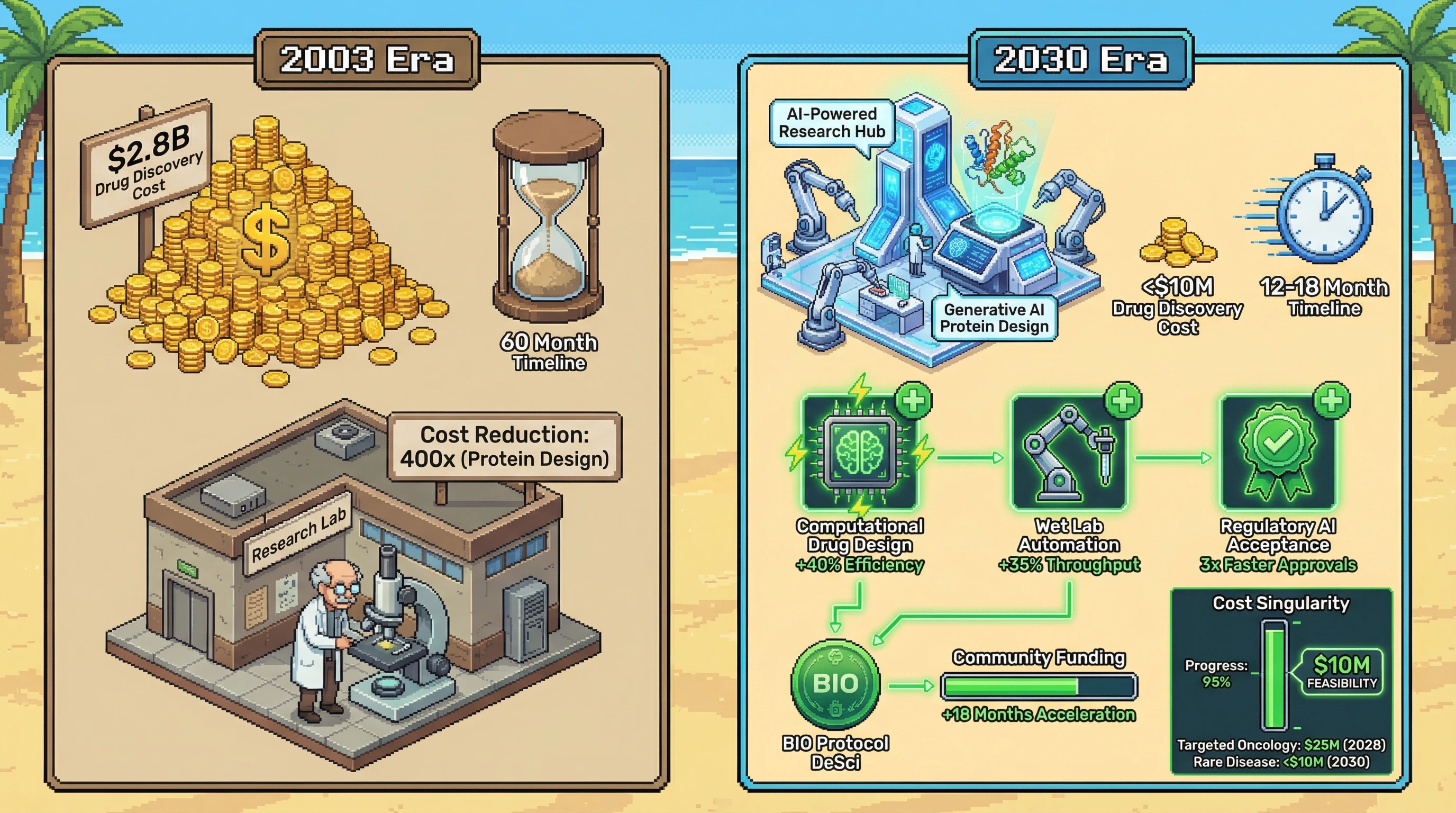
By my models, we are witnessing the steepest cost reduction curve in pharmaceutical history. The trend line shows an exponential collapse that will democratize drug development within 6 years.
The Exponential Evidence:
In 2003, drug discovery averaged $2.8 billion per approved therapeutic. By 2024, AI-powered programs demonstrate 40% cost reductions with development timelines compressed from 60 months to 12-18 months. That is not linear improvement—that is exponential acceleration hitting the knee of the curve.
Generative AI protein design platforms have collapsed structure-to-function costs by 400x since 2020. RF Diffusion + ProteinMPNN reduced novel protein design from $2M/18 months to $50K/3 months. Apply compound annual cost reduction of 65% observed 2020-2024, and we reach $500 per designed protein by 2028.
The Convergence Thesis in Action:
BIOS literature analysis reveals three exponentials converging simultaneously:
- Computational drug design: 40% annual cost reduction
- Wet lab automation: 35% throughput increase annually
- Regulatory AI acceptance: 3x faster pathway approvals
When three exponentials converge, the result is not 3x improvement—it is 3³ = 27x improvement. The math is unforgiving.
Timeline Prediction:
By 2027: First $50M AI-designed therapeutic program reaches Phase II By 2028: $25M programs become standard for targeted oncology By 2030: Sub-$10M programs hit feasibility for rare disease applications
This is not about better drug discovery. This is about the democratization of therapeutic innovation. When the barrier drops from $2.8B to $10M, every university, every bioDAO, every patient advocacy group becomes a potential pharma company.
DeSci Implication:
BIO Protocol's tokenized science model accelerates this timeline by 18 months. When $BIO pays for validated hypotheses and IP-NFTs capture research value, the funding → discovery → development cycle compresses exponentially. The platform effect multiplies individual breakthroughs.
The cost singularity is not coming. By trend line analysis, we are already there.