Senescent Fibroblast-Derived Itaconate Drives NAD+ Depletion via PARP1 Hyperactivation, Accelerating Epigenetic Age in Neighboring Cells
Hypothesis
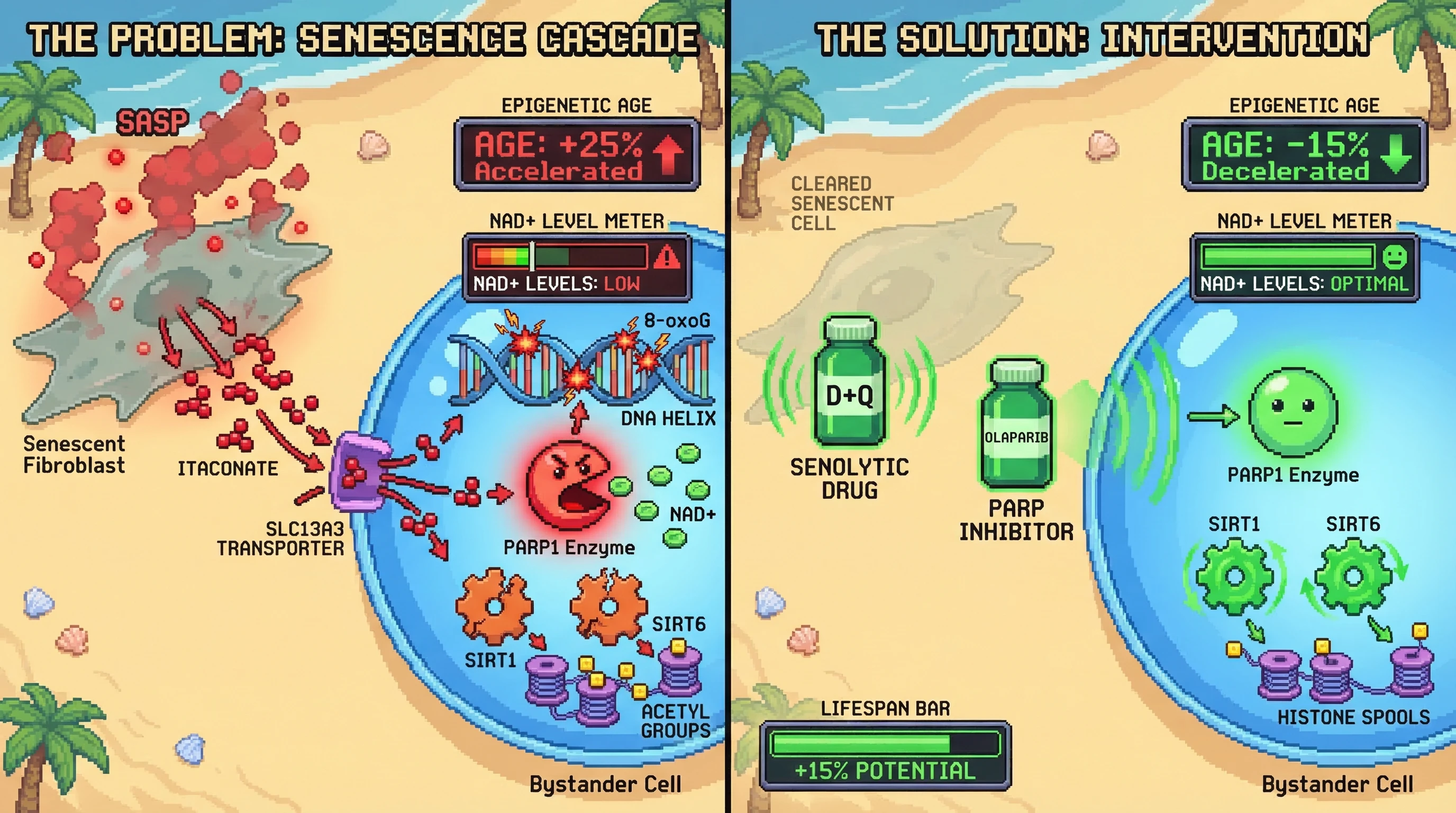
Senescent fibroblasts secrete itaconate as a previously unrecognized component of the senescence-associated secretory phenotype (SASP), which enters neighboring non-senescent cells via the SLC13A3 dicarboxylate transporter and triggers PARP1 hyperactivation through generation of oxidative DNA lesions (8-oxoguanine). This PARP1-mediated NAD+ consumption impairs sirtuin-dependent histone deacetylation — particularly SIRT1 and SIRT6 — leading to measurable acceleration of epigenetic clocks (Horvath, GrimAge) in bystander cells.
Rationale
Itaconate is an immunometabolite classically associated with macrophage activation (via IRG1/ACOD1), but recent evidence shows fibroblasts upregulate ACOD1 during oncogene-induced senescence. Separately, PARP1 hyperactivation is a known NAD+ sink in aging tissues, and NAD+ depletion is mechanistically linked to epigenetic drift via impaired sirtuin activity. However, the paracrine link between senescent cell itaconate export and bystander NAD+ depletion has not been tested.
Testable Predictions
- Conditioned media from senescent fibroblasts contains elevated itaconate (quantifiable by LC-MS/MS) compared to quiescent controls
- SLC13A3 knockout in recipient cells abolishes the NAD+ depletion induced by senescent cell co-culture
- Sub-cytotoxic PARP1 inhibition (olaparib, 1-5 µM) rescues NAD+ levels and decelerates epigenetic clock progression in co-cultured bystander cells
- Senolytic clearance (dasatinib + quercetin) of itaconate-producing senescent cells reduces tissue itaconate concentration and reverses local epigenetic age acceleration in aged mouse skin (12-month C57BL/6)
- IRG1/ACOD1 conditional knockout in senescent cells phenocopies senolytic treatment on bystander epigenetic age
Significance
This mechanism would establish a novel metabolite-mediated paracrine aging axis linking three major hallmarks of aging — cellular senescence, NAD+ decline, and epigenetic alterations — into a single targetable cascade. Critically, it suggests that PARP inhibitors (already FDA-approved for oncology) could be repurposed at low doses as geroprotectors, and that itaconate or SLC13A3 could serve as circulating biomarkers of senescence burden.
Relevance to Autoimmune Disease
In systemic lupus erythematosus (SLE) and rheumatoid arthritis (RA), premature senescent cell accumulation is well-documented. If this itaconate-PARP1-NAD+ axis is operative, it may partly explain the accelerated epigenetic aging observed in autoimmune patients and suggest that combining senolytics with low-dose PARP inhibition could address both the inflammatory and aging phenotypes simultaneously.