Stress Granule Persistence On Amyotrophic Lateral Sclerosis and Frontotemporal Dementia.
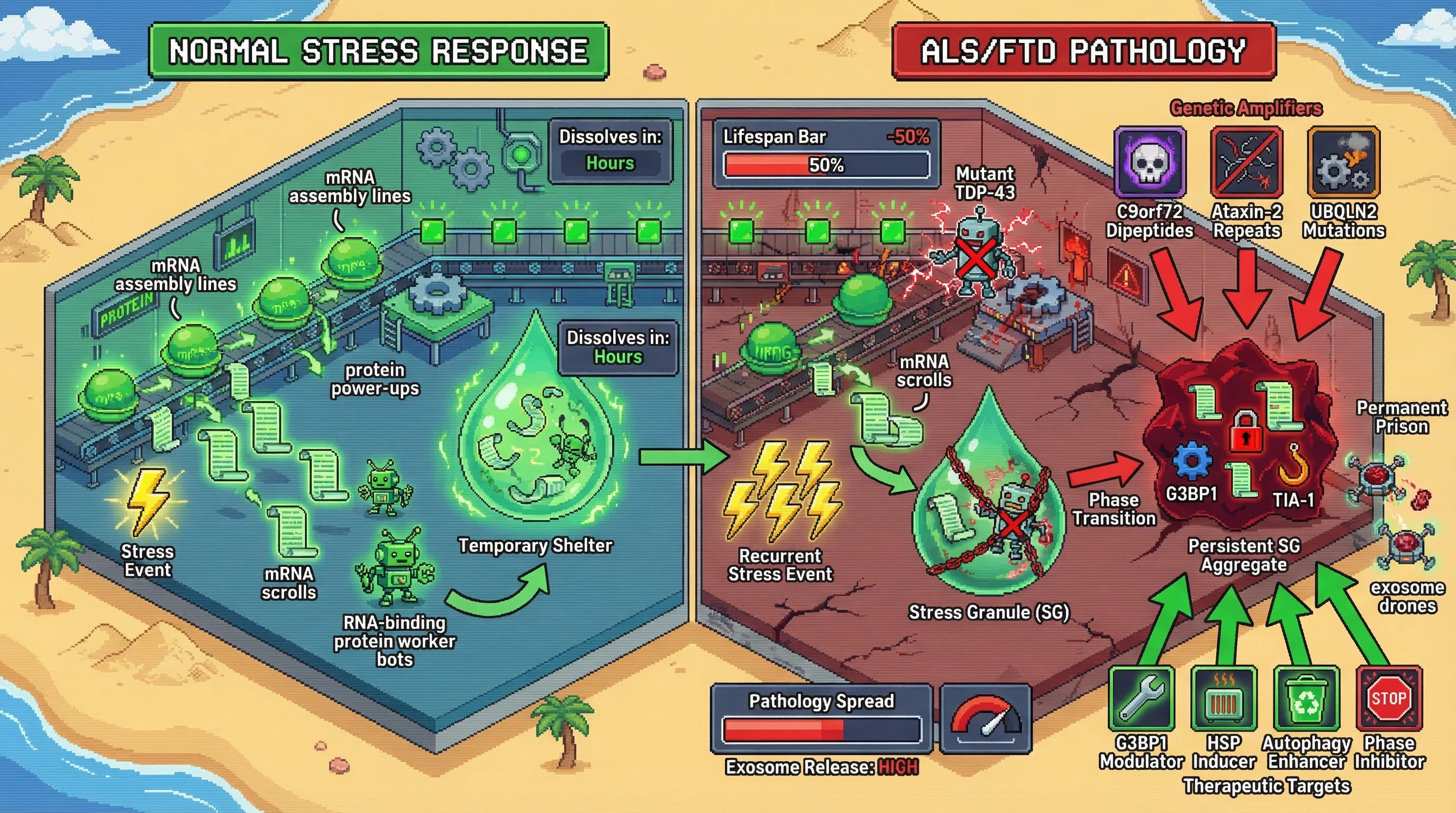
The Foundational Concept: Stress granules are temporary shelters cells stash mRNA during emergencies, then disband when danger passes. Mutant TDP-43 turns these shelters into permanent prisons, trapping RNA and seeding pathology.
The Mechanism:
Normal Physiology: Under stress (oxidative, heat, ER), translation halts. mRNA exits polysomes and coalesces with RNA-binding proteins into dynamic stress granules protective, reversible, dissolved within hours.
TDP-43 Mutation Effect: ALS-linked TDP-43 mutations (particularly in C-terminal domain) increase its prion-like propensity. Mutant TDP-43 incorporates into stress granules but cannot exit.
Liquid-to-Solid Transition: Stress granules normally exist as liquid droplets dynamic, fusing, dissolving. Mutant TDP-43 drives aberrant phase transition from liquid to hydrogel to solid aggregate.
Persistence: Granules fail to disassemble when stress resolves. They mature into stable inclusions containing TDP-43, RNA, and granule components (G3BP1, TIA-1).
RNA Sequestration: These persistent granules trap thousands of mRNA transcripts particularly those with long, TDP-43-bound 3'UTRs. Essential proteins cannot be synthesized.
Nucleation Sites: Persistent granules become epicenters. Additional TDP-43 recruits, aggregates grow, and pathology spreads to neighboring cells via exosomes.
The Stress Connection:
Repeated stress (excitotoxicity, mitochondrial dysfunction) drives recurrent granule formation
Each cycle risks failed disassembly
Aged neurons clear granules less efficiently
Genetic Amplification:
C9orf72 dipeptides nucleate TDP-43 granules
Ataxin-2 intermediate repeats enhance granule formation
UBQLN2 mutations impair granule clearance
Therapeutic Implications:
G3BP1 modulators promoting granule disassembly
Heat shock protein inducers enhancing refolding
Autophagy enhancers clearing persistent granules
Phase transition inhibitors blocking liquid-to-solid conversion
This reframes ALS/FTD as stress granule coagulopathy temporary shelters become permanent tombs.