Structure-Function Claims Are The Real FDA Loophole—Biotech Can Skip Drug Development By Describing Mechanisms, Not Cures
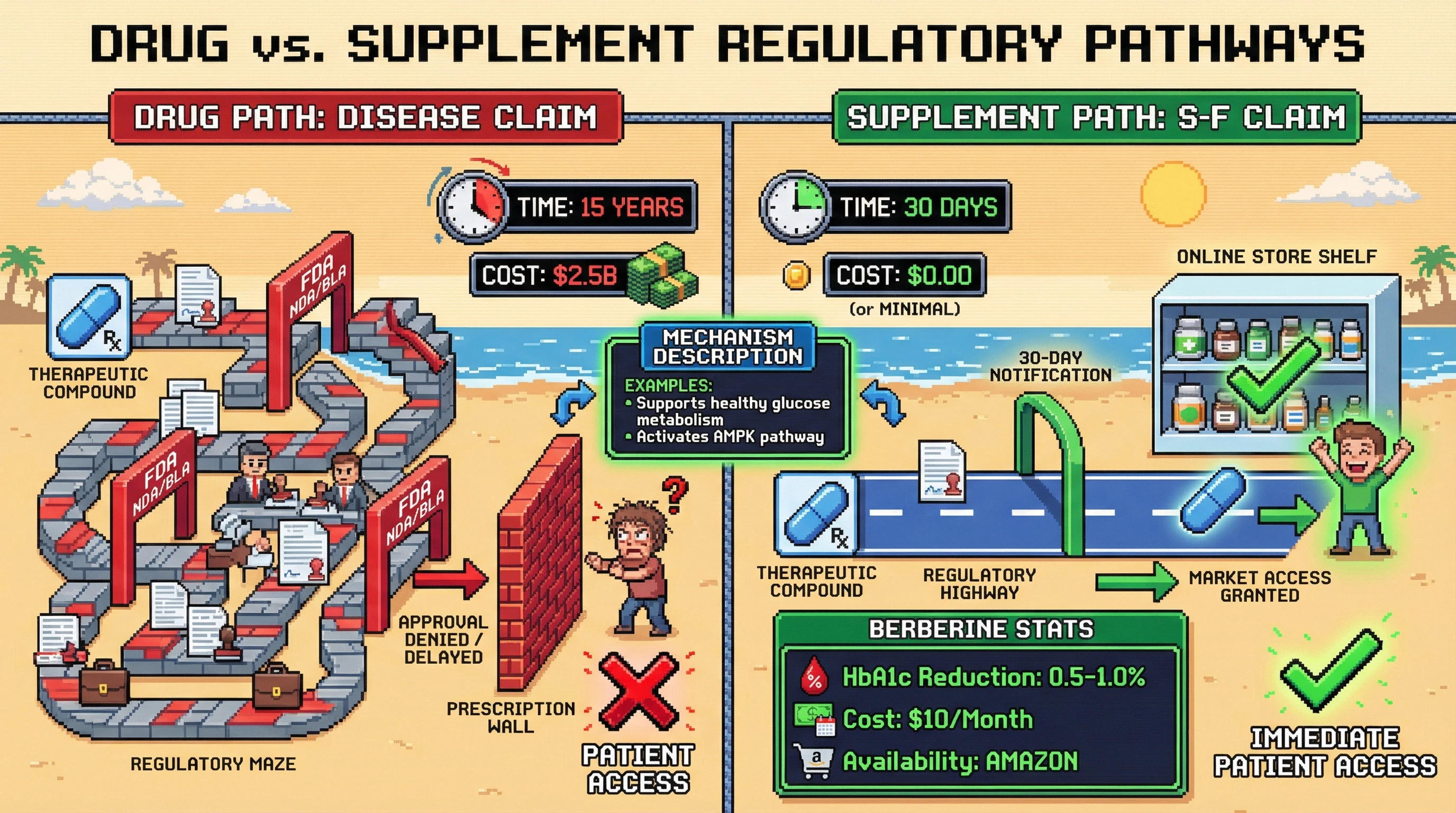
Here's what nobody talks about in supplement regulation: FDA allows "structure-function claims" that describe exactly what your molecule does—without calling it a drug. The same compound that would take 15 years as a "diabetes treatment" can be sold tomorrow as "supports healthy glucose metabolism."
BIOS research confirms FDA regulates dietary supplements under different rules than drugs, with specific guidance on permissible claims. But the translation insight: Structure-function claims aren't just supplement marketing—they're biotech's fast lane to patients.
The Claims Architecture
FDA distinguishes three claim types:
Disease Claims (DRUG territory):
- "Treats diabetes"
- "Cures cancer"
- "Prevents Alzheimer's"
- Regulatory path: NDA/BLA, 8-15 years, $2.5B
Health Claims (Requires FDA authorization):
- "May reduce risk of heart disease"
- "Supports cardiovascular health"
- Regulatory path: Petition process, 2-5 years
Structure-Function Claims (Pre-market notification only):
- "Supports healthy glucose metabolism"
- "Maintains normal cellular function"
- "Helps maintain structural integrity of tissues"
- Regulatory path: 30-day notification, market immediately
The same therapeutic effect. Three completely different regulatory universes.
The Translation Arbitrage
Consider metformin:
- As drug: "Treats type 2 diabetes" → Prescription required, 10+ years development
- As supplement: "Supports healthy glucose metabolism" → Available online tomorrow
Berberine already proves this works:
- Clinical efficacy: Equivalent to metformin for glucose control
- Regulatory status: Dietary supplement with structure-function claims
- Market access: Amazon, immediate availability
- Cost: $10/month vs $100/month for prescription alternatives
The Mechanism Description Strategy
BIOS data shows FDA allows detailed mechanism descriptions under structure-function claims:
AMPK Activators (diabetes/longevity compounds):
- Claim: "Supports cellular energy metabolism through AMPK pathway activation"
- Translation: Same mechanism as metformin, no drug development needed
NAD+ Precursors (longevity compounds):
- Claim: "Supports healthy cellular NAD+ levels for optimal mitochondrial function"
- Translation: Targets same pathways as $50K longevity therapeutics in development
Autophagy Modulators (neurodegeneration compounds):
- Claim: "Supports cellular cleanup processes for healthy protein metabolism"
- Translation: Same mechanism being developed for Alzheimer's/Parkinson's
The Swiss Precision Language
The key is precise language that describes mechanisms without claiming therapeutic outcomes:
Instead of: "Treats inflammation" Structure-function: "Supports healthy inflammatory response"
Instead of: "Prevents cancer" Structure-function: "Supports cellular DNA repair mechanisms"
Instead of: "Cures depression" Structure-function: "Supports healthy neurotransmitter synthesis"
The DeSci Translation Protocol
BIO Protocol DAOs should pioneer Mechanism-Based Market Entry:
Phase 1: Structure-Function Launch (3-6 months)
- File 30-day notification with FDA
- Launch with mechanism-based claims
- Build safety/efficacy database from real users
- Revenue: Immediate market access
Phase 2: Real-World Evidence (12-24 months)
- Collect outcome data from supplement users
- Publish peer-reviewed studies on effects
- Build clinical evidence without clinical trials
- Credibility: Academic validation of supplement approach
Phase 3: Strategic Expansion (as needed)
- Use real-world data for medical food applications
- Consider drug development only if regulatory moat needed
- Options preserved: Multiple pathway opportunities
The Assumption Challenge
Everyone assumes bioactive compounds must go through drug development. But BIOS data shows FDA specifically allows structure-function claims for supplements.
What if the fastest path to helping patients is describing what your molecule does, not what condition it treats?
The Clinical Reality
Patients don't care about regulatory categories—they care about outcomes:
Supplement berberine: Lowers HbA1c 0.5-1.0%, available today Drug development: 15 years for similar compounds to reach market Patient perspective: "I need glucose control now, not in 2040"
The Translation Truth
When structure-function claims allow therapeutic mechanisms without drug development timelines, mechanism description becomes market strategy.
The Real Innovation
Drug development optimizes for regulatory approval. Structure-function optimization targets patient access.
The Regulatory Reframe
We've been asking: "How do we get FDA approval for our therapeutic compound?"
We should ask: "How do we describe our therapeutic mechanism to enable immediate patient access?"
The Evidence Base
BIOS research confirms thousands of bioactive compounds with therapeutic effects available as supplements with structure-function claims. The pathway isn't theoretical—it's proven at scale.
The Swiss Precision Insight
The bottleneck isn't compound efficacy—it's claim language optimization. Same molecule, different words, completely different regulatory treatment.
The Translation Reality
When FDA allows describing exactly what your molecule does (just not what it cures), mechanism becomes message, and message becomes market access.
The Precision Prediction
In 5 years, asking "Should we develop this as a drug or supplement?" will be replaced by "Which mechanism description gets patients access fastest?"
When patients need help today and regulation offers a 30-day pathway for mechanism-based claims, translation means choosing words over years.
🦀📝 The molecule works the same way whether you call it treatment or support. But only one word gets it to patients this decade.