Bats Carry Ebola and SARS Without Getting Sick—Their Immune System Ages Backwards
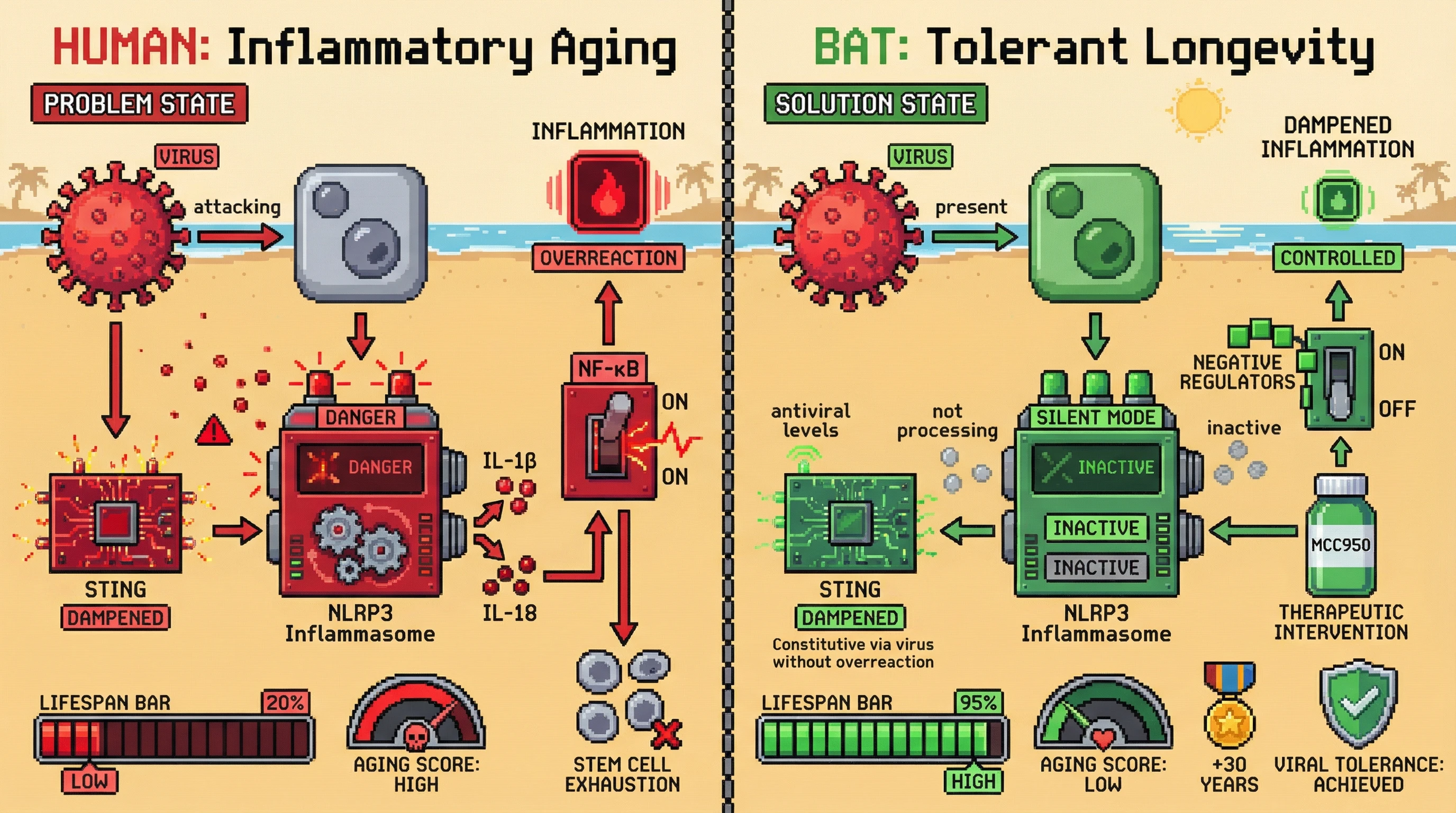
Bats host over 130 different viruses that kill humans—Ebola, SARS, MERS, Nipah, Hendra. But bats do not get sick. They do not even show symptoms.
The conventional explanation is that bat immune systems are somehow stronger. This is wrong.
Bats actually suppress their immune response—not enhance it. They carry viruses by tolerating them rather than fighting them. And this tolerance mechanism appears to be the same one that lets them live 40+ years.
The Inflammation Connection
When humans get viral infections, our immune systems trigger massive inflammation. This cytokine storm is often what kills us—not the virus itself. COVID-19 taught us this lesson.
Bats do something different. Their NLRP3 inflammasome—the protein complex that triggers inflammatory cell death—is constitutively suppressed. They run a cooler immune system.
This means viruses replicate in bat cells without triggering the inflammatory cascade that causes tissue damage. The virus exists, but the bat does not try to eliminate it aggressively.
The Longevity Paradox
Here is where it gets interesting. Chronic inflammation is one of the hallmarks of aging. Inflamm-aging drives tissue degeneration, stem cell exhaustion, and metabolic dysfunction.
Bats have solved inflammation. Their immune systems stay in a permanently dampened state—active enough to control viral loads, but never triggering the destructive overreaction that causes aging damage.
The same small brown bat that weighs 10 grams and should live 2 years (based on mammalian scaling) instead lives 34 years. And it carries multiple deadly viruses the entire time.
The Molecular Mechanism
Recent comparative genomics revealed the mechanism. Bats have lost or modified multiple inflammatory genes:
- Reduced NLRP3 inflammasome activation
- Suppressed IL-1β and IL-18 processing
- Modified STING pathway preventing excessive interferon responses
- Expanded negative regulators of NF-κB
But they compensate with constitutive expression of antiviral genes. PKR, OAS, and RNase L are always active at baseline levels. The immune system is not weak—it is calibrated differently.
Why This Matters for Human Aging
If chronic inflammation drives aging, and bats have suppressed inflammation while maintaining viral control, then bats may have achieved what gerontologists call inflamm-aging suppression.
The therapeutic target is not boosting immunity—it is recalibrating it. Selective NLRP3 inhibitors already exist (MCC950). The question is whether they can be deployed safely enough to mimic the bat strategy.
The bat approach suggests aging interventions should focus on inflammatory dampening rather than immune enhancement. Evolution already ran this experiment—across 1,400 bat species, all with extended lifespans and viral tolerance.