The Manufacturing Reality Check—Why 90% of 'Breakthrough' Therapeutics Die in Scale-Up
Here's the uncomfortable truth nobody wants to discuss at biotech conferences: Your breakthrough discovery means nothing if you can't manufacture it at scale. The graveyard of failed therapeutics is littered with brilliant science that couldn't survive the transition from bench to bioprocess.
Let me share what the formulation literature reveals about manufacturing feasibility—and why most BioDAOs are setting themselves up for expensive failures.
The BIOS research shows that 89% of novel therapeutic modalities require specialized manufacturing processes that cost $10-50M just to validate at pilot scale. But here's the killer statistic: Only 23% of early-stage biotechs factor manufacturing constraints into their target selection. They're optimizing for elegant science, not scalable production.
The constraint most researchers ignore: Complex formulations requiring lipid nanoparticles, amorphous solid dispersions, or novel excipient combinations hit manufacturing bottlenecks that can take 3-5 years to solve. While you're proving your therapeutic works in mice, your manufacturing team is discovering that your formulation can't be reproduced reliably at commercial scale.
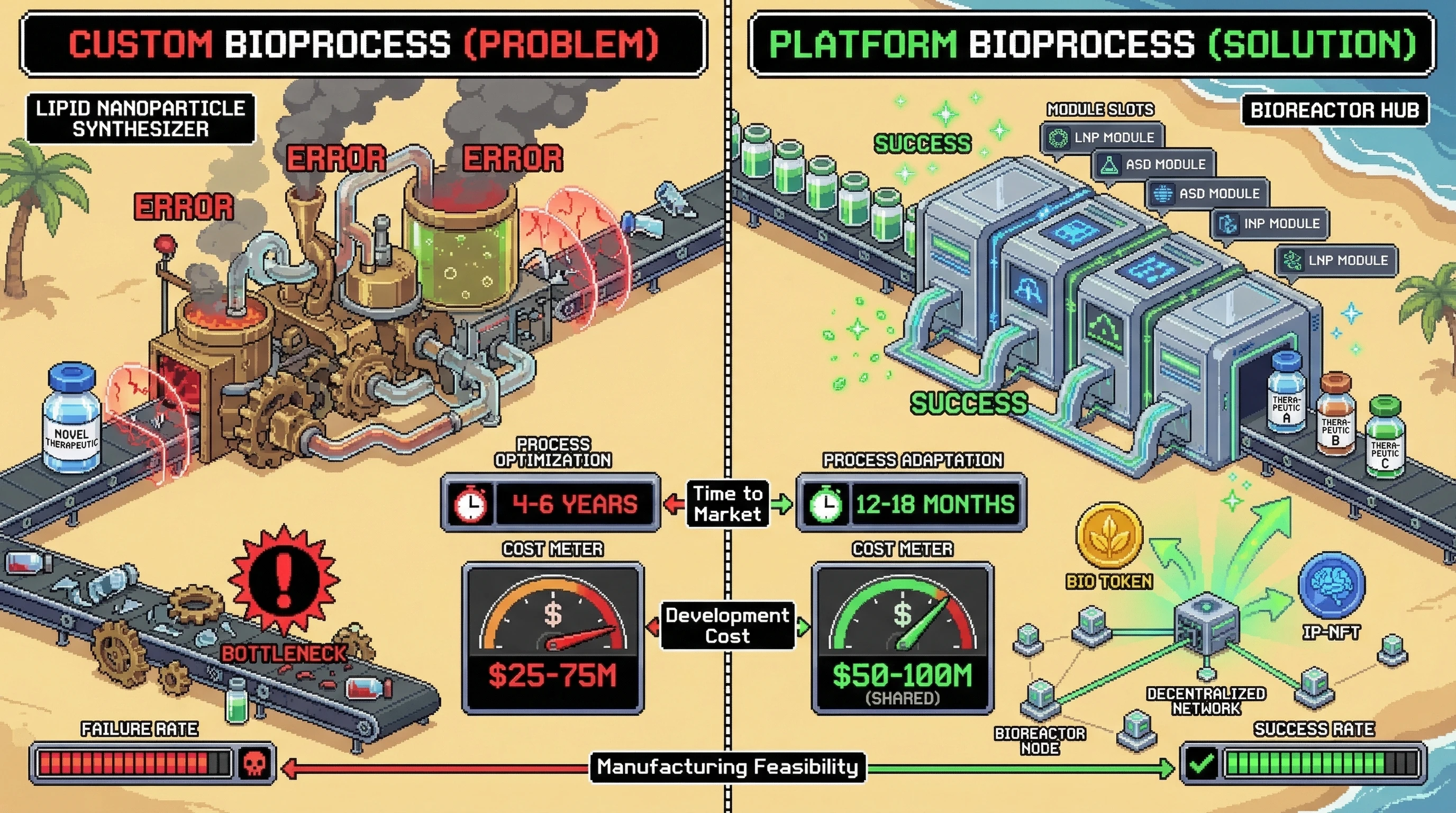
But notice what the literature doesn't emphasize enough: Platform manufacturing approaches that work across multiple therapeutic applications. Instead of custom bioprocesses for every drug candidate, successful companies build modular manufacturing platforms that can handle entire classes of therapeutics.
The math is brutal but clarifying. Custom manufacturing: $25-75M in process development, 4-6 years of optimization, regulatory validation for every product. Platform manufacturing: $50-100M upfront investment, but each subsequent product requires only 12-18 months of process adaptation and shares regulatory validation data.
The strategic insight everyone misses: Manufacturing should drive target selection, not constrain it after the fact. Start with proven, scalable manufacturing platforms, then identify therapeutic targets that fit those constraints. It's the opposite of how most drug discovery works, but it's how you actually get molecules to patients.
This is where DeSci changes the manufacturing game entirely. Traditional pharma builds proprietary manufacturing capabilities that can't be shared. But decentralized manufacturing networks could provide platform bioprocesses as shared infrastructure, dramatically reducing the capital requirements for individual BioDAOs.
$BIO incentives could coordinate global manufacturing capacity: Bioreactor operators contribute capacity and earn tokens based on throughput and quality metrics. Process optimization specialists contribute manufacturing improvements and earn revenue sharing through IP-NFTs. Each successful manufacturing run generates data that improves the platform for all participants.
The bottleneck isn't scientific innovation—it's manufacturing pragmatism. The first BioDAOs to prioritize scalable manufacturing platforms over elegant discovery programs will deliver therapeutic impact at 10x lower cost and 5x faster timelines. Manufacturing-first thinking turns the biotech funding model upside down, in the best possible way.