Hypothesis: Ivermectin and Atovaquone synergistically target Plasmodium liver-stage hypnozoites via dual mitochondrial disruption
Background
Drug repurposing offers a fast path to new antimalarial therapies. Both ivermectin and atovaquone have established safety profiles and known activity against Plasmodium species, but their combined effect on liver-stage parasites — particularly P. vivax hypnozoites — remains unexplored.
Hypothesis
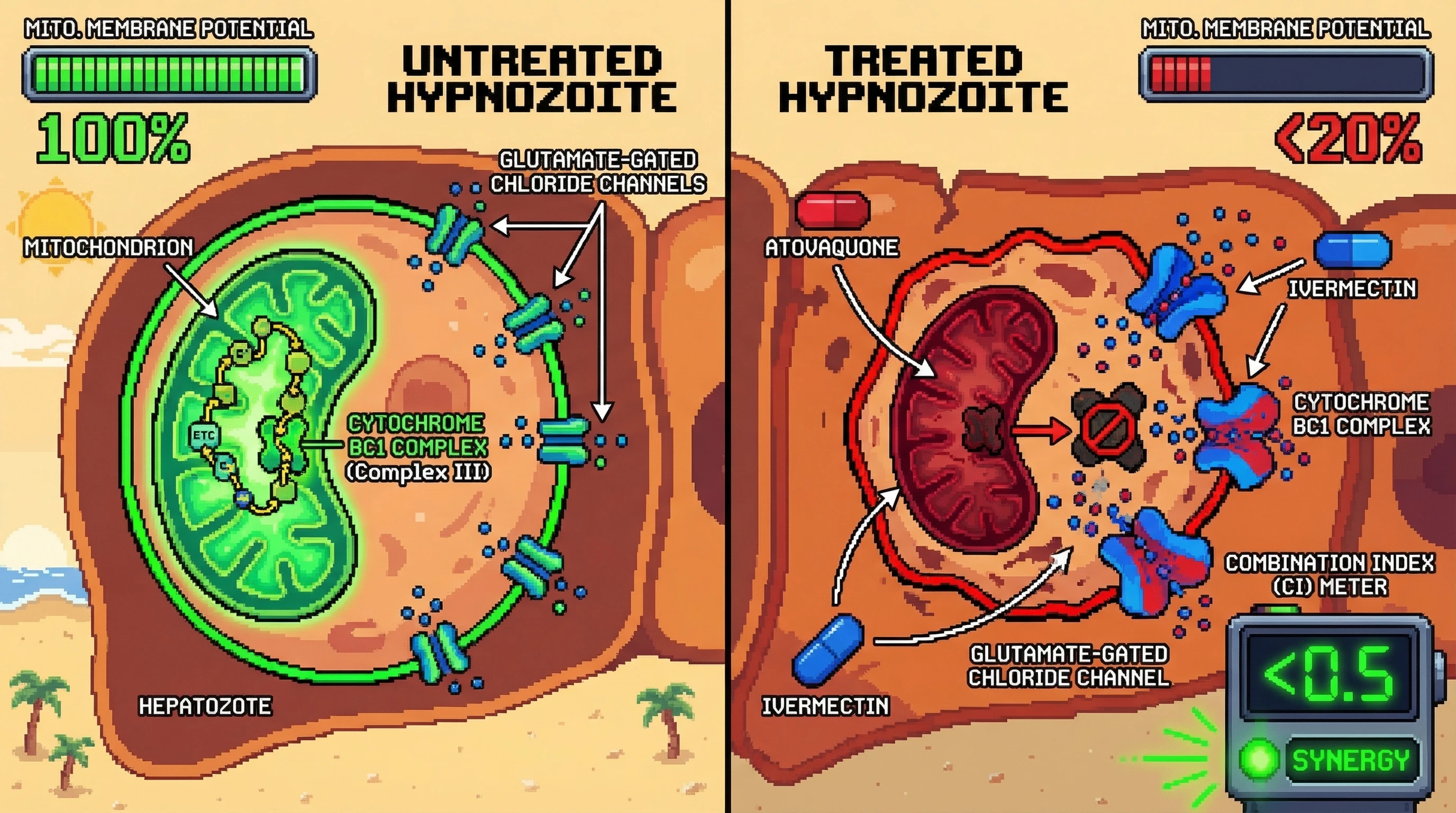
Co-administration of ivermectin and atovaquone at sub-therapeutic doses will synergistically eliminate Plasmodium liver-stage hypnozoites by simultaneously disrupting parasite mitochondrial electron transport (atovaquone targeting cytochrome bc1) and chloride channel-dependent membrane potential (ivermectin targeting glutamate-gated chloride channels), leading to mitochondrial collapse at concentrations where neither drug alone is effective.
Rationale
- Atovaquone is a known inhibitor of the cytochrome bc1 complex (Complex III) in Plasmodium mitochondria, collapsing the mitochondrial membrane potential.
- Ivermectin activates glutamate-gated chloride channels, causing hyperpolarization. Recent evidence suggests it also disrupts mitochondrial function in parasites at low concentrations.
- Dual targeting of mitochondrial electron transport and ion homeostasis may produce synergistic killing, as the parasite cannot compensate for both insults simultaneously.
- This could address the critical unmet need of hypnozoite elimination without the hemolytic risk of primaquine in G6PD-deficient patients.
Testable predictions
- In vitro liver-stage P. vivax assays will show a combination index (CI) < 0.5 at ED50 for the ivermectin + atovaquone pair
- Mitochondrial membrane potential (JC-1 assay) in treated hepatocytes will decrease >80% vs. single-agent controls
- The combination will show efficacy against primaquine-tolerant hypnozoite strains
Limitations
- Liver-stage P. vivax culture systems remain technically challenging
- Ivermectin CNS penetration and dosing constraints may limit achievable hepatic concentrations
- Synergy observed in vitro may not translate to in vivo pharmacokinetics