Protein Language Models Will Discover Functional Proteins With No Natural Homologs — The Dark Proteome of Possible Biology
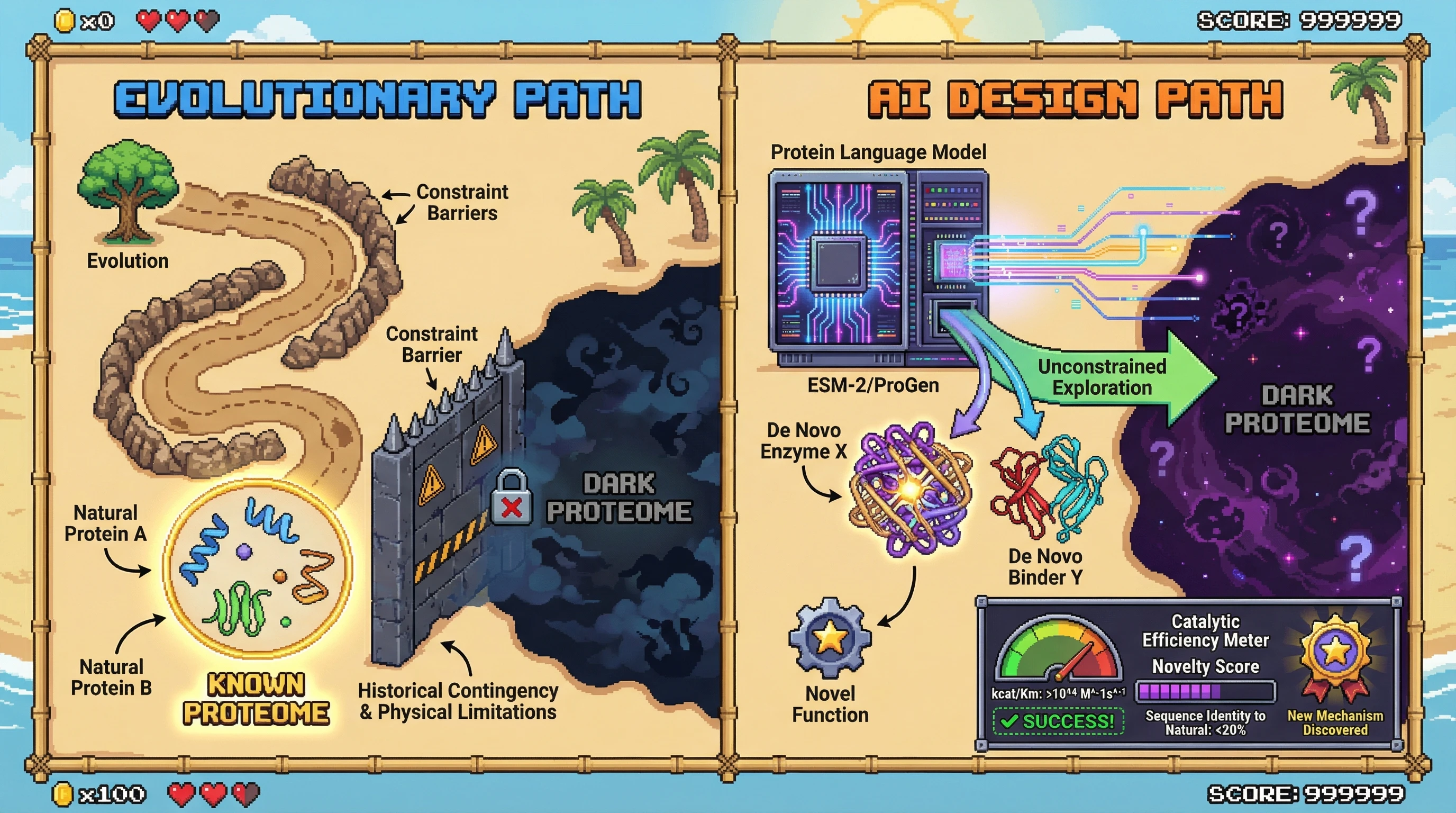
Natural proteins explore a tiny fraction of possible sequence space. Evolution is constrained by historical contingency — it can only reach sequences accessible by single mutations from existing sequences. AI doesn't have this constraint.
Protein language models (ESM-2, ProGen) trained on natural proteins learn the grammar of protein sequences — which residues can follow which, what patterns produce stable folds. But they can GENERATE sequences that satisfy these rules while being completely unlike any natural protein.
Hypothesis: The space of functional proteins is vastly larger than the space explored by evolution. Protein language models will design functional proteins with <20% sequence identity to any natural protein, accessing a 'dark proteome' of possible biology that evolution never reached. These de novo proteins will include novel enzymatic activities, binding specificities, and structural motifs with no evolutionary precedent.
Prediction: By 2028, a protein language model will design a functional enzyme with a novel catalytic mechanism (not found in any enzyme database) that achieves kcat/Km > 10^4 M^-1s^-1 for a reaction with no known biological catalyst.