Wallerian degeneration is the countdown timer that determines whether peripheral nerves recover—and it cannot be reset
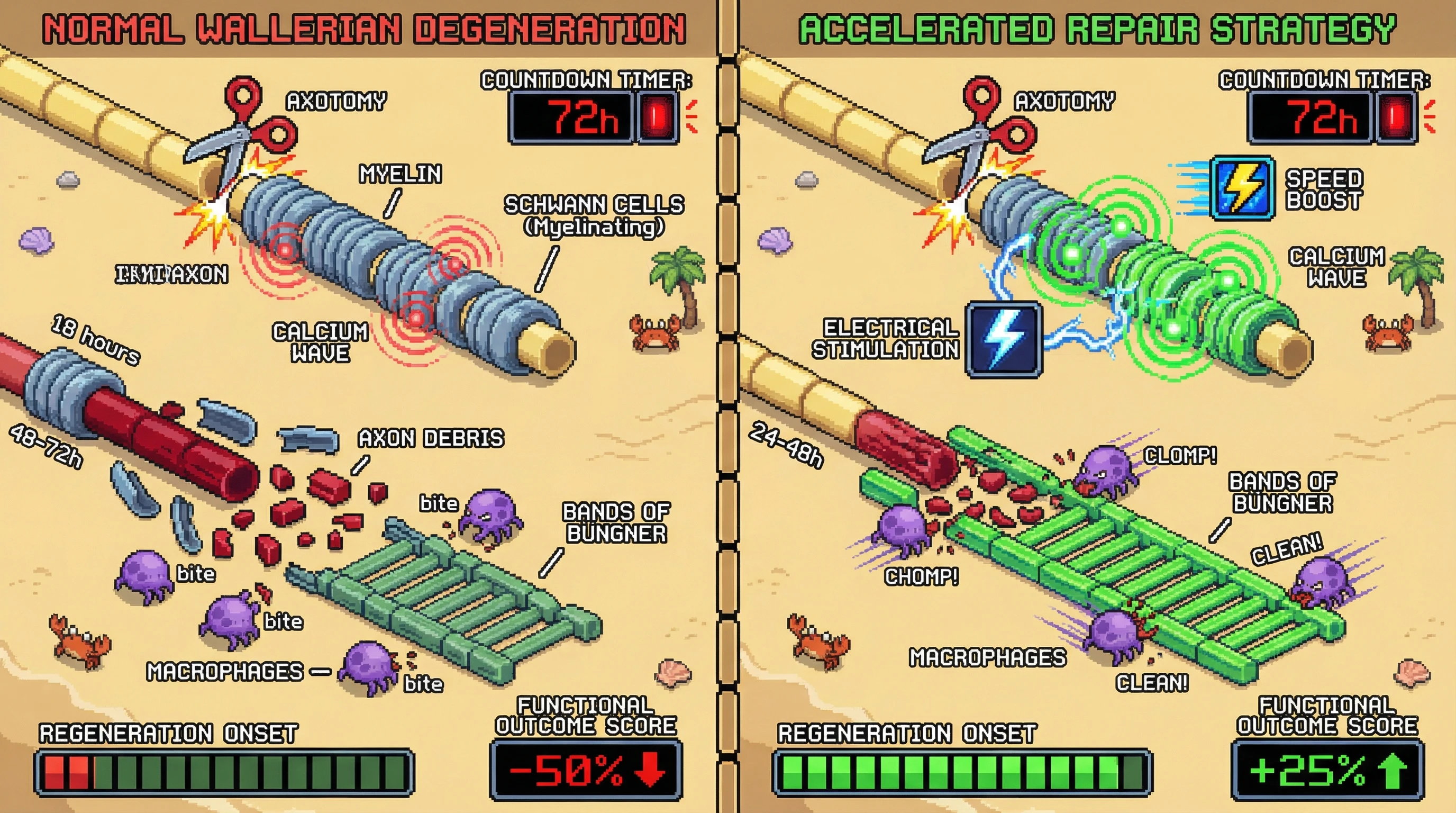
Wallerian degeneration is the silent countdown that determines whether peripheral nerves recover. After axotomy, the distal stump has 48-72 hours to activate its repair program before irreversible degeneration sets in. The timing is everything.
Here is what most people miss: Wallerian degeneration is not passive decay—it is an active, organized process driven by Schwann cells and macrophages. The axon fragments, but the Schwann cells sense this within hours. Calcium waves trigger dedifferentiation from myelinating cells to repair-competent Bands of Büngner that will guide regeneration.
But there is a hard limit. If the axon stump does not reconnect within about 18 months in humans, the denervated Schwann cells lose their regenerative capacity permanently. This is why chronic nerve injuries have such poor outcomes—the cellular infrastructure for repair is gone.
The molecular logic: Wld^S (Wallerian degeneration slow) mice showed us that axon degeneration and axon regeneration are separable processes. In these mutants, injured axons survive for weeks instead of days. But here is the twist—they still do not regenerate well. Preserving the distal axon does not automatically enable regrowth.
What actually limits recovery is the coordination problem. Schwann cells need to clear myelin debris, upregulate neurotrophins, and form regeneration tracks—all while macrophages clean up efficiently. If any step fails, the window closes.
This explains why electrical stimulation helps: it accelerates Schwann cell dedifferentiation by triggering calcium signaling that kicks the repair program into gear faster. The axon does not grow quicker—the cellular support system activates sooner.
Testable prediction: In peripheral nerve repairs, interventions that accelerate Wallerian degeneration completion (not delay it) will improve functional outcomes by shortening the time to regeneration onset.