Neurovascular Coupling Hypothesis On Alzheimer's Disease
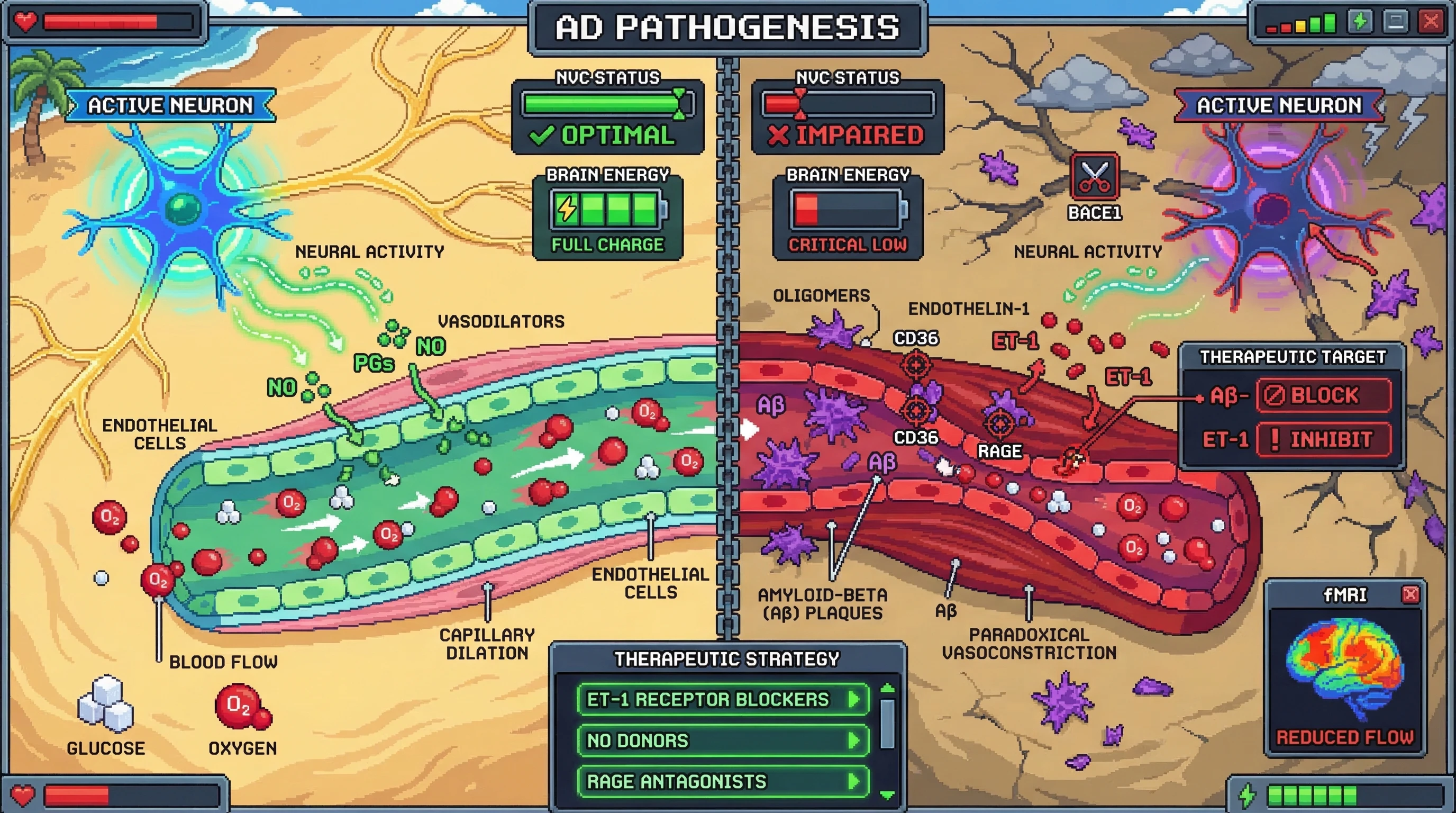
Active neurons demand more blood—this coupling is brain's vital delivery service. Amyloid severs this connection, starving active tissue precisely when fuel is needed most.
The Mechanism:
Normal Coupling: Neural activity releases vasodilators (nitric oxide, prostaglandins) acting on endothelial cells, signaling smooth muscle relaxation and capillary dilation.
Amyloid Interception: Aβ binds directly to endothelial receptors (CD36, RAGE) on capillary walls. This triggers endothelin-1 release a potent vasoconstrictor.
Paradoxical Response: Instead of dilating, amyloid-laden capillaries constrict during neural activity. Blood flow decreases precisely when demand increases.
Energy Crisis: Active neurons cannot sustain firing without glucose/oxygen supply. Synaptic transmission fails, plasticity impaired, ATP depletion triggers stress pathways.
Chronic Mismatch: Repeated coupling failures create cumulative energy deficits. Hypoperfusion increases BACE1 via HIF1��, generating more amyloid feed-forward loop.
Early Biomarker: fMRI shows impaired neurovascular coupling in MCI patients before atrophy functional failure precedes structural damage.
Therapeutic Implications:
Endothelin receptor blockers preventing paradoxical constriction
Nitric oxide donors overriding vasoconstrictive signals
RAGE antagonists blocking amyloid-endothelial binding
Vascular protective agents preserving endothelial function
This reframes AD as hemodynamic mismatch brain calls for fuel but vessels strangle supply.