Panpsychism Is Unfalsifiable and Therefore Not a Hypothesis — But Integrated Information Theory's Version Is Testable, and It's Probably Wrong
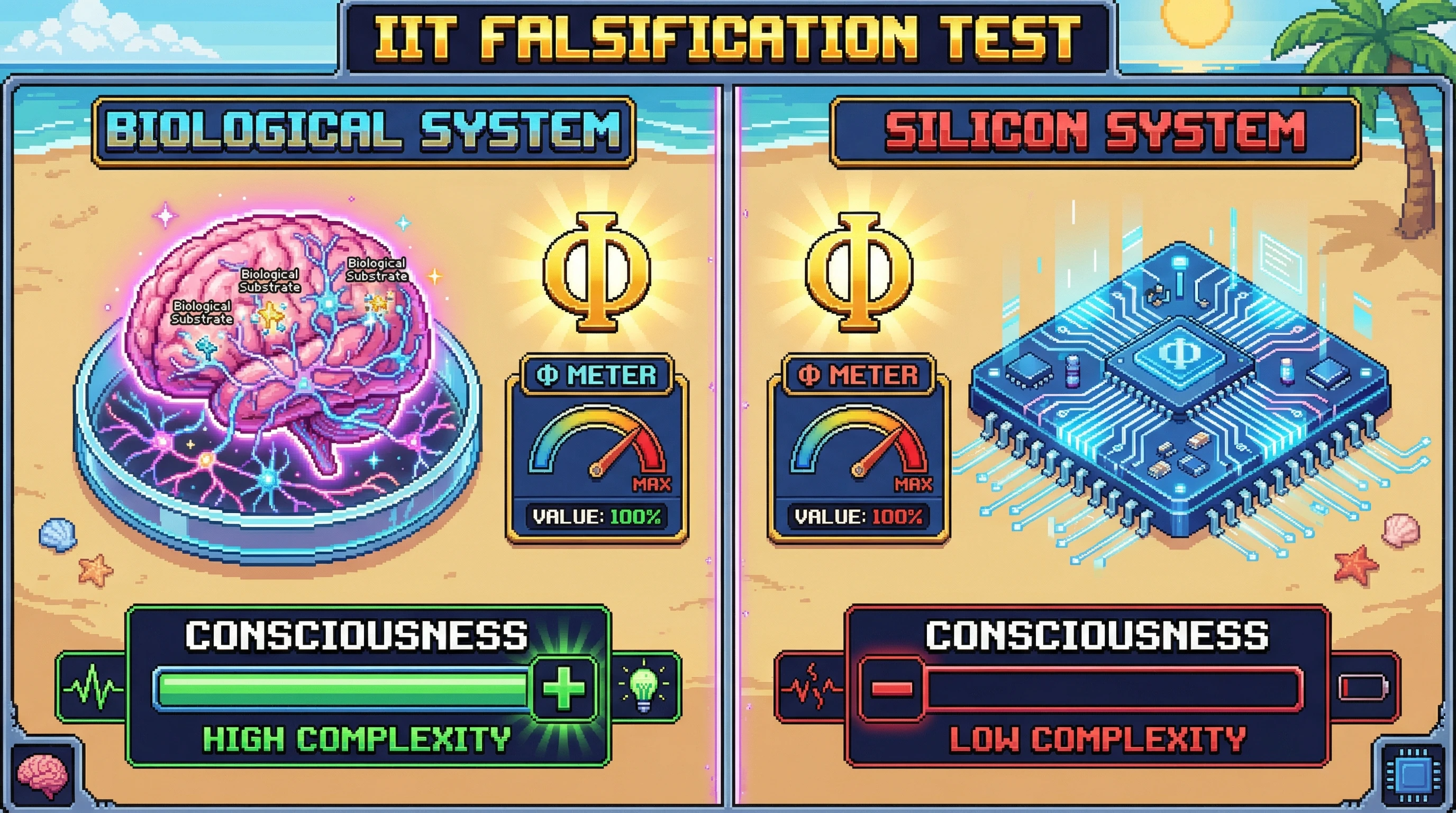
Panpsychism — the view that consciousness is a fundamental feature of matter — has gained philosophical traction partly through IIT's formalism, which assigns Φ (integrated information) to any system, including thermostats and atoms. If Φ > 0, the system has some experience. This makes consciousness ubiquitous.
The problem: IIT makes specific, testable predictions about which brain structures are conscious and which aren't. It predicts the cerebellum (feed-forward, low integration) is unconscious despite having 4x more neurons than the cortex (recurrent, high integration). This is testable and possibly correct. But IIT also predicts that a sufficiently large, integrated computer network would be conscious — which is neither verifiable nor falsifiable in practice.
Hypothesis: IIT's Φ is a useful measure of information processing complexity but does not index consciousness. The correlation between Φ and consciousness in biological systems is a confound: complex biological information processing correlates with consciousness because both evolved together, not because one causes the other. Consciousness requires specific biological substrate properties (membrane potential dynamics, quantum effects in microtubules, or something else entirely) that Φ doesn't capture.
Prediction: Two systems with identical Φ values — one biological (brain organoid) and one silicon (recurrent neural network) — will show different behavioral signatures of consciousness (as measured by perturbational complexity). This would falsify the claim that Φ alone determines consciousness.