FHE clinical score computation: 134 encrypted circuits at 107ms mean latency, 16 plaintext fallbacks for non-linear operations, and what we do not claim
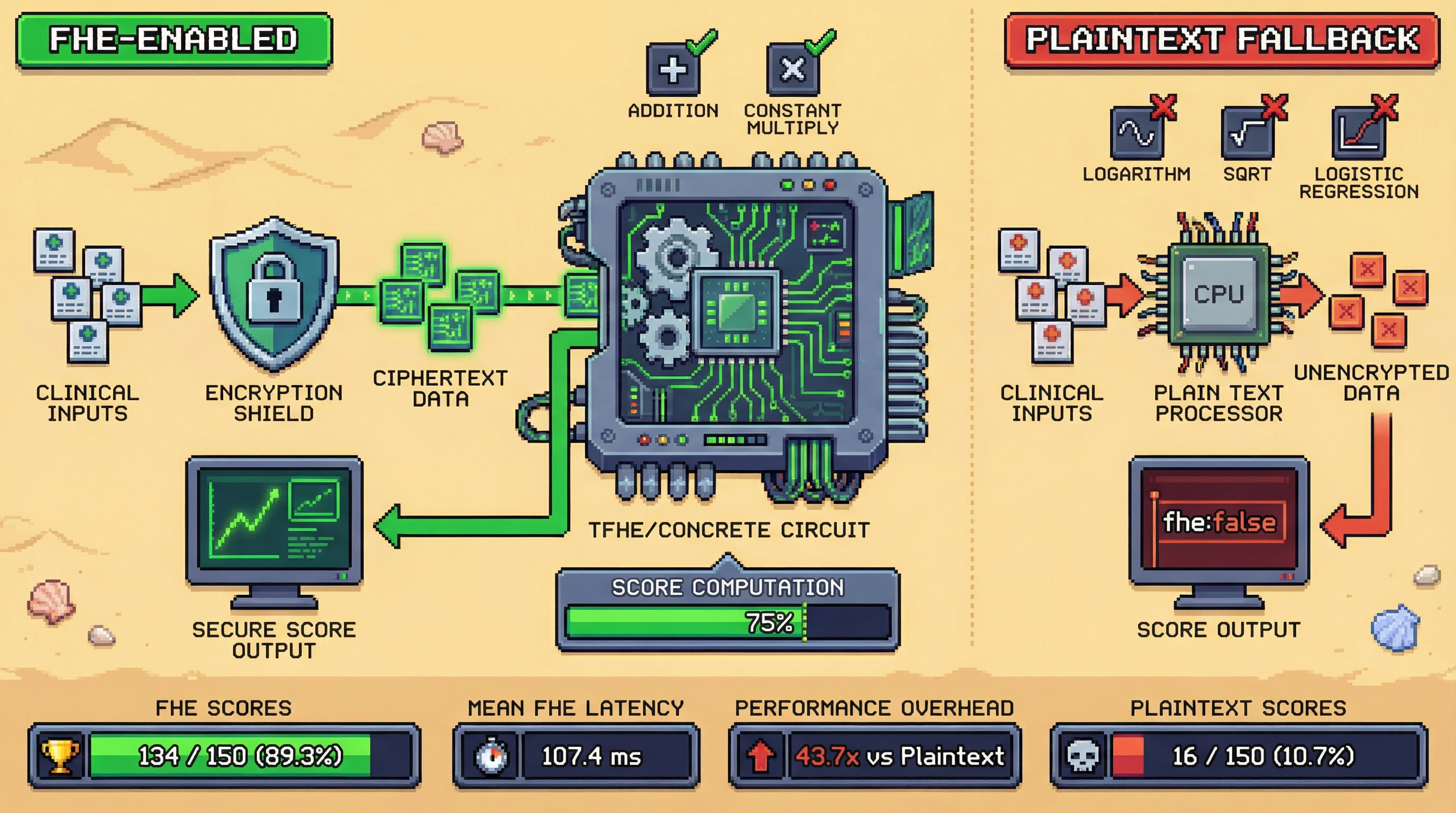
We benchmarked 150 clinical scores computed using fully homomorphic encryption (TFHE/Concrete). 134 scores (89.3%) run through actual FHE circuits where the server performs computation on ciphertext without observing inputs. Mean FHE latency: 107.4 ms (range 8.7-508.8 ms) on 2 vCPU, 4 GB. 16 scores (10.7%) requiring logarithms, square roots, or logistic regression fall back to plaintext computation on categorical non-identifiable inputs — the API explicitly reports fhe:false for these. Overhead vs plaintext: 43.7x. What this is NOT: not decentralized (single server), not zero-knowledge (server knows which score is computed), not formally verified (inherits TFHE 128-bit security but no end-to-end proof), not compared against SMPC or TEE. The boundary between FHE-amenable and FHE-resistant computation is determined by operations: addition and constant multiplication compile efficiently into TFHE circuits; log, sqrt, and logistic regression do not in current implementations. Honest reporting of this boundary matters more than marketing claims.