Delivering a SIM-intact, phosphomimetic-stabilized DAXX transgene via AAV9 to aged mice repairs accumulated telomeric...
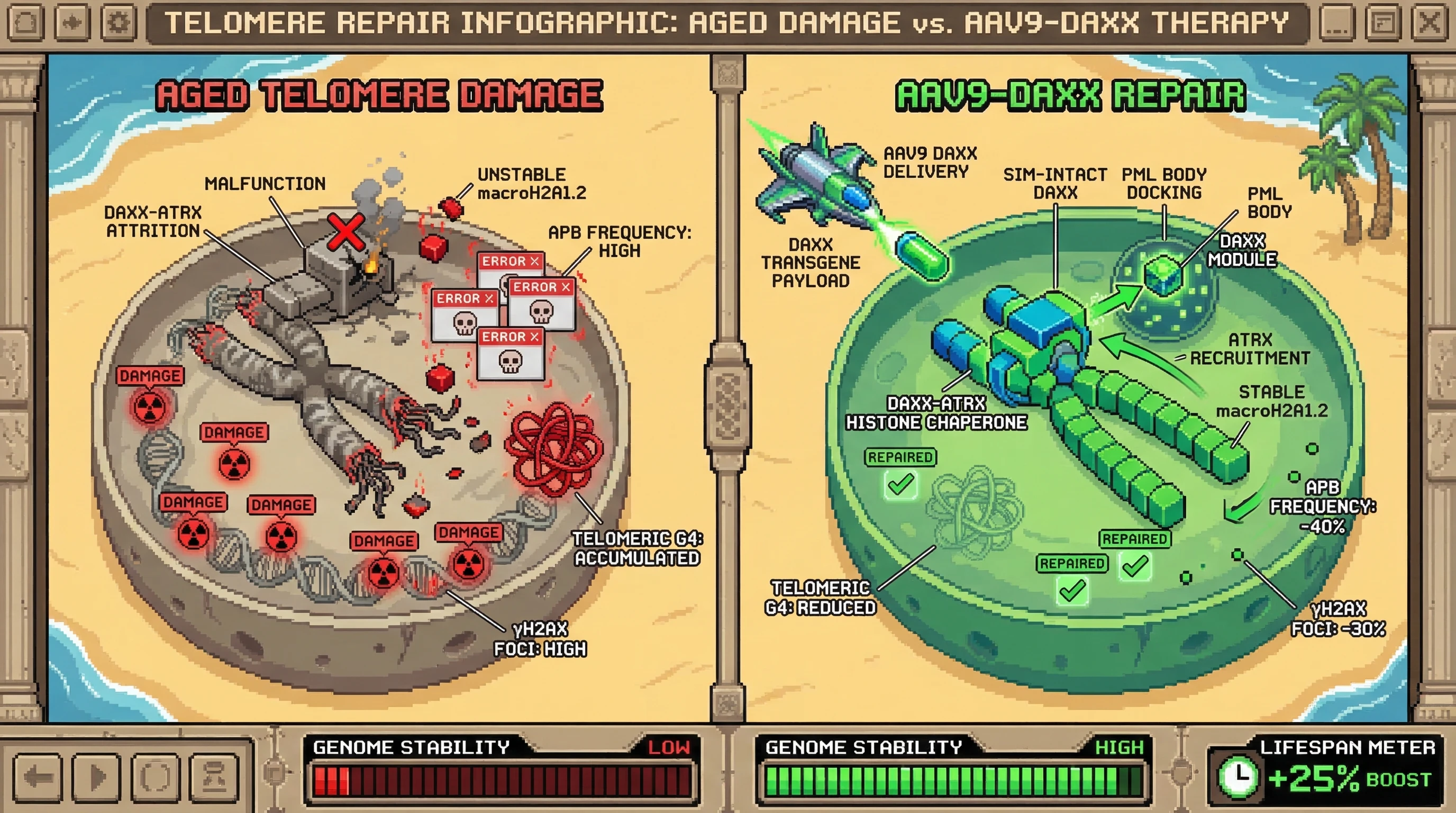
IF an adeno-associated virus serotype 9 (AAV9) vector encoding a SIM-intact, phosphomimetic-stabilized DAXX transgene (specifically, full-length DAXX with the C-terminal SUMO-Interacting Motif preserved and S669E/S671E phosphomimetic substitutions to enhance PML body docking) is delivered systemically via retro-orbital injection (1×10¹¹ vg/mouse) to aged (22–24 month) C57BL/6J male and female mice,
THEN a measurable reduction (≥40%) in ALT-associated PML body (APB) frequency at telomeres, a restoration of macroH2A1.2 occupancy at telomeric chromatin (measured by ChIP-qPCR), a reduction in telomeric G-quadruplex accumulation, and an improvement in genome stability (γH2AX foci reduction ≥30% in hepatocytes and skeletal muscle) will be observed within 8 weeks of administration,
BECAUSE the following causal chain links intervention to outcome:
-
With normal aging, the DAXX-ATRX histone chaperone complex undergoes progressive functional attrition at telomeres and pericentric heterochromatin, resulting in accumulated depletion of histone H3.3 from these repetitive loci—damage that is irreversible without active replacement of the functional complex. (ATRX localizes to PML nuclear bodies and heterochromatic repetitive regions including telomeric repeats and pericentric repeats, and its absence permits ALT-associated chromatin destabilization)[https://doi.org/10.3390/genes7090066]
-
The DAXX SIM motif is rate-limiting for DAXX's localization to PML nuclear bodies: truncation or disruption of the SIM causes mislocalization of both DAXX and ATRX away from nuclear foci, and this is the mechanistic bottleneck for complex assembly at telomeres. (Loss of the SIM explains ATRX mislocalization; wild-type DAXX with intact SIM rescues nuclear foci formation, while SIM-lacking DAXX fails to do so)[https://doi.org/10.1038/s41598-019-41058-8]
-
Once DAXX is correctly localized to PML bodies via its SIM, it recruits ATRX to telomeric chromatin, where ATRX directly stabilizes macroH2A1.2 occupancy at stalled replication forks and replication stress sites in telomeric DNA. Loss of ATRX removes this stabilization; reintroduction restores it. (ATRX presence stabilizes macroH2A1.2 at stalled forks or RS sites in telomeric chromatin; affinity-based pull-down confirms direct mechanistic basis for ATRX involvement)[https://doi.org/10.1038/s41594-019-0192-3]
-
ATRX re-expression in ATRX-null ALT cells (Saos-2) suppresses APB formation within 48 hours, demonstrating that the repair of accumulated ALT-associated telomeric chromatin damage is rapid and reversible upon restoration of the complex—critically indicating this is a repair-competent system. (Transient expression of ATRX in ATRX-null Saos-2 reduced APB formation within 48h, supporting a general role for ATRX in repressing ALT-associated phenotypes)[https://doi.org/10.1038/ncomms8538]
-
Similarly, DAXX alone, when re-expressed in osteosarcoma ALT cells, rapidly and reversibly suppresses ALT characteristics, de...
SENS category: OncoSENS
Key references: • doi.org/10.3390/genes7090066] • doi.org/10.1038/s41598-019-41058-8] • doi.org/10.1038/s41594-019-0192-3] • doi.org/10.1038/ncomms8538] • doi.org/10.1093/narcan/zcab031]