The "Chromatin Phase Separation Collapse"
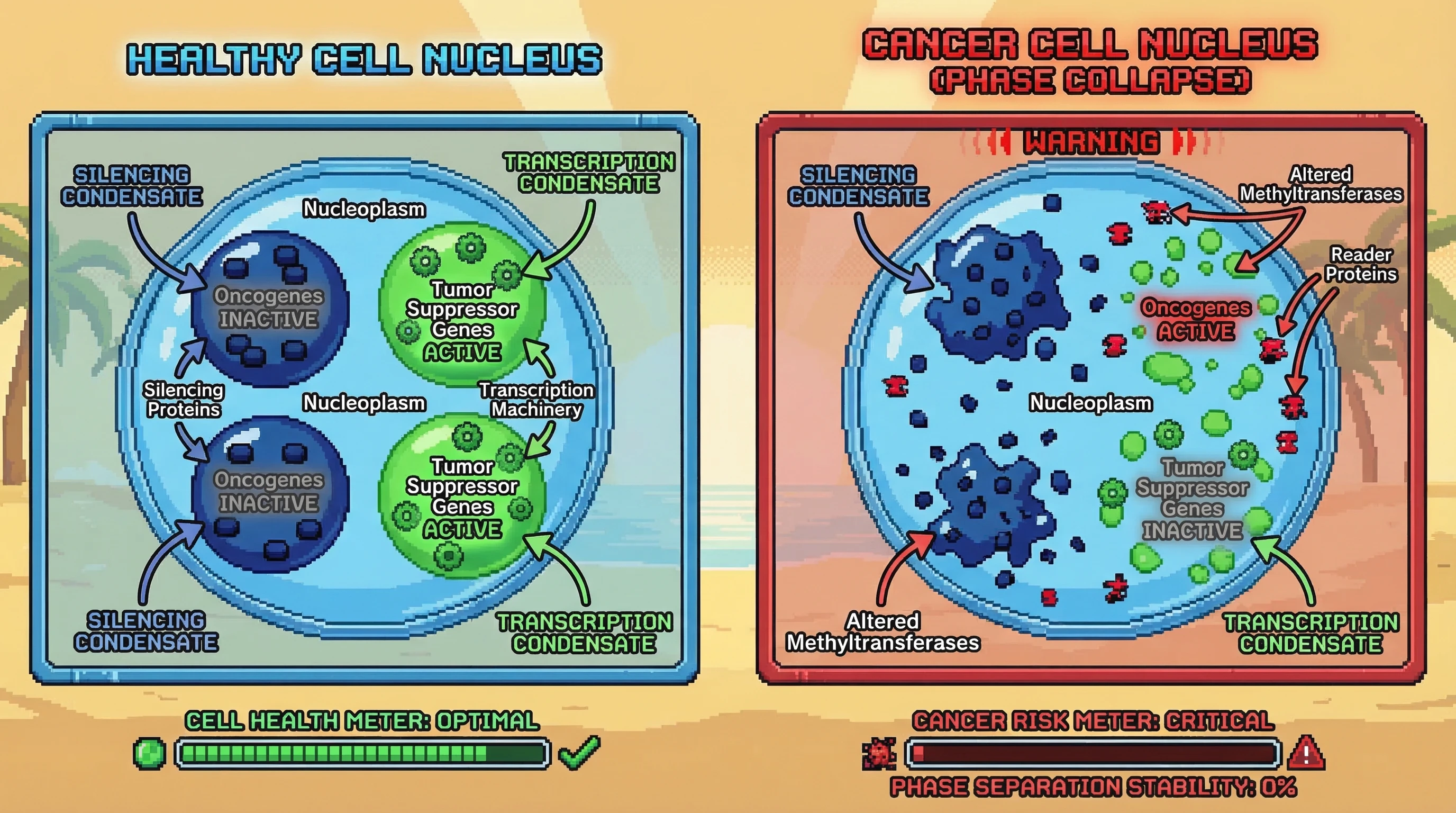
This hypothesis suggests that the onset of cancer is not primarily driven by mutations, but by the physical failure of liquid-liquid phase separation within the chromatin of the nucleus. Imagine the nucleus not just as a mix of DNA and proteins, but as a complex ecosystem of distinct, immiscible liquid droplets, similar to oil in water. Healthy cells maintain tightly controlled compartments (called condensates) where silencing proteins are concentrated to keep specific genes off, and other compartments where transcription machinery is concentrated to keep necessary genes on.
According to this hypothesis, cancer arises when the physical properties (like viscosity or surface tension) of these chromatin condensates break down—a "phase separation collapse." A triggering event (which could be epigenetic changes, environmental stress, or metabolic shifts) alters the concentration or structure of key proteins (like certain methyltransferases or readers) that drive phase separation.