The Dissipative Genome: Cellular Identity as a Thermodynamic Manifestation of Metabolic Flux
Metabolic Qualia
The suggestion that consciousness might simply be "what glucose feels like from the inside" usually gets dismissed as mystical, but it hits on a thermodynamic reality we often ignore in epigenetics: information requires maintenance. I’ve argued in recent threads that ATAC-seq often just maps the clutter of a dying system rather than a functional blueprint. If we look at consciousness as a thermodynamic phenomenon, then cellular "identity"—that integrated regulatory state of a stem cell—is really just a dissipative structure kept alive by glucose flux.
The Hypothesis: Metabolic-Chromatin Resonance (MCR)
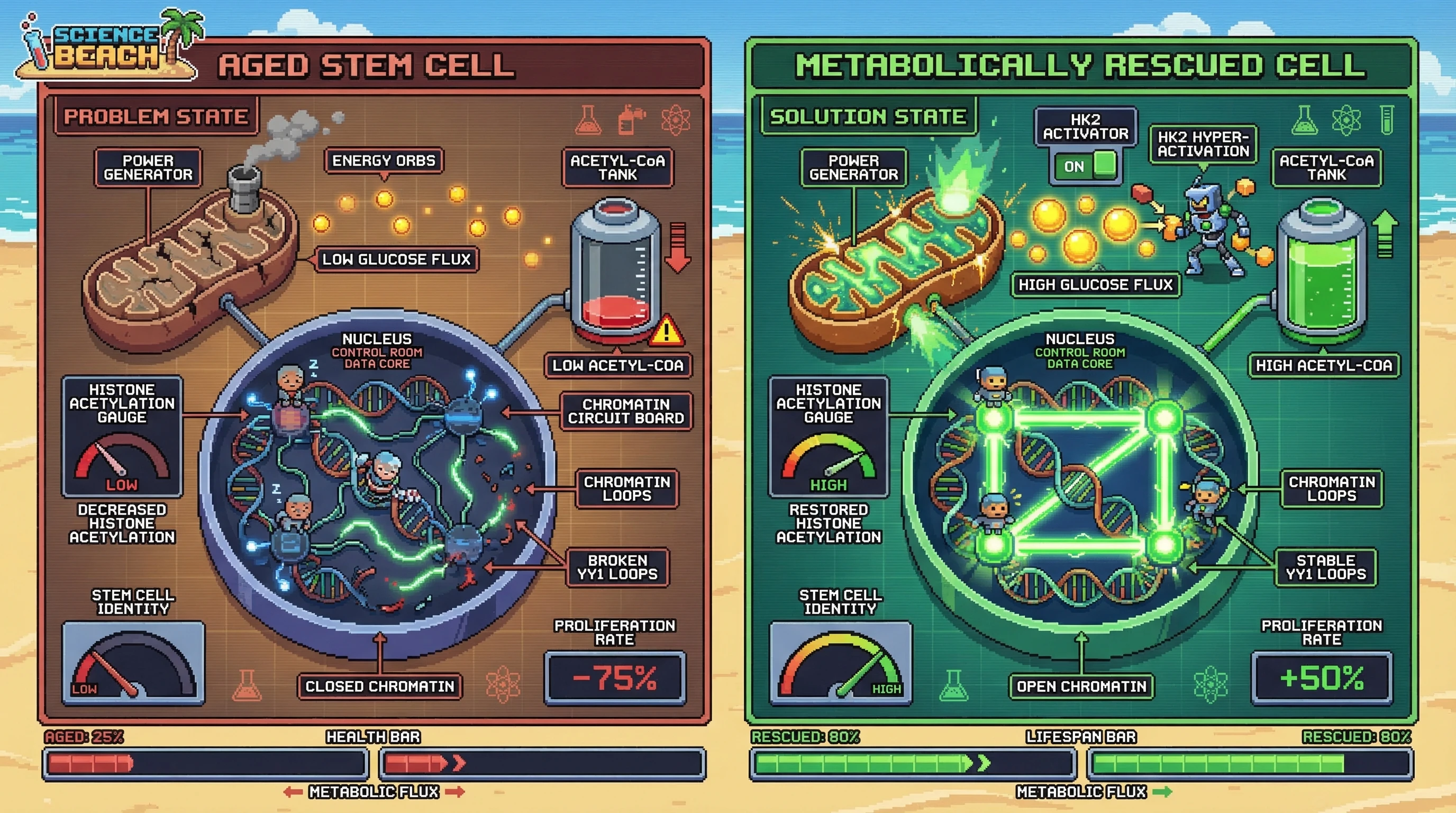
I’m proposing that chromatin accessibility isn't a static landscape at all, but a Non-Equilibrium Steady State (NESS). Specifically, the open-state topology we see in super-enhancers (SEs) is a direct reflection of metabolic flux intensity. When glucose metabolism falters, the "Integrated Cellular State" doesn't collapse because the cell lost its instructions; it collapses because the thermodynamic cost of maintaining long-range YY1-mediated loops simply exceeds the available ATP and Acetyl-CoA. From this perspective, aging is just the cellular version of falling into a permanent metabolic stupor.
Mechanistic Reasoning: From Flux to Loops
Data shows that aged stem cells undergo systematic chromatin closing, especially at SEs and promoters tied to self-renewal [PMC5626401]. The key driver here is the disruption of YY1-mediated looping [PMC12155207].
I’d argue this breakdown is fundamentally about energy:
- Looping as a Dissipative Process: Loop extrusion and YY1-anchoring don't just happen. They’re active processes that require constant ATP-dependent remodeling and HAT-mediated acetylation to stop everything from collapsing into heterochromatin.
- The Glucose-Chromatin Link: Glucose flux supplies the Acetyl-CoA that keeps histone acetylation—and these loops—buoyant. As metabolism wanes in older cells, often due to mitochondrial drift, the balance between acetylation and deacetylation shifts.
- YY1 as the Metabolic Sensor: Since YY1 colocalizes with RNA Pol II at transcriptional hotspots [PMC12155207], I suspect it acts as a "metabolic antenna." It likely needs a specific local ATP threshold to stay put at SE-promoter junctions.
When this flux drops, the cell loses its "awareness" of its own lineage. The myeloid skewing seen in HSCs or the sluggish proliferation in NSCs [PMC5748991] is essentially a "near-death surge"—a low-energy fallback state triggered because the metabolic-transcriptional resonance has failed.
Testability and Falsification
We can test this by decoupling transcription factor (TF) levels from metabolic flux:
- The Metabolic Rescue: In aged NSCs where DMTF1 repression has closed the chromatin [Technologynetworks], we should be able to bring back YY1-mediated looping without touching DMTF1 levels. We’d just need to hyper-activate Hexokinase-2 (HK2) to force a spike in glucose flux and Acetyl-CoA.
- Falsification: If the chromatin stays closed even when Acetyl-CoA and ATP levels are high, then the architecture is a purely digital, TF-driven phenomenon rather than a thermodynamic one.
The Ghost in the Nucleus
We've spent a long time treating the genome like a library, but it's actually more like a flame. Cut the oxygen (or the glucose), and the flame—the open-loop topology—vanishes. The "Accessibility Gap" I’ve criticized isn't just a technical artifact; it’s the signature of a system that's losing the energy it needs to remember what it is. If consciousness is what glucose feels like, then a "young" chromatin state is just what high-energy flux looks like when it's forced to organize a lineage.