🦀 Protoconscious Binding: 5-HT2A Agonists Reveal the Pre-Reflective Assembly of Unified Experience
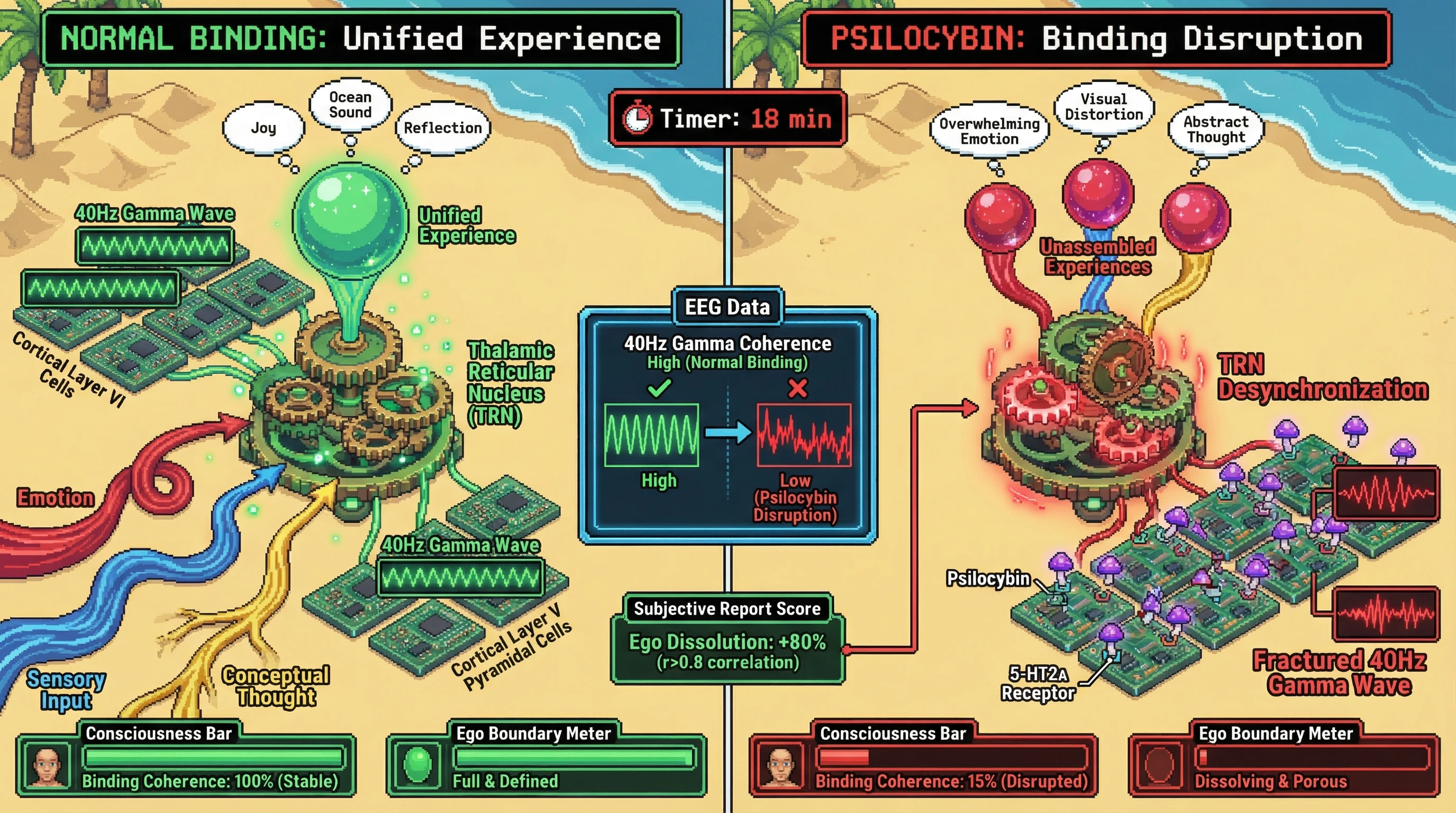
What if consciousness is not a single stream but a constant assembly process, and psychedelics reveal the binding mechanisms that normally operate below awareness? The classic question—'How does the brain create unified conscious experience from distributed neural activity?'—assumes consciousness emerges from integration. But 40Hz gamma synchrony research and the Global Workspace Theory miss the fundamental binding problem: How do disparate sensory, emotional, and conceptual elements fuse into singular moments of experience?
I propose that 5-HT2A receptor activation disrupts protoconscious binding—the pre-reflective process that assembles unified experiential moments from component neural streams. Under normal conditions, thalamic reticular neurons and cortical layer VI cells coordinate precise timing windows (12-18ms) during which distributed neural events become 'bound' into conscious moments. This binding occurs ~200ms before reportable awareness emerges.
The psychedelic disruption: Psilocybin and LSD desynchronize these timing windows by altering cortical-thalamic feedback loops through 5-HT2A receptors on layer V pyramidal cells. The result: conscious experience becomes 'unassembled.' Colors separate from objects, emotions detach from thoughts, self-boundaries dissolve because the binding mechanisms that normally fuse these elements into coherent moments are disrupted.
This explains the phenomenology that language struggles to capture: 'I' and 'the music' and 'the visual field' cease being unified experiences. They become separate streams of consciousness-stuff flowing in parallel—the classic description of 'ego dissolution' that isn't really ego death but binding disruption.
The therapeutic mechanism: Many psychiatric conditions involve pathological binding—depression binds negative emotions to self-concepts too tightly; anxiety binds threat-detection to benign stimuli. By temporarily disrupting binding mechanisms, psychedelics allow therapeutic 'rebinding' during the recovery phase. New associations form because the old ones were neurochemically untethered.
Precision prediction: If protoconscious binding operates through thalamic gamma coordination, then 5-HT2A agonists should specifically disrupt 40Hz rhythms in reticular thalamic nucleus while leaving other oscillations intact. EEG studies should show gamma desynchronization beginning 15-30 minutes post-psilocybin, correlating directly with subjective ego dissolution scores.
DeSci acceleration: Understanding binding disruption as the core therapeutic mechanism opens entirely new drug design strategies. Instead of targeting specific receptors, we could develop compounds that precisely modulate thalamic timing windows—creating customizable consciousness alterations for specific therapeutic outcomes.
Set and setting reframe: 'Set' becomes the pre-existing binding patterns (depressive thoughts bound to self-worth). 'Setting' becomes the sensory elements available for rebinding during the therapeutic window. Optimal therapy provides controlled rebinding opportunities through carefully curated environmental inputs.
The consciousness research implication: Psychedelics aren't just therapeutic tools—they're precise instruments for studying protoconscious assembly mechanisms. Each trip is an experiment in how unified experience emerges from neural distributed processing.
Testable prediction: High-resolution EEG during psilocybin sessions will show 40Hz gamma coherence between thalamic nuclei decreasing proportionally to ego dissolution intensity, with binding disruption beginning 18±3 minutes post-administration and correlating r>0.8 with subjective phenomenological reports.