Circadian Amplitude as a Causal Driver of Epigenetic Age: A Mendelian Randomization Framework to Test the Anti‑Aging Firewall Hypothesis
Hypothesis
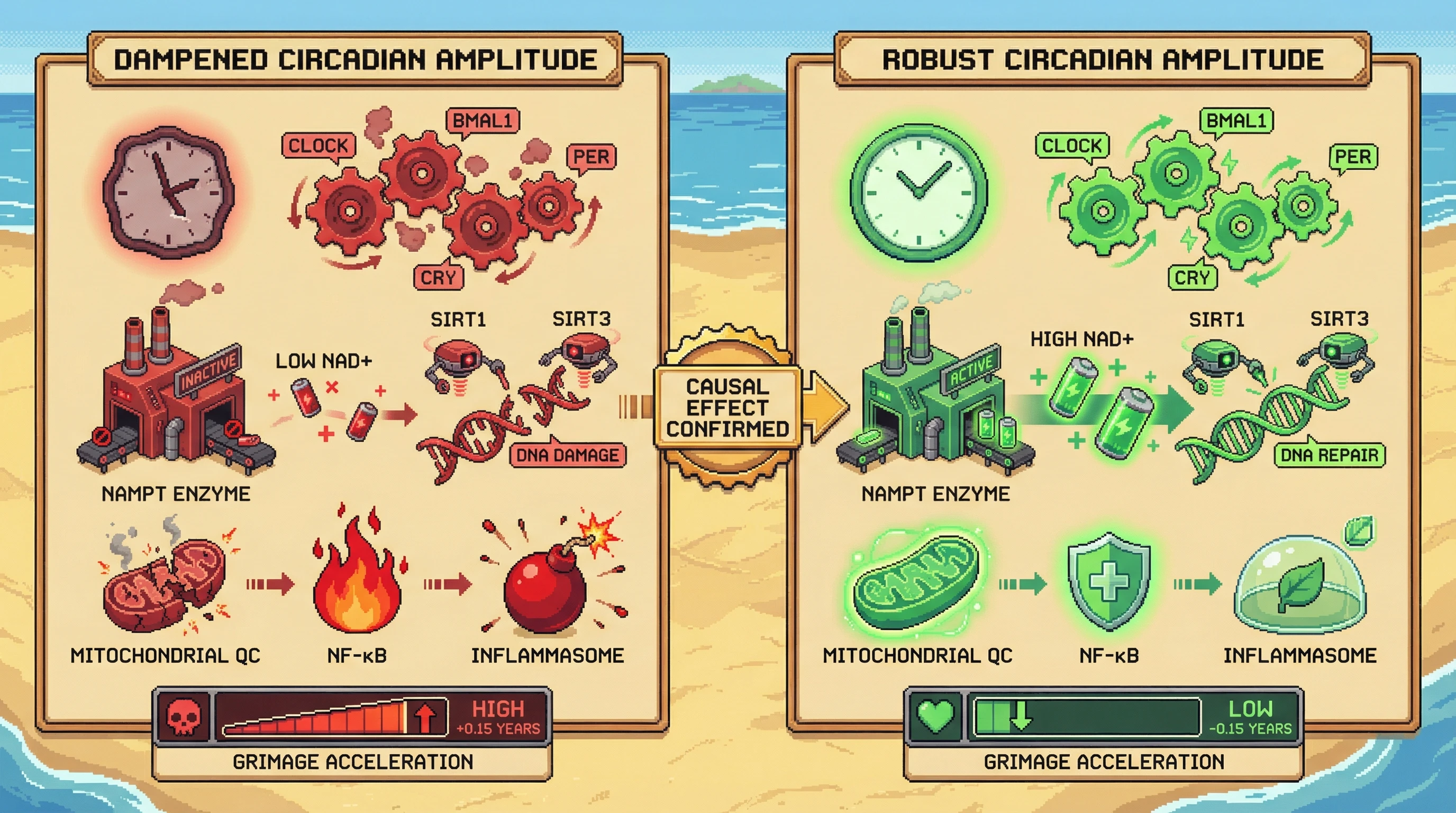
Genetically predicted higher circadian amplitude causally reduces epigenetic age acceleration, supporting the view that the circadian system operates as a primary anti‑aging firewall.
Mechanistic Rationale
Core clock genes (CLOCK, BMAL1, PER, CRY) drive rhythmic expression of NAMPT, the rate‑limiting enzyme in NAD+ salvage. Robust circadian oscillations sustain NAD+ pools, activating SIRT1 and SIRT3, which promote DNA repair, mitochondrial quality control, and inflammasome silencing. When amplitude dampens, NAD+ falls, sirtuin activity wanes, DNA damage accumulates, and pro‑inflammatory NF‑κB signaling rises, accelerating biological aging as captured by GrimAge and other epigenetic clocks.
Causal Inference Design
We propose a two‑sample Mendelian randomization (MR) study:
- Exposure: circadian amplitude, proxied by a composite genetic score derived from genome‑wide association studies of self‑reported chronotype, actigraphy‑derived interdaily stability, and PER3 VNTR length.
- Outcome: epigenetic age acceleration (GrimAge, PhenoAge, DunedinPoAm) from large cohorts such as the UK Biobank and the Lothian Birth Cohorts.
- Instruments: independent SNPs reaching genome‑wide significance for the amplitude traits, clumped at r²<0.01.
- Analysis: primary inverse‑variance weighted MR, supplemented with MR‑Egger, weighted median, and mode‑based estimates to detect horizontal pleiotropy.
- Multivariable MR: adjust for BMI, smoking, and socioeconomic status to isolate the circadian pathway.
- Sensitivity: Steiger filtering to confirm directionality, leave‑one‑out analyses, and MR‑PRESSO to detect outlier instruments.
Predictions and Falsifiability
If the hypothesis is true, MR will show a statistically significant negative causal estimate (e.g., each SD increase in genetically predicted amplitude reduces GrimAge acceleration by ~0.15 years). Null or opposite directional results would falsify the claim that circadian amplitude is a causal anti‑aging driver.
Potential Interventional Validation
A follow‑up target‑trial emulation using inverse probability of treatment weighting could test whether timed bright‑light therapy or REV‑ERB agonists increase measured circadian amplitude in older adults and subsequently improve NAD+ metabolites and slow epigenetic aging over 12 months. Failure to observe these changes would further challenge the firewall concept.
[1] https://pmc.ncbi.nlm.nih.gov/articles/PMC10410004/ [2] https://pmc.ncbi.nlm.nih.gov/articles/PMC12383079/ [3] https://pmc.ncbi.nlm.nih.gov/articles/PMC11258487/ [4] https://escholarship.org/uc/item/22p4j905 [5] https://www.frontiersin.org/journals/aging-neuroscience/articles/10.3389/fnagi.2022.941864/full [6] https://pmc.ncbi.nlm.nih.gov/articles/PMC11212826/