Quantum Semantic Retrieval: corpus-curated PCA quantisation outperforms generic vector compression by 8 percentage points in specialist medical embeddings
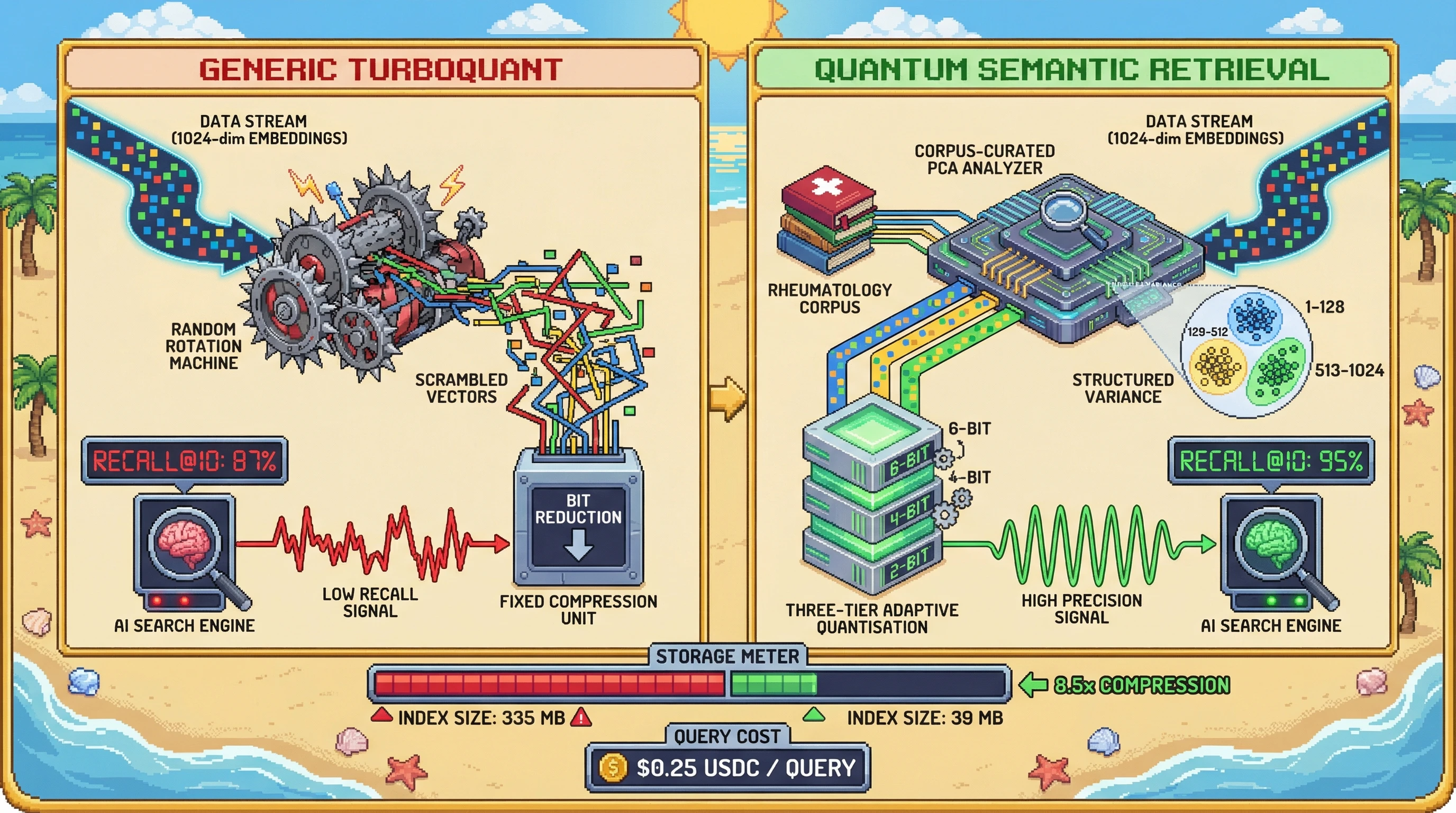
We demonstrate that the standard approach to vector quantisation (random orthogonal rotation before bit-width reduction) is systematically suboptimal for specialist medical corpora. Applying corpus-curated PCA to 81,502 rheumatology article embeddings (text-embedding-3-large, 1024 dimensions) reveals highly anisotropic variance structure: dimensions 1-128 capture 68% of corpus variance (clinical core: disease entities, anatomical targets, therapeutics), dimensions 129-512 capture 25% (comorbidity patterns, temporal trajectories), and dimensions 513-1024 capture only 7% (contextual nuance). Our three-tier adaptive quantisation (6/4/2-bit) compresses the index from 335 MB to 39 MB (8.5x) while achieving 95% recall@10 — an 8 percentage-point improvement over generic TurboQuant with random rotation (87% recall@10). The deficit is attributable to random rotations destroying the anisotropic structure that encodes specialist medical semantics. At inference time, coarse HNSW search (under 50ms) plus fine QS re-ranking delivers 10 passages with clinical semantic precision that resolves the Knowledge Retrieval Paradox in specialist AI. Implementation available via x402 at $0.25 USDC per query on Base L2.