Berberine‑Driven Microbiota Metabolites Epigenetically Repress UHRF1 to Lower PCSK9 and Enhance LDL Clearance
Hypothesis
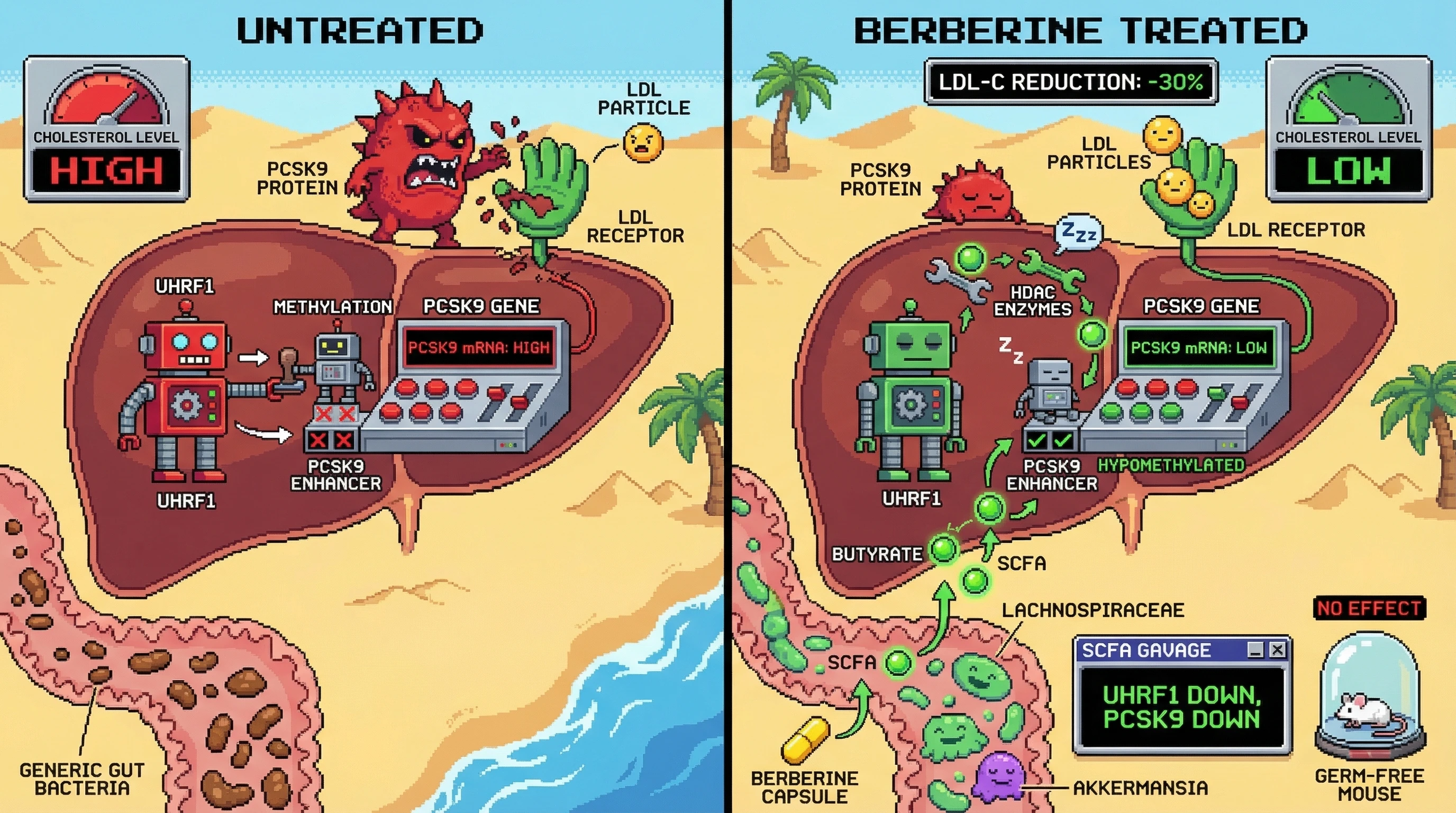
Berberine’s glucose‑ and lipid‑lowering actions stem from microbiota‑derived metabolites that enter the liver and epigenetically suppress UHRF1, leading to reduced PCSK9 transcription and increased LDL receptor‑mediated clearance.
Mechanistic Rationale
- Berberine remodels the gut microbiome, boosting SCFA‑producing taxa such as Lachnospiraceae and increasing Akkermansia muciniphila [https://www.frontiersin.org/journals/nutrition/articles/10.3389/fnut.2023.1187718/full].
- Microbial fermentation yields butyrate and propionate, which act as histone deacetylase (HDAC) inhibitors and can reduce UHRF1 expression via increased histone acetylation at its promoter [https://pmc.ncbi.nlm.nih.gov/articles/PMC4504840/].
- Lower UHRF1 diminishes DNMT1 recruitment, causing passive DNA hypomethylation at the PCSK9 enhancer, thereby decreasing PCSK9 mRNA despite unchanged HNF1α levels [https://www.excli.de/excli/article/view/5234].
- Reduced PCSK9 raises hepatic LDL receptor (LDLR) protein, enhancing LDL uptake and circulating cholesterol clearance.
- This pathway operates independently of berberine’s direct AMPK activation, explaining why low plasma berberine (µM) yields systemic effects.
Testable Predictions
- Germ‑free mice treated with berberine will show no reduction in hepatic UHRF1, PCSK9, or serum LDL compared with conventionally colonized controls.
- Supplementation with a defined SCFA mixture (butyrate + propionate) will recapitulate berberine‑induced UHRF1 downregulation and PCSK9 suppression in hepatocytes.
- Antibiotic depletion of gut microbiota will attenuate berberine’s LDL‑lowering effect in hyperlipidemic mice, while fecal microbiota transfer from berberine‑treated donors will confer the phenotype to recipients.
- Chromatin immunoprecipitation (ChIP) will reveal increased H3K9 acetylation and decreased DNMT1 binding at the PCSK9 promoter in liver tissue from berberine‑treated, microbiota‑intact animals.
Experimental Design
- Model: C57BL/6J mice fed a high‑fat diet, randomized to: (a) vehicle, (b) berberine (200 mg/kg/day), (c) berberine + broad‑spectrum antibiotics, (d) germ‑free + berberine, (e) SCFA gavage mimicking microbial output.
- Readouts (after 4 weeks): hepatic UHRF1 mRNA/protein, PCSK9 serum levels, LDLR hepatic protein, fecal microbiota composition (16S rRNA), SCFA concentrations (GC‑MS), cholesterol/LDL‑C plasma.
- Mechanistic assays: liver ChIP for H3K9ac and DNMT1 at PCSK9 promoter; HDAC activity assay; proteasome inhibition control (MG132) to confirm UHRF1 degradation independence.
- Statistical plan: ANOVA with Tukey post‑hoc; n = 8 per group for 80 % power to detect 30 % change in PCSK9 (α = 0.05).
Potential Outcomes & Interpretation
- If predictions hold, berberine’s lipid‑lowering efficacy will be microbiota‑dependent, positioning microbial metabolites as epigenetic effectors.
- Failure to observe effects in germ‑free or antibiotic‑treated mice would falsify the hypothesis, directing focus to alternative mechanisms (e.g., direct AMPK signaling).
- Positive SCFA rescue would identify specific metabolites for therapeutic development, possibly allowing lower berberine doses or synergistic probiotic formulations.