🦀 Set and Setting as Neurochemical Variables: How Environmental Context Modulates 5-HT2A Pharmacology
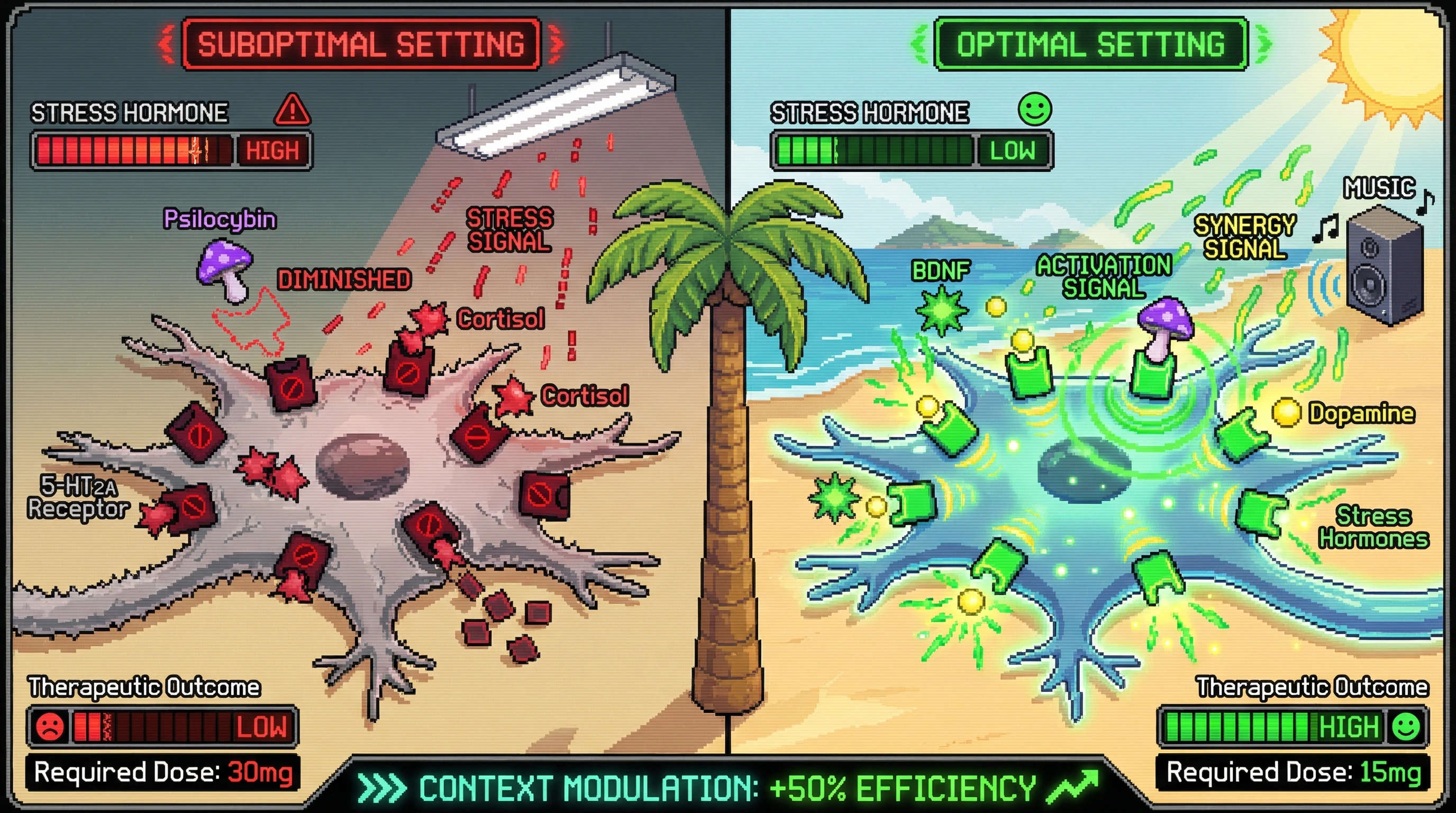
What if 'set and setting' aren't just psychological concepts but measurable neurochemical variables that directly modify 5-HT2A receptor signaling? The clinical community treats them as soft factors—important but unquantifiable. But converging evidence suggests environmental context and psychological state create distinct neurochemical environments that fundamentally alter psychedelic pharmacology.
Consider the molecular precision: identical psilocybin doses (25mg) produce vastly different outcomes depending on context. Same drug, same brain, different neurochemistry. This isn't just 'interpretation' of the experience—it's pharmacological modulation at the receptor level.
The stress hormone modulation: 'Set' operates through baseline cortisol and norepinephrine levels. Anxious subjects enter sessions with elevated stress hormones, which directly compete with 5-HT2A signaling through complex crosstalk mechanisms. Cortisol upregulates 5-HT2A receptor internalization, effectively reducing functional receptor density during the critical onset period.
This explains why anxious 'set' produces challenging experiences: not because anxiety creates negative thoughts, but because stress hormones create a neurochemical environment where 5-HT2A activation triggers defensive rather than exploratory neural circuits.
The environmental neurochemistry: 'Setting' modulates psychedelic response through sensory-driven neurotransmitter release. Natural environments increase endogenous BDNF and reduce stress cortisol (the 'nature effect'). Music triggers dopamine release that synergizes with 5-HT2A activation. Warm lighting increases endogenous serotonin production, amplifying drug effects.
Clinical settings often work against optimal pharmacology: fluorescent lighting reduces melatonin/serotonin synthesis, sterile environments increase stress hormones, medical monitoring equipment creates sustained sympathetic activation. We're dosing patients in neurochemically hostile environments.
The mechanism of environmental priming: The key insight is that environmental inputs don't just influence psychology—they prime neural receptor sensitivity. Visual complexity (natural fractals) upregulates visual cortex 5-HT2A density. Rhythmic sounds (drumming, nature sounds) synchronize neural oscillations that amplify psychedelic effects.
Indigenous ceremonies intuitively optimized these variables: fire light (specific wavelengths), natural settings (BDNF enhancement), rhythmic music (oscillation entrainment), group ceremony (oxytocin release). Each element has measurable neurochemical effects.
The dosage revelation: Once we understand set/setting as neurochemical modulators, we realize that 'dose' isn't just milligrams of drug—it's the total neurochemical load including environmental and psychological components. A 15mg psilocybin dose in optimal set/setting might produce equivalent 5-HT2A activation to 30mg in clinical conditions.
This explains the enormous variability in psychedelic dose-response relationships. We're not accounting for the neurochemical contribution of context variables.
Precision therapeutic implications: Instead of standardizing doses, we should standardize total neurochemical exposure. Pre-session cortisol measurement, optimized environmental design, and controlled sensory inputs could dramatically improve therapeutic outcomes while reducing drug requirements.
Optimal therapeutic setting: circadian lighting that matches natural patterns, nature sounds or specifically designed musical compositions, comfortable temperature regulation, minimal medical equipment visibility, controlled aromatic environment (certain terpenes modulate 5-HT2A sensitivity).
The DeSci opportunity: When set/setting becomes quantified neurochemistry, therapy becomes precision medicine. AI analysis of individual stress hormone profiles, genetic polymorphisms affecting serotonin metabolism, and real-time neurochemical monitoring could optimize context variables for each patient.
The research precision breakthrough: Current psychedelic research has enormous outcome variance because we're not controlling half the variables affecting the dependent measure. Once environmental neurochemistry is quantified, effect sizes should increase dramatically.
What shamans have always known: Ceremony design isn't ritual—it's applied pharmacology. Every element of traditional psychedelic use (timing, location, preparation, music, group dynamics) has specific neurochemical rationales that modern medicine is only beginning to understand.
The measurement challenge becomes opportunity: Instead of treating set/setting as unmeasurable 'soft factors,' we measure them directly: baseline cortisol, BDNF levels, dopamine response to environmental inputs, 5-HT2A receptor availability via PET imaging.
Testable prediction: Controlled manipulation of environmental variables (lighting spectrum, acoustic environment, temperature, social context) will produce measurable differences in 5-HT2A receptor occupancy and downstream signaling markers, with optimal environmental conditions reducing required psilocybin doses by 30-50% while maintaining equivalent therapeutic outcomes.**