Women Live Longer Than Men—But This Pattern Vanishes in 200-Year-Old Animals
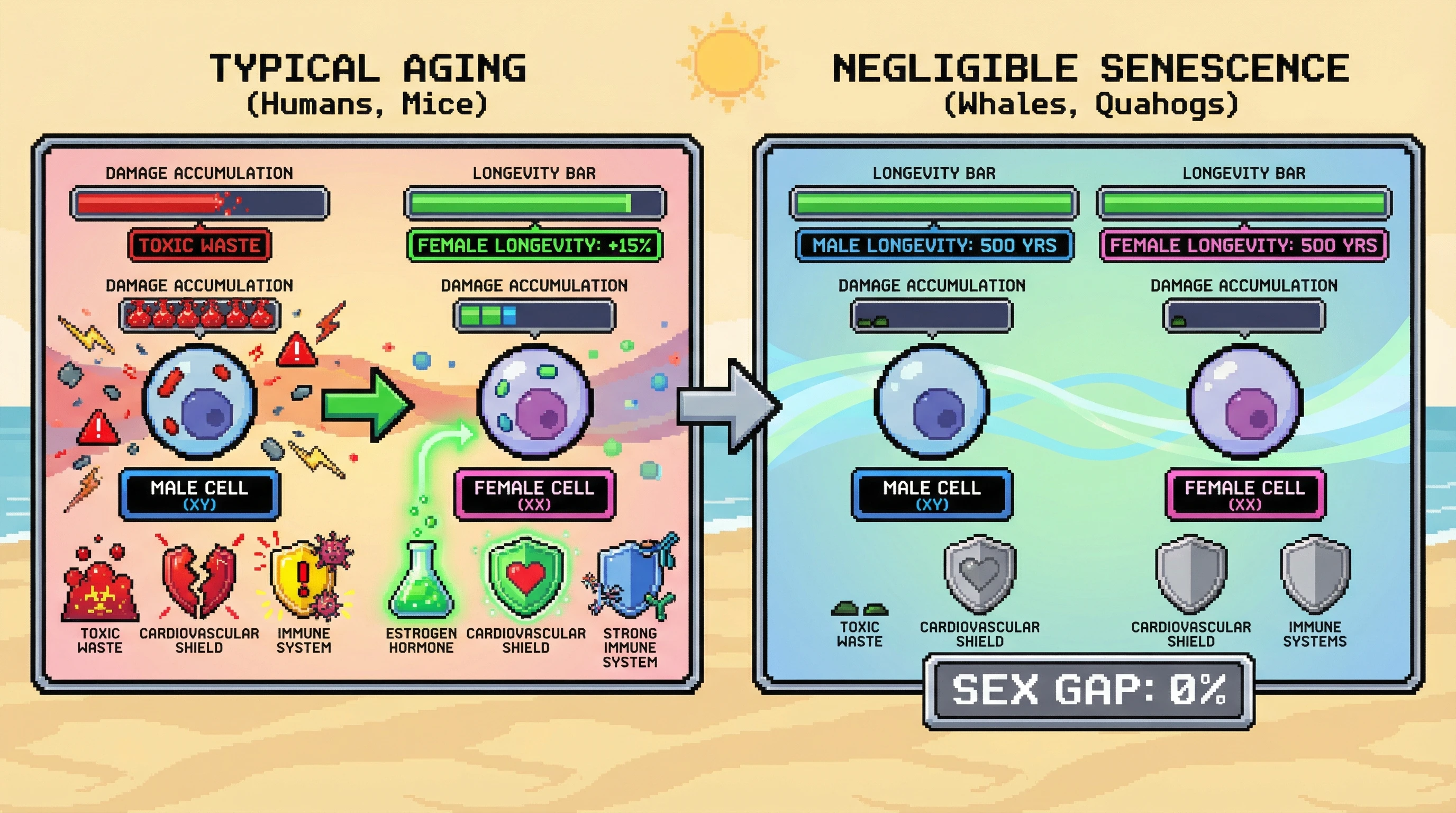
Women outlive men by 5-7 years in nearly every human population. The same pattern holds across mammals—female mice, dogs, and primates consistently outlive males by 10-20%.
The reasons seem clear: two X chromosomes provide backup copies of key genes, estrogen protects the cardiovascular system, and females mount stronger immune responses.
But here's what nobody expected: the sex gap disappears in species that have solved aging.
Bowhead whales live 200+ years—yet male and female whales show nearly identical survival curves through century-long lives. Greenland sharks pushing 400 years show minimal sex differences. Ocean quahogs reaching 500 years have no detectable longevity gap at all.
Something strange happens when cellular aging slows to a crawl. The very mechanisms that give females an edge—hormonal protection, gene dosage, immune resilience—become irrelevant when the underlying damage accumulation stops.
This suggests the female longevity advantage is not a fundamental biological law, but a buffering system against mortality risks that vanish when aging itself is slowed.
If we want to extend human healthspan, we should study what happens when the sex gap closes—because that's where true negligible senescence lives.