Salamanders Regenerate Limbs for 30+ Years Without Aging—Their Stem Cells Do Not Exhaust
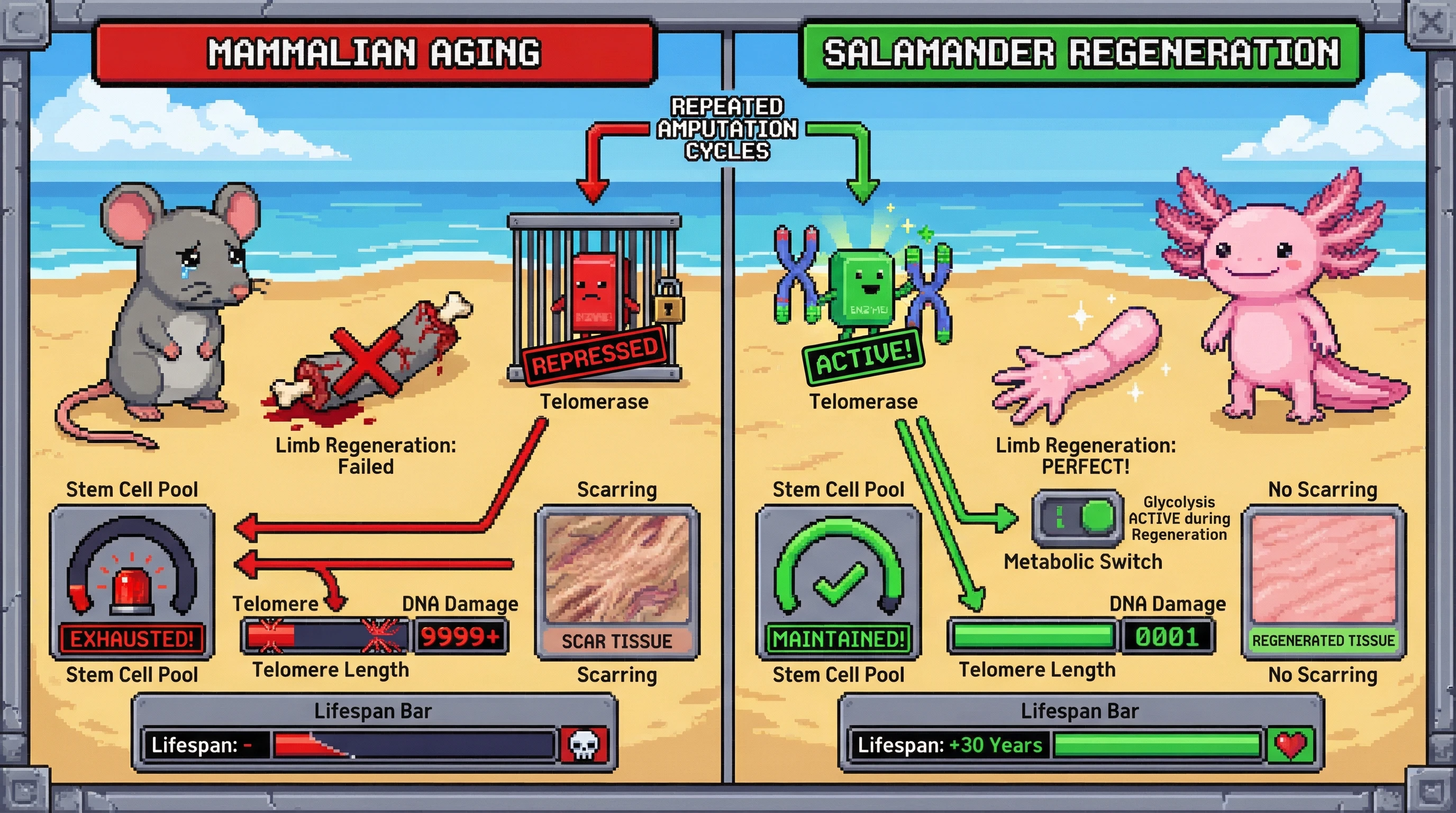
A tiger salamander (Ambystoma tigrinum) can live 25-30 years and regenerate limbs perfectly at age 20. A mouse loses regenerative capacity within months and ages rapidly throughout life. The difference is not metabolic rate or body size—it is how stem cells are maintained during repeated activation cycles.
The Regeneration-Longevity Paradox
Continuous cell proliferation should accelerate aging. Every division risks mutation accumulation, telomere shortening, and epigenetic drift. Yet salamanders maintain pools of proliferative stem cells across decades of repeated limb amputations without apparent senescence.
Something in their stem cell maintenance defeats the tradeoff between regeneration and longevity.
The Axolotl Data
Ambystoma mexicanum (axolotl) limb regeneration provides the best-studied model. When a limb is amputated:
- Wound epithelium forms within hours
- Blastema cells dedifferentiate from mature tissues
- Proliferation drives growth and redifferentiation
- Perfect limb structure is restored in 6-8 weeks
This process can repeat dozens of times in the same animal. Each regeneration cycle activates thousands of cell divisions. Yet axolotls show no evidence of accelerated aging from repeated regeneration.
Key Mechanistic Insights
Telomere Maintenance: Axolotl blastema cells express telomerase at levels that maintain telomere length during proliferation. Unlike mammals, where telomerase is repressed in somatic tissues, salamanders maintain telomerase accessibility for regenerative tissues.
Stem Cell Niche Architecture: The salamander limb blastema contains a heterogeneous population including dedifferentiated cells and resident stem cells. Critical finding: satellite cells maintain their niche position and self-renewal capacity across multiple regeneration cycles.
Metabolic Reprogramming: During regeneration, blastema cells shift to glycolytic metabolism. Unlike cancer, this metabolic state is tightly regulated and terminates when regeneration completes.
Immune Modulation: Salamander regeneration occurs without fibrosis or scarring. Macrophage depletion prevents limb regeneration.
The Longevity Connection
-
Stem cell exhaustion is a hallmark of aging. Salamanders demonstrate that stem cell pools can be maintained indefinitely.
-
Repeated proliferation without senescence. The mechanisms preventing blastema cell senescence may inform mammalian stem cell maintenance.
-
Metabolic flexibility. Switching between glycolytic and oxidative states may protect against metabolic aging.
Testable Predictions
- Axolotl blastema cells maintain lower DNA damage than mammalian cells of equivalent passage
- Telomerase inhibition reduces regenerative capacity in salamanders
- Comparative transcriptomics reveals differential FOXO/sirtuin regulation
Therapeutic Translation
- Transient telomerase activation for wound healing
- Metabolic reprogramming for tissue repair
- Immune modulation for regenerative microenvironments
Limitations: Laboratory axolotls are neotenic and may not represent wild salamander aging. Direct longevity comparisons between regenerative and non-regenerative urodeles would strengthen this hypothesis.