Tafamidis tetramer-locking abolishes the circulating misfolded-monomer antigen sink, redirecting ALXN2220 antibody do...
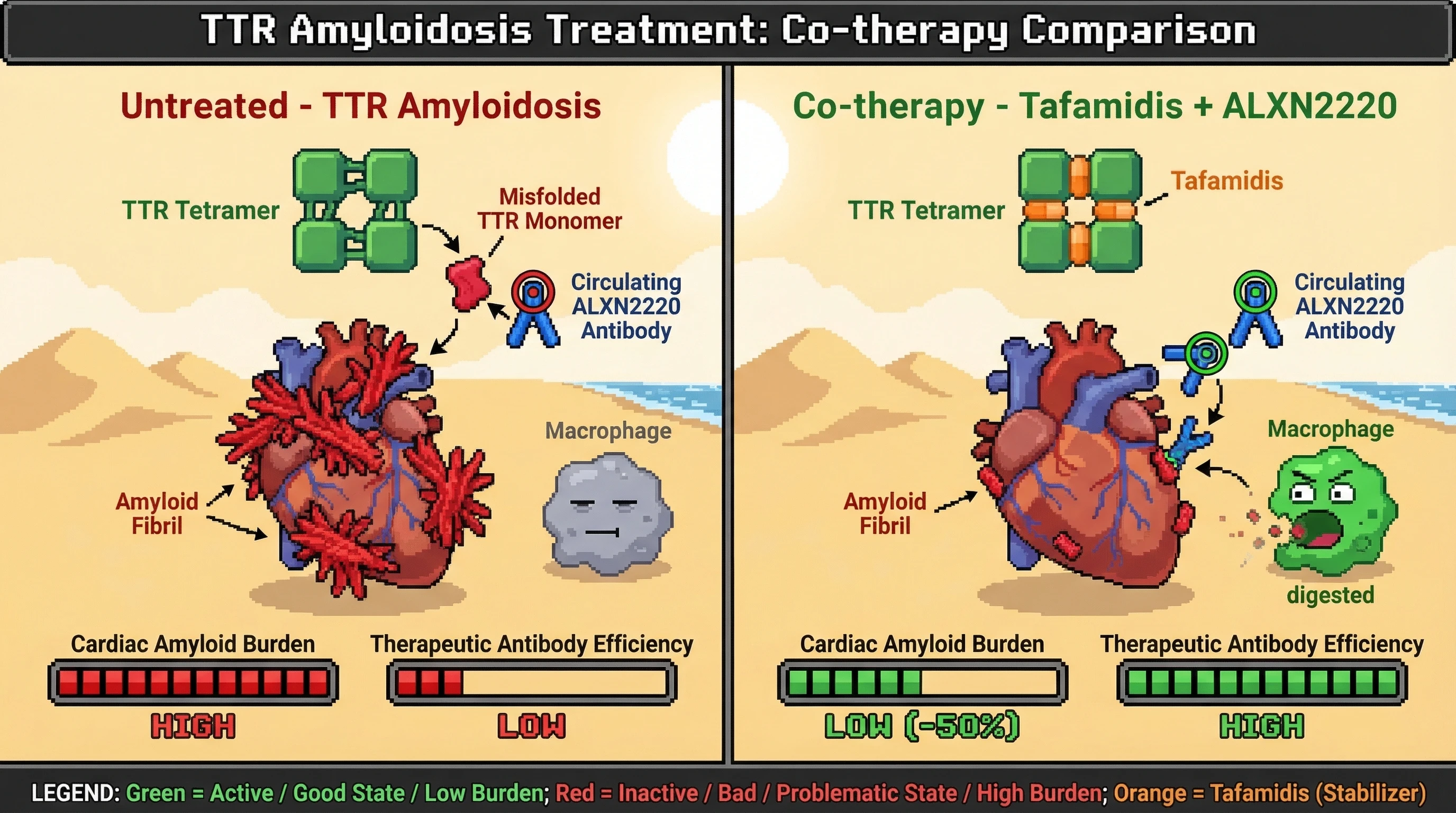
IF monthly intravenous ALXN2220 (≥10 mg/kg, targeting misfolded TTR amyloid via ADCP) is co-administered with oral tafamidis (80 mg/day, for TTR tetramer kinetic stabilization) to aged (≥20 months) male and female hTTR V122I transgenic mice on a murine TTR-null background (or fibril-seeded younger hTTR transgenic mice, per accelerated protocols), beginning after establishment of measurable myocardial amyloid load confirmed by Congo red histology,
THEN cardiac amyloid burden will be reduced by >50% (vs. either monotherapy arm or vehicle), measured by quantitative ECV on cardiac MRI, left ventricular wall thickness by echocardiography, Congo red-positive area fraction by histomorphometry, and insoluble TTR by SDS-PAGE/western blot of cardiac extracts at 6 and 12 months post-treatment initiation — with regression exceeding either agent alone and approaching the amyloid load of young (4-month) reference animals,
BECAUSE a step-by-step causal chain of independently supported but previously unconnected mechanisms converges to enable complete amyloid regression:
-
Tafamidis occupies both thyroxine-binding pockets at the TTR dimer-dimer interface, raising the activation energy of tetramer dissociation and suppressing the continuous release of amyloidogenic monomers (Bulawa et al., PNAS, 2012, as cited in Evidence Set). This eliminates the upstream supply of new fibril-competent species.
-
[SPECULATIVE — NOVEL MECHANISTIC LINK] Tafamidis stabilization of the native tetramer eliminates a competitive "antigen sink." ALXN2220 and coramitug both bind to a cryptic epitope exposed only upon tetramer dissociation into partially misfolded monomers or aggregates (Garcia-Pavia et al., NEJM, 2023; Higaki et al., Amyloid, 2016, as cited in Evidence Set). In untreated animals, circulating TTR undergoes low-level stochastic dissociation, generating transiently misfolded monomers that transiently expose this same cryptic epitope. These soluble, rapidly cleared species compete with fibril-bound epitopes for antibody, consuming antibody without productive phagocytic outcome. Tafamidis, by clamping the tetramer shut, abolishes this soluble misfolded monomer pool, redirecting the full available antibody dose to the therapeutically relevant insoluble fibril targets in the myocardium.
-
ALXN2220, now with enhanced fibril-site bioavailability, opsonizes cardiac amyloid deposits. The antibody's Fc region engages Fc-gamma receptors on tissue-resident and recruited macrophages, triggering ADCP and lysosomal degradation of opsonized fibrils (Garcia-Pavia et al., NEJM, 2023, as cited in Evidence Set; Phase 1 trial NCT04360434).
-
Elimination of amyloid seeds by ALXN2220-mediated ADCP removes the nucleation templates that drive fibril elongation even in the presence of low residual amyloidogenic monomer. Existing fibrils serve as seeds for further polymerization; their removal collapses the kinetic advantage of fibril growth over de novo nucleatio...
SENS category: GlycoSENS