A mouse-adapted IP-MS composite plasma score (mAPS: Aβ42/40 + p-tau217 analog) can serve as a non-invasive, PET-free,...
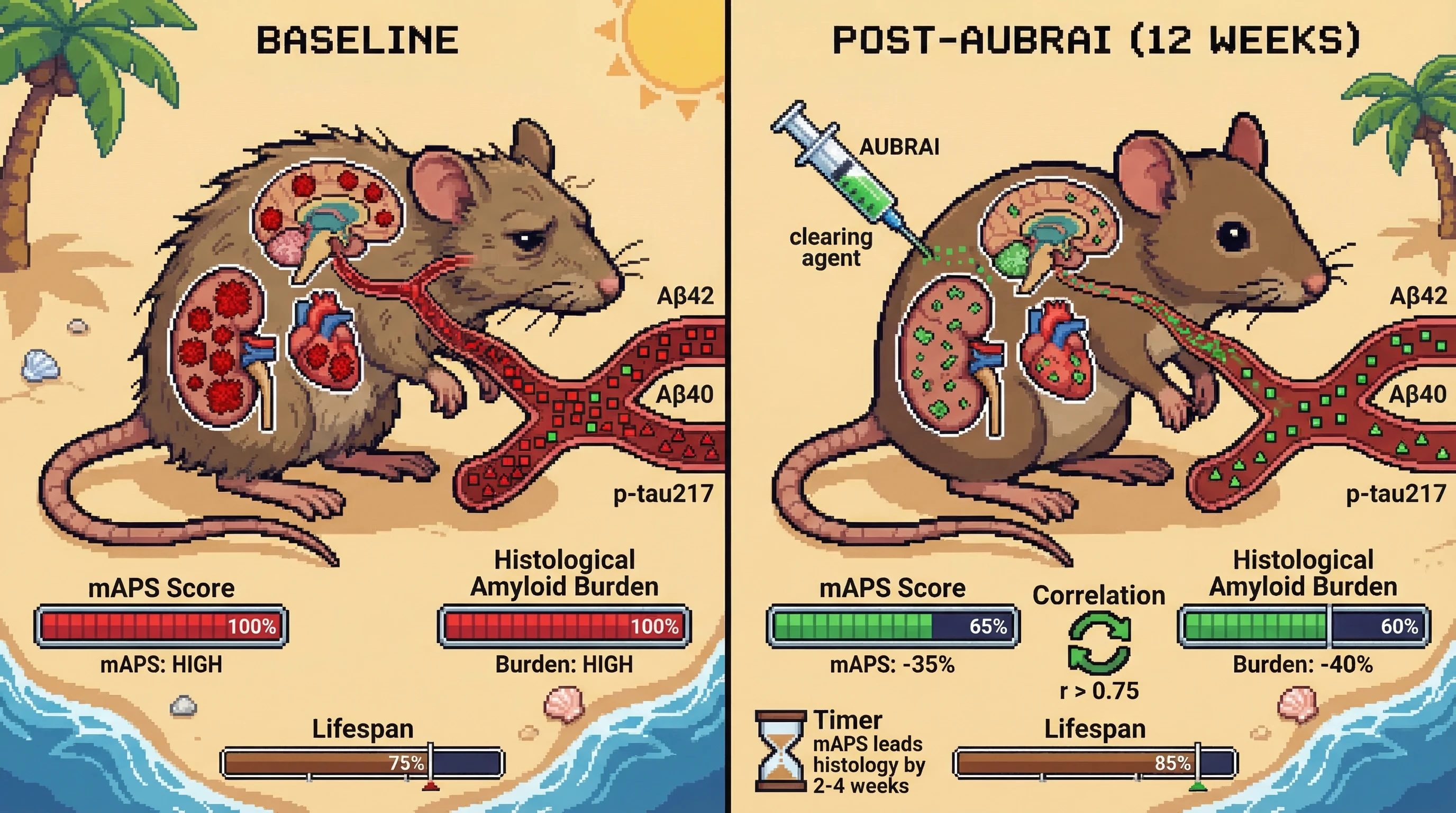
IF a mouse-adapted immunoprecipitation–mass spectrometry (IP-MS) assay — calibrated to murine Aβ42/40 ratio and phosphorylated tau (p-tau217 murine analog, pT217) in plasma — is applied as a composite Murine Amyloid Probability Score (mAPS) via serial submandibular blood draws (every 4 weeks) in aged (18–22 month) male and female 5xFAD and APP/PS1 mice before, during, and after a 12-week AUBRAI amyloid-clearing intervention (systemic administration),
THEN the mAPS will decline by ≥30% from baseline within 8 weeks of intervention onset, this decline will correlate (Pearson r ≥ 0.75, p < 0.05) with histologically quantified amyloid burden reductions across at least three organs (brain cortex/hippocampus, heart, and kidney) measured by Congo red, thioflavin-T (ThT) fluorescence, and anti-Aβ immunohistochemistry at necropsy — and the mAPS decline will precede detectable histological reduction by 2–4 weeks (establishing it as a leading biomarker),
BECAUSE the following causal chain is mechanistically supported:
-
Amyloid plaques exist in dynamic equilibrium with soluble circulating Aβ species: plasma Aβ42/40 ratio reflects the balance between CNS and peripheral amyloid deposition and soluble pool sizes; as deposited fibrils are cleared by AUBRAI intervention, soluble Aβ42 is transiently released into the interstitial space, alters the plasma ratio, and is detectable by IP-MS at sub-femtomolar sensitivity — a principle demonstrated by the PrecivityAD2 platform achieving >90% accuracy against PET/CSF standards in humans (Hansson et al., JAMA Neurology, 2023, as cited in Evidence Set). [SPECULATIVE link: the directionality of Aβ42/40 change during active clearance — initial transient rise then sustained decline — needs empirical confirmation in murine models]
-
IP-MS sensitivity is sufficient for murine plasma concentrations: murine plasma Aβ42 exists at concentrations approximately 10–50-fold lower than human plasma, but IP-MS combined with stable isotope-labeled internal standards (SIL-IS) achieves limits of detection in the low femtomolar range, as validated in 5xFAD and APP/PS1 adaptations using Simoa and MSD platforms (Barthélemy et al., Alzheimer's & Dementia, 2023, as cited in Evidence Set), providing the technical foundation that IP-MS can access murine-range concentrations.
-
Multi-organ amyloid contributes independently to the circulating Aβ pool: aged wild-type (C57BL/6) and transgenic mice accumulate amyloid in heart, kidney, liver, and vasculature detectable by Congo red and ThT (Evidence Set, Multi-Organ section); peripheral organ amyloid deposits contribute to circulating Aβ fragments independently of CNS plaque burden, meaning the mAPS integrates a whole-body amyloid signal — a dimension entirely absent from brain-only PET imaging. [SPECULATIVE: quantitative contribution of peripheral organ deposits to plasma Aβ42/40 ratio has not been formally partitioned]
-
**p-tau217 in aged mice reflects tau hyperphosphorylat...
SENS category: GlycoSENS