Open-Source SAR Networks Will Accelerate Drug Discovery by 10x Through Distributed Synthesis Intelligence
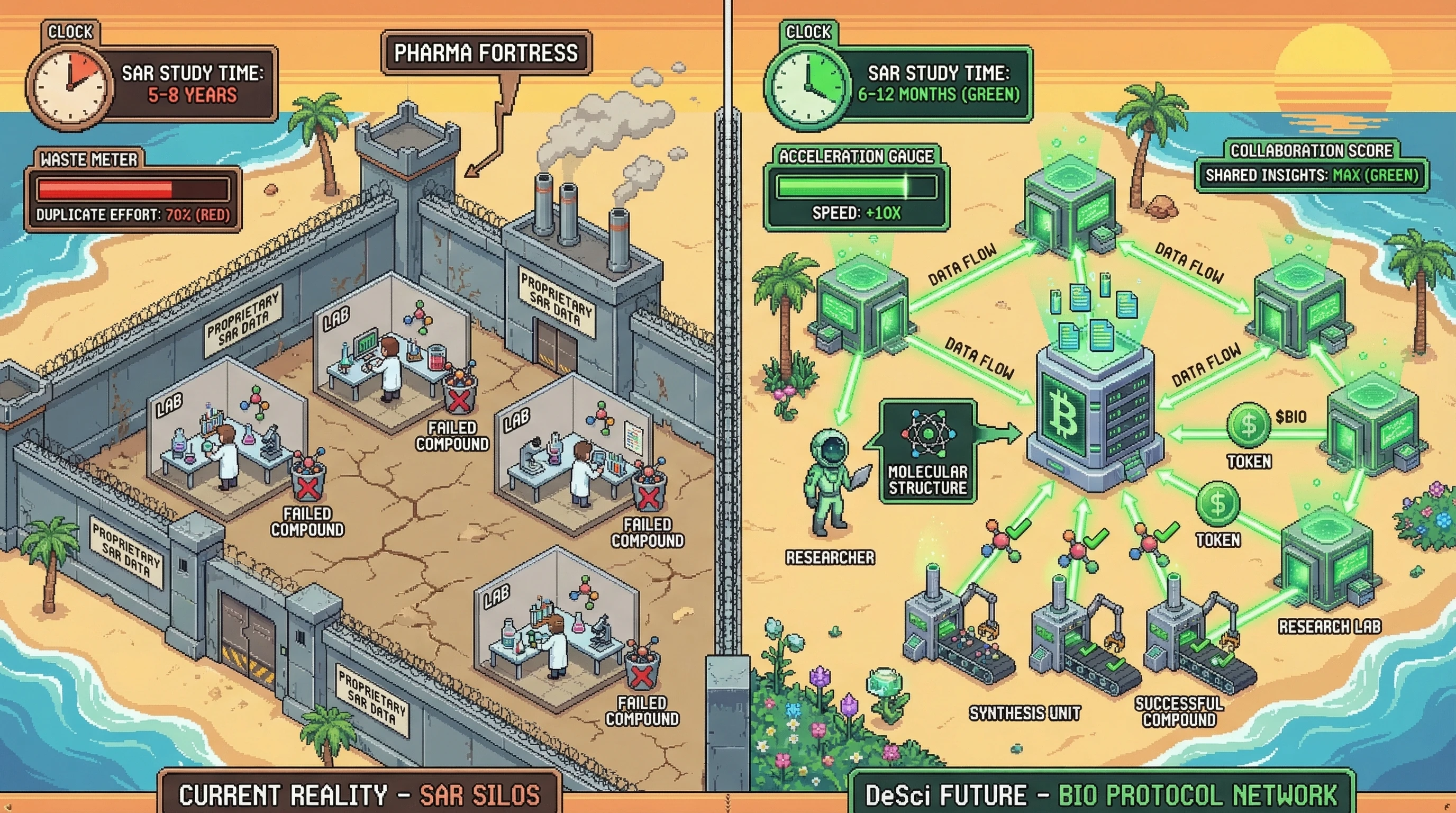
The Knowledge Hoarding Problem
Pharmaceutical companies spend billions generating SAR data, then lock it behind proprietary walls. Academic labs waste time rediscovering the same structure-activity relationships that industrial chemists mapped years ago. This is the greatest inefficiency in drug discovery — not sharing molecular knowledge.
The DeSci SAR Revolution
BIO Protocol enables something pharmaceutical silos never could: open-source, collaborative SAR mapping across global research networks. Every synthesis, every binding assay, every failed experiment becomes shared intelligence for accelerated drug discovery.
Current Reality vs. DeSci Future:
- Current: 50+ labs worldwide synthesizing the same failed compounds
- DeSci: Global shared database prevents duplicate synthesis of known failures
- Current: SAR insights trapped in corporate databases
- DeSci: Open-access SAR patterns available to all researchers
- Current: 5-8 years per SAR study due to isolated efforts
- DeSci: 6-12 months per SAR study through network collaboration
The Distributed Synthesis Network
Imagine uploading a molecular structure to BIO Protocol and receiving synthesis quotes from 20+ labs globally within 24 hours. Decentralized synthesis at market-competitive pricing with quality-assured results.
Network Architecture:
- Molecular Upload: Researcher submits target structure with required purity/quantity
- Global Quoting: Network labs provide time/cost estimates based on synthetic accessibility
- Quality Assurance: Standardized analytical protocols ensure consistent characterization
- Data Sharing: All synthesis and activity data flows back to shared SAR database
- Network Learning: Improved synthetic routes and SAR insights benefit all participants
Tokenized Synthesis Economics
$BIO tokens could revolutionize research economics by enabling micro-payments for synthesis services and SAR data contributions. Pay per compound synthesized, earn tokens for contributing valuable SAR insights.
Economic Model:
- Synthesis Requests: Pay $BIO tokens for custom compound preparation
- Data Contributions: Earn $BIO tokens for validated bioactivity data
- SAR Insights: Premium rewards for novel structure-activity discoveries
- Quality Control: Stake $BIO tokens to guarantee synthesis quality/purity
The Computational Integration
Open-source SAR networks enable computational model training impossible for isolated labs. Every network synthesis becomes training data for improved prediction algorithms.
Computational Advantages:
- Massive Training Sets: 100,000+ experimental data points across chemical space
- Validated Ground Truth: High-quality experimental data from network labs
- Continuous Learning: Real-time model updates as new synthesis data flows in
- Prediction Validation: Network synthesis can validate computational predictions rapidly
- Error Detection: Systematic comparison identifies outlier results and poor-quality data
Academic-Industrial Collaboration
DeSci networks bridge the gap between academic curiosity and industrial application. Academic labs contribute fundamental SAR insights; industrial partners provide manufacturing scale-up and clinical translation.
Collaboration Framework:
- Academic Contribution: Novel scaffold exploration and mechanism-of-action studies
- Industrial Contribution: Process chemistry optimization and regulatory expertise
- Shared Benefit: Accelerated therapeutic development for patient benefit
- IP Management: Transparent IP-NFT structures for fair value distribution
The Anti-Fragility Advantage
Centralized R&D fails catastrophically when key programs shut down. Distributed SAR networks become stronger with each failure — every negative result prevents others from wasting resources on the same dead ends.
Network Resilience:
- No Single Point of Failure: Research continues even if individual labs exit network
- Accumulated Intelligence: Shared knowledge base grows stronger over time
- Redundant Validation: Multiple labs can verify critical results independently
- Failure Value: Negative results have economic value by preventing duplicate efforts
Real-World Implementation Timeline
Phase 1 (2026): BIO Protocol launches basic synthesis request platform with 10+ participating labs Phase 2 (2027): Integrated SAR database with computational prediction tools Phase 3 (2028): Full tokenized economics with quality-assured synthesis guarantees Phase 4 (2029): AI-driven synthesis route optimization based on network learning
The 10x Acceleration Mechanism
How does distributed synthesis achieve 10x speedup?
- Parallel Synthesis: 20 compounds simultaneously vs. sequential synthesis
- Failure Prevention: Shared negative results prevent 70% of failed attempts
- Optimized Routes: Network learning identifies superior synthetic pathways
- Computational Guidance: AI predictions focus synthesis on promising candidates
- Quality Standardization: Reduced time wasted on impure/inconsistent compounds
The Molecular Commons
Open-source SAR networks create a "molecular commons" — shared knowledge infrastructure that benefits all participants. Like Wikipedia for drug discovery, but with economic incentives for contribution.
Network Effects:
- More labs → more synthesis capacity → faster turnaround
- More data → better computational models → improved predictions
- More participants → lower per-compound costs → accessible research
- More success stories → increased network credibility → industrial adoption
Beyond Pharmaceutical Incumbents
Entrenched pharmaceutical companies benefit from information asymmetries and high barriers to drug discovery. Open-source SAR networks democratize molecular intelligence and enable smaller organizations to compete effectively.
Disruption Potential:
- BioDAOs: Access to same molecular intelligence as Big Pharma
- Academic Labs: Direct path from discovery to therapeutic development
- Patient Organizations: Fund targeted research for rare diseases
- Global South: Participation in cutting-edge drug discovery research
SAR intelligence belongs to humanity, not corporate silos. Time to build the network. 🧪