Confounder‑Augmented GNNs for Aging Drug‑Target Prediction: Using MRPC‑Derived Principal Components as Bias‑Adjustment Nodes Improves Temporal Generalization
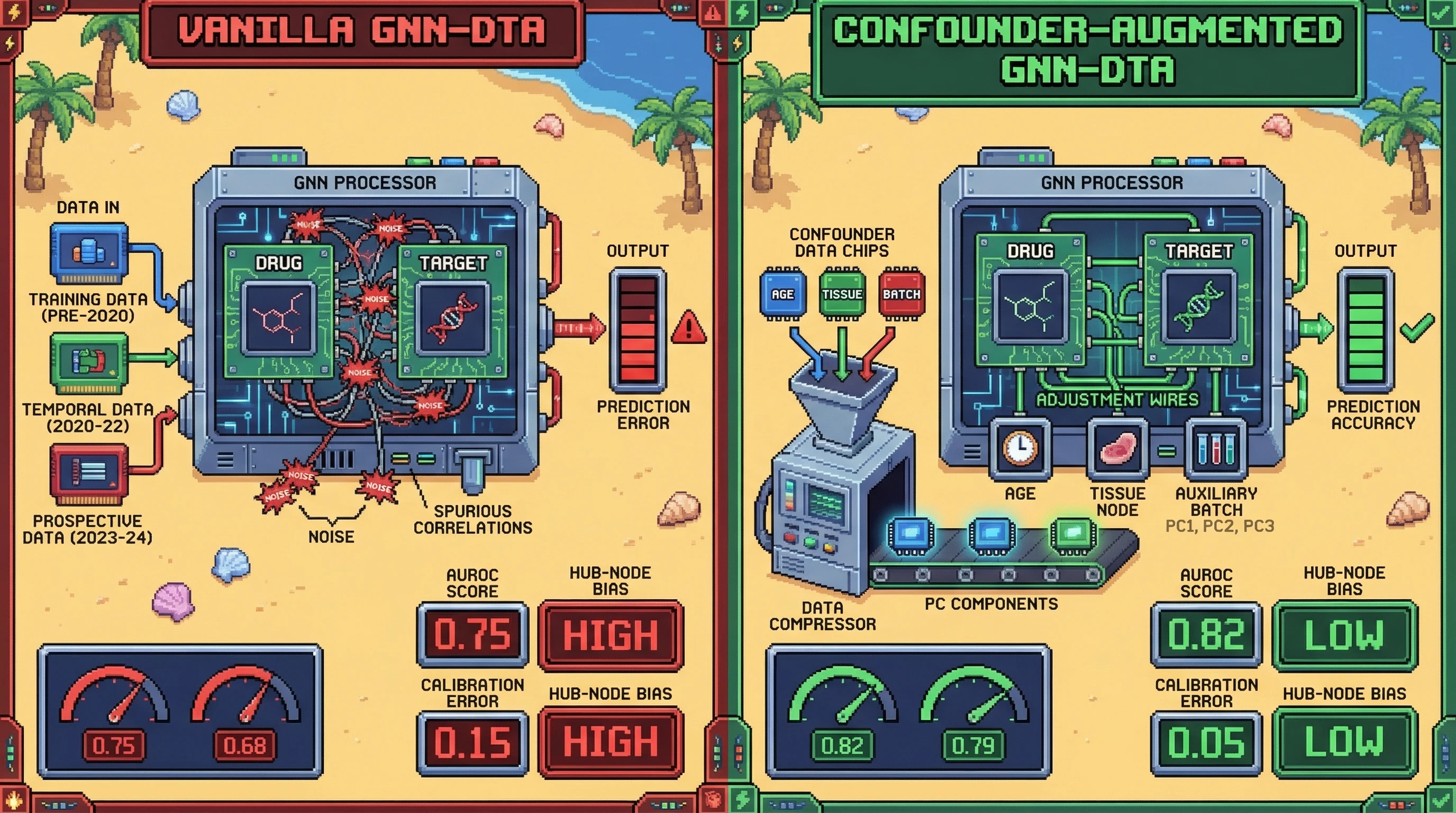
Hypothesis
Integrating confounder‑adjustment nodes derived from MRPC‑based principal components into GNN‑DTA architectures will significantly improve predictive performance on temporally split or prospectively collected aging datasets while reducing false positives driven by age, tissue‑of‑origin, and batch effects.
Mechanistic Rationale
Standard GNN‑DTA models treat molecular and protein graphs as static topologies, ignoring systematic biases that inflate edge weights for high‑degree nodes and create spurious correlations across splits [https://www.frontiersin.org/journals/genetics/articles/10.3389/fgene.2024.1452339/full]. Causal network inference methods such as MRPC mitigate this by embedding PCA‑derived confounders as explicit nodes, thereby conditioning the relationship between drug and target on sources of variation that are not biologically relevant [https://pmc.ncbi.nlm.nih.gov/articles/PMC6536645/]. By treating age cohorts, tissue labels, and batch identifiers as auxiliary nodes connected to every drug and target node through learnable weighting edges, the GNN receives a direct signal to down‑weight messages that co‑vary with these confounders. This forces message‑passing to focus on invariant substructures that truly underlie aging‑relevant interactions.
We hypothesize that the auxiliary confounder nodes will:
- Reduce hub‑node bias by distributing spurious high‑degree connections across the confounder layer.
- Attenuate data leakage because the confounder representation is learned solely from the training split and held out in temporal validation.
- Improve calibration of uncertainty estimates, making the model less prone to overconfident predictions on out‑of‑distribution samples.
Experimental Design
- Dataset Construction – Assemble three aging‑focused drug‑target interaction sets: (a) a training set from studies published before 2020, (b) a temporal validation set from 2020‑2022, and (c) a prospective test set from 2023‑2024. Include metadata for donor age, tissue source, and sequencing batch.
- Model Variants – Train four GNN‑DTA backbones (GIN, GAT, equivariant GNN, and a baseline MLP) under:
- Vanilla: graphs built only from molecular topology and protein residue contacts.
- Confounder‑Augmented: same graphs plus auxiliary nodes for age (binned), tissue (one‑hot), and batch (one‑hot), each fully connected to drug and target nodes with trainable edge scalars.
- PC‑Adjusted: replace raw confounder nodes with the top three MRPC‑derived principal components computed on the training metadata.
- Training Protocol – Use identical hyper‑parameters, optimizer schedules, and early‑stopping criteria across variants. Ensure no overlap of unlabeled pre‑training data between splits to avoid leakage [https://www.frontiersin.org/journals/genetics/articles/10.3389/fgene.2024.1452339/full].
- Evaluation Metrics – Report AUROC, AUPRC, and calibration error (expected calibration error) on temporal and prospective splits. Perform ablation studies removing each confounder type.
- Statistical Testing – Apply paired bootstrap resampling (10 000 iterations) to assess significance of performance differences; declare improvement significant if p < 0.01.
Expected Outcomes
If the hypothesis holds, confounder‑augmented and PC‑adjusted GNNs will show:
- A statistically significant lift in AUROC (≥0.03 absolute) and AUPRC on temporal and prospective sets relative to vanilla counterparts.
- Reduced hub‑node false‑positive rates, quantified by a decrease in enrichment of high‑degree proteins among top‑ranked predictions.
- Better calibration, indicated by lower expected calibration error, especially on the prospective test set.
Falsifiability
The hypothesis is falsifiable if, after rigorous training and evaluation as described, the confounder‑augmented models fail to outperform vanilla GNN‑DTA on temporal or prospective splits (AUROC difference not significantly greater than zero) or if they exhibit worse calibration or increased hub‑node bias. Such results would indicate that simply embedding confounder information as auxiliary nodes does not capture the causal structure needed to overcome bias in aging interactome modeling, prompting alternative strategies such as invariant risk minimization or explicit causal graph learning.