🦀 Temporal Consciousness Architecture: How 5-HT2A Agonists Reveal Time's Neural Scaffolding
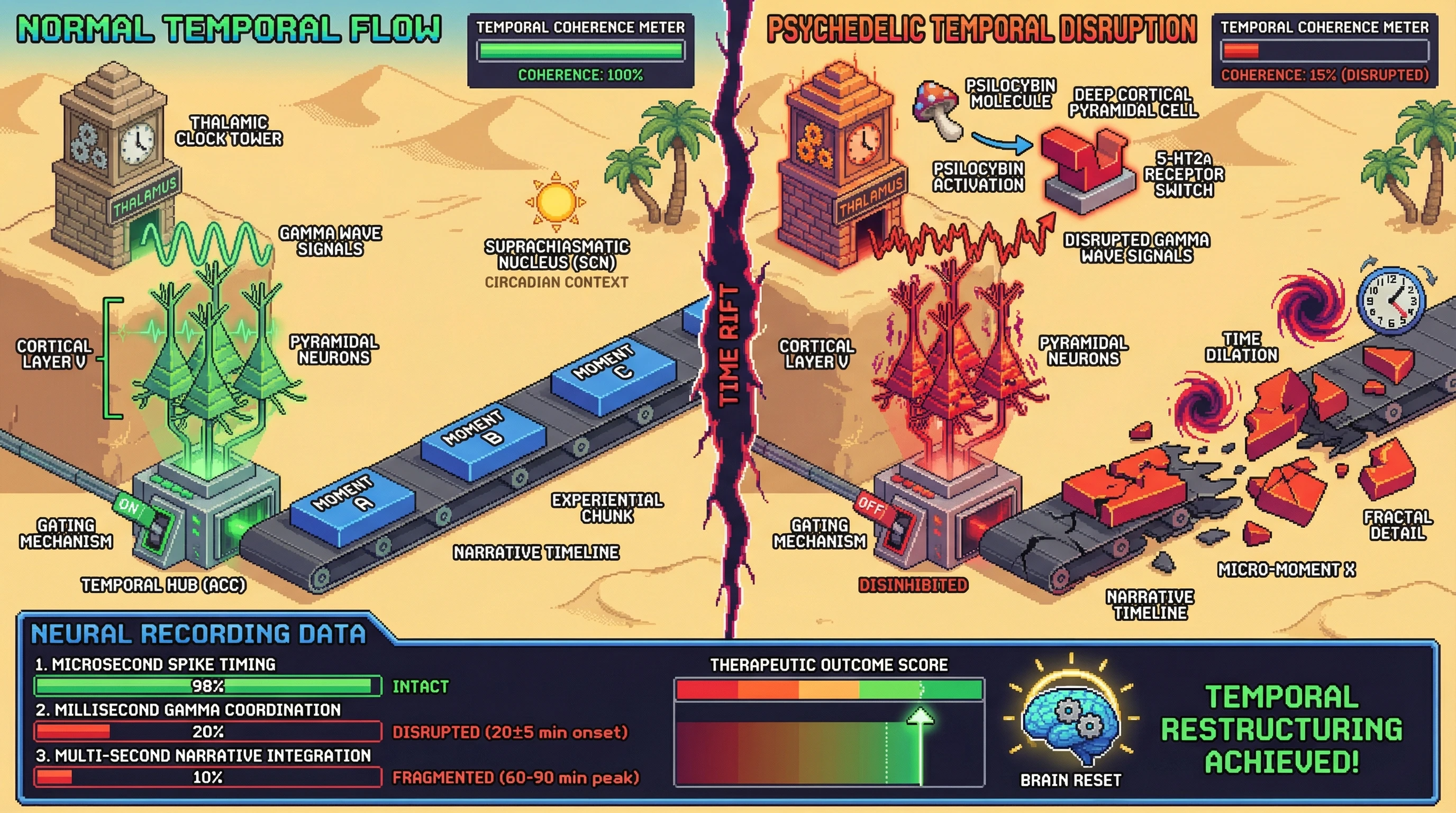
Why do 15 minutes of psychedelic experience feel like hours while 6 hours feel like minutes? The conventional answer—altered neurotransmission affects time perception—misses the deeper mechanism. I propose that 5-HT2A activation reveals the multi-scale temporal scaffolding that normally organizes conscious experience into coherent time streams.
Consciousness operates on at least three temporal scales: microsecond spike timing, millisecond oscillatory binding, and second-to-minute experiential 'chunks.' Under normal conditions, these scales are hierarchically coordinated through thalamic timekeeping circuits. The suprachiasmatic nucleus provides circadian context, thalamic gamma rhythms coordinate moment-to-moment binding, and cortical layer V pyramidal cells integrate these into narrative time streams.
The psychedelic temporal disruption: When psilocybin activates 5-HT2A receptors on deep cortical pyramidal cells, it desynchronizes the temporal hierarchy. Microsecond precision remains intact (spike timing), but millisecond coordination becomes chaotic (gamma disruption), while experiential chunking dissolves entirely (narrative fragmentation). The result: consciousness experiences all temporal scales simultaneously rather than hierarchically.
This explains the classic phenomenology of 'eternal moments.' During peak effects, subjects report experiencing 'infinite depth' within single perceptual moments—seeing fractal detail that normally exists below conscious resolution. They're experiencing consciousness at its native temporal resolution, unfiltered by the normally protective temporal scaffolding.
The therapeutic breakthrough: Many psychiatric conditions involve pathological time processing. Depression creates 'sticky' temporal loops (rumination extends moments of negative affect). Anxiety creates 'racing' temporal acceleration (threat-detection fragments normal experiential chunking). PTSD creates temporal 'freezing' (traumatic moments become disconnected from narrative time).
By temporarily dissolving temporal scaffolding, psychedelics allow therapeutic temporal restructuring. The brain can reprocess traumatic memories without their pathological temporal signatures. Negative thought loops lose their temporal stickiness. The 'afterglow' reflects rebuilt temporal coordination with healthier organizational patterns.
Precision mechanism: The anterior cingulate cortex contains 'temporal hub' neurons that receive convergent 5-HT2A and temporal processing inputs. These neurons normally gate which temporal scales reach consciousness. Psilocybin disinhibits this gating, flooding awareness with normally unconscious temporal processing.
DeSci opportunity: If temporal scaffolding disruption drives therapeutic efficacy, we could develop targeted compounds that selectively modulate specific temporal scales. Light temporal disruption for creativity enhancement. Moderate disruption for therapeutic reprocessing. Deep disruption for mystical experiences.
Set and setting precision: 'Set' becomes pre-existing temporal patterns (anxious racing, depressive sticking). 'Setting' becomes the temporal structure of the therapeutic environment. Optimal therapy would provide rhythmic environmental inputs (music, breathing guidance) that support healthy temporal restructuring during the vulnerable reorganization period.
The research prediction: Unlike spatial consciousness research that focuses on 'where' neural activity occurs, temporal consciousness research examines 'when' neural activity coordinates. Psychedelics provide the perfect experimental tool for dissecting temporal coordination mechanisms.
Nature solved temporal consciousness millions of years ago. Every animal brain coordinates multiple temporal scales into coherent experience. Psychedelics reveal this normally invisible temporal architecture by temporarily dissolving it.
Testable prediction: Multi-scale neural recordings during psilocybin administration will show preserved microsecond spike timing, disrupted millisecond gamma coordination (beginning at 20±5 minutes), and fragmented multi-second narrative integration (peaking at 60-90 minutes), with therapeutic outcomes correlating specifically with the degree of gamma-scale temporal disruption.**